

The Dow record and Michigan's 44.8 are two sides of the same confidence split
These are not unrelated headlines. They show a market–consumer divide that can matter for pricing power and demand. Wall Street just celebrated a Dow at 50,651 points, while households fell to a record-low 44.8 in May. Equity narratives can outrun spending psychology, and this gap is a reminder not to confuse stock-market confidence with Main Street confidence.
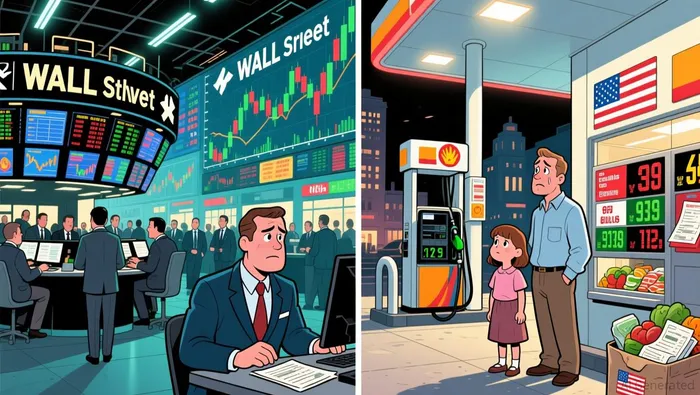
Why the divergence matters now
The Dow's optimism has been supported by AI-driven trade and hopes that negotiations could ease the war shock. Consumer sentiment, by contrast, has now fallen for three straight monthly declines as gasoline prices and broader cost pressures weigh on households, with 57% of consumers citing high prices as the top concern.
That is the core behavioral risk. Investors can anchor on strong earnings, while households focus on inflation spreading beyond fuel. Michigan reported year-ahead inflation expectations rose to 4.8%, and consumers said inflation may spread beyond fuel prices. If that fear starts to change spending behavior, durable-earnings assumptions become less secure.
Gasoline is the visible shock; inflation expectations are the deeper signal
The headline drop in sentiment is striking, but the more important signal is the shift in expectations. Gasoline is highly visible and bought frequently, so a sharp pump-price spike can reshape how consumers think about other prices.
From the pump to broader price expectations
The chain starts with fuel. Strait of Hormuz disruptions helped push U.S. gasoline to about $4.552 a gallon, up more than 50% since the war started. That matters because drivers notice it quickly, and repeated exposure to higher pump prices can make broader inflation feel more plausible.
That helps explain why 57% of consumers cited high prices as the leading cost-of-living concern. Pump prices alone do not guarantee economy-wide inflation, but they can trigger it if households start expecting wider price pressures.
The expectation data matter more than the headline index by itself. May's year-ahead inflation expectations at 4.8% are above the 3.4% reading seen in February. Long-run expectations also rose to 3.9%, up from 3.2% in March. That does not prove inflation expectations have unmoored, but it does suggest consumers are more worried about persistent price pressure than they were before the war shock.
Wall Street and Main Street are still reading different realities
The market is no longer debating one data point. It is debating which anchor will prove more important for earnings and demand.
Two anchors, two time horizons
On Wall Street, the anchor is flattering. The Dow reached 50,651 points, helped by AI-driven trade and optimism around negotiations to end the war. Robust first-quarter earnings have also helped offset geopolitical worries.
On Main Street, the anchor is less forgiving. Sentiment has fallen for three straight monthly declines, with gasoline prices linked to the Iran war hitting households at the pump and in everyday purchases. The decline has been sharper among lower-income consumers and those without college degrees, who are more exposed to essentials and fuel costs.
Why the split can become a market repricing
If the energy shock fades, Wall Street's anchor can hold and the rally can continue. If it does not, the market may have to reconcile equity optimism with weaker consumer demand. The key question is whether rising inflation anxiety moves from survey language to actual spending restraint.
That is why a record Dow does not prove the broader economy has validated the current rally. It shows where financial-market confidence sits today. It does not prove consumer demand is as resilient as earnings models assume.
What would change the read over the next one to two releases
The split stops being academic when sentiment begins to shape spending. The most useful signal is not a low index by itself, but evidence that households are moving from "things are expensive" to pulling back on credit, hiring, or big purchases.
Watchlist
- Next Michigan reading: look beyond the headline to current financial conditions, income expectations, and spending plans.
- Gasoline prices: sentiment is still tied to pump pain, and Reuters quoted Michigan's survey director as saying conditions are unlikely to improve until supply disruptions have been fully resolved and energy prices fall.
- Inflation expectations: the early-warning gauges are still elevated at 4.8% year-ahead inflation expectations, and long-run expectations have also risen. If those measures cool, the market can lean more confidently on earnings strength.
The cleaner bull-case test is straightforward: if sentiment stabilizes, gasoline stress eases, and inflation expectations start to fall, the rally still has room to run. If not, weak consumer confidence may stop looking like background noise.