

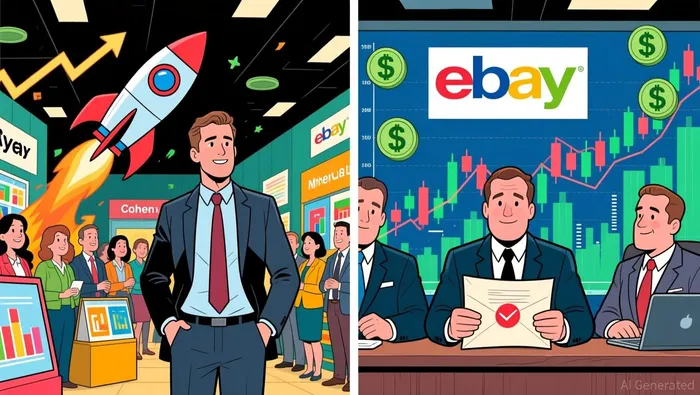
Ryan Cohen just tried to pull the ultimate whale move - a $56 billion leveraged buyout of eBay, a company nearly five times his own market cap. The offer: $125 per share, half cash, half GameStop stock. The response from eBay's board? "Not credible, not attractive." The rejection is personal - Chairman Paul Pressler's letter laid out six reasons why Cohen's vision doesn't add up on paper. But here's what's really being tested: can a meme-stock visionary actually execute a traditional leveraged buyout, or is this just a very expensive publicity stunt?
The numbers tell a brutal story. GameStop's market cap sits around $12 billion. eBay's is nearly four times that. eBay stock has been trading $20 below the offer price - meaning the market is pricing in serious doubt about whether this deal ever closes. At press time, eBay was hovering around $110, roughly $15 under Cohen's $125 bid. That gap is where the whole narrative hangs by a thread.
Cohen's pitch was simple: replicate his cost-cutting playbook at GameStop, tap into eBay's undermonetized inventory, and use GameStop's 1,600 U.S. stores as a physical network to finally give Amazon a real fight. He pointed to $20 billion in potential debt financing from TD Securities and GameStop's ability to issue stock. But when CNBC hosts ran the numbers, the financing didn't add up - the cash and stock offered fell short of covering the full $55.5 billion price tag.
What makes this interesting for holders: Michael Burry - yes, the guy who called the housing crash - dumped all his GameStop shares after the bid dropped. He called the strategy "pedestrian" and warned about debt load and shareholder dilution. That's some serious FUD from a legend who once compared Cohen to Warren Buffett.
The real tension? Cohen is betting his reputation on a playbook that works in meme-stock territory - where narrative and community sentiment can move markets - but this is a traditional leveraged buyout. The establishment (eBay's board, Wall Street analysts, credit rating agencies) gets veto power. The question for GameStop holders now: does Cohen have the conviction to follow through, or does this fold when the financing gets real?
The Weak Link: Financing Uncertainty and Burry's Exit
The establishment's sharpest weapon against Cohen's bid isn't legal or strategic - it's arithmetic. eBay's rejection letter explicitly flagged the uncertainty regarding your financing proposal as one of six fatal flaws. That's the crack in the narrative that everyone's watching.
Michael Burry didn't just sell - he dumped the entire position. The Big Short himself, the man who called the housing crash and once compared Cohen to Warren Buffett, sold all his shares in the company after the bid dropped. His reasoning? He called the deal strategy "pedestrian" and warned about the debt load and shareholder dilution. That's not just FUD - that's a legend seeing through the hype to the fundamentals. When the guy who shorted banks tells you the leverage is too high, you listen.
Here's the brutal math: GameStop's market cap sits around $10.2 billion, yet Cohen is pitching a $55.5 billion buyout. He's touted $20 billion in potential debt financing from TD Securities - unconfirmed, uncommitted, just potential. The CNBC hosts ran the numbers and the cash and stock offered fell short of covering the full price tag. The gap is where the whole deal dies.
Now look at Cohen's upside: he receives no salary, but could make $35 billion if GameStop hits a $100 billion market cap and $10 billion in cumulative earnings. That's the moonshot narrative - but the current market cap is roughly $12 billion. The spread between where GME trades and where Cohen needs it to go to cash out is where the risk lives. Diamond hands might HODL through the volatility, but the smart money is asking: can the financing actually close?
Burry's exit signals something critical for holders: the sophisticated crowd sees the financing gap as a dealbreaker, not a hurdle. When the establishment and the shorts are aligned on "not credible," that's a tough narrative to fight. Cohen's betting his reputation on a playbook that works in meme-stock territory - but this is a traditional leveraged buyout. The numbers need to add up before Wall Street writes the check. Right now, they're not.
The Narrative Battle: Cohen's Vision vs eBay's Turnaround Story
This is where the real fight happens - not in boardrooms, but in the collective belief of investors. Cohen is selling a moonshot narrative: combine forces, cut costs, take on Amazon, and unlock hundreds of billions in value. eBay's board is selling something simpler: we're already winning, and we don't need your help.
On paper, eBay's story is stronger. Chairman Paul Pressler's rejection letter didn't just say no - it laid out a full-throated defense of the status quo. eBay is a strong, resilient business that has delivered meaningful results, Pressler wrote. The company has sharpened its strategic focus, enhanced its marketplace, and consistently returned capital to shareholders. The market is buying it: eBay shares are up nearly 24% year-to-date and more than 55% in the last year. That's not a company begging for a savior. That's a company telling Cohen to take his $56 billion and shove it.
Cohen's counter-narrative is pure meme-stock energy: he sees undermonetized inventory, he sees a physical store network (1,600 U.S. locations), he sees the chance to finally give Amazon a real fight. He told the Wall Street Journal he's envisioning "turning eBay into something worth hundreds of billions of dollars." That's the diamond hands pitch - the belief that together, you can build something bigger than what exists today. It's the same energy that drove GameStop to $484 million in market cap at its peak. It's the energy that makes holders HODL through the volatility, waiting for the catalyst.
But here's the tension: eBay's "we're already winning" story has actual numbers behind it. Cohen's "we'll make you richer" pitch has... potential. The CNBC hosts already ran the financing math and it didn't add up. The $20 billion in debt financing is unconfirmed, uncommitted. The stock portion of the deal requires GameStop's market cap - currently around $10 billion - to somehow become large enough to pay for nearly half of a $55.5 billion acquisition. That's not a leveraged buyout; that's a leveraged dream.
Then there's the governance red flag. Pressler's letter explicitly flagged GameStop's governance and executive incentives as a problem. Translation: Cohen's compensation package - no salary, but $35 billion if GameStop hits $100 billion market cap and $10 billion in cumulative earnings - looks like a self-serving moonshot to Wall Street. When Michael Burry, the guy who called the housing crash, calls a deal "pedestrian" and dumps the position, that's not just FUD. That's the establishment seeing through the narrative to the underlying risk.
The brutal truth? eBay's narrative is more credible today. The market is pricing in that - eBay trades roughly $15 under Cohen's $125 offer, but the gap exists because the deal is uncertain, not because eBay is broken. Cohen controls the story in meme-stock territory, where community sentiment can move markets. But this is a traditional leveraged buyout. The numbers need to add up before Wall Street writes the check. Right now, they're not.
What's Next: Hostile Bid or Humble Pie?
This is where the story splits. Cohen just got rejected - but he also just signaled he's willing to go around the board and take the offer directly to eBay shareholders via a special meeting. That's the classic hostile playbook. The question for holders: is this the setup for a legendary proxy fight, or is it a very expensive way to eat humble pie?
The clock is now ticking. Cohen has 30 to 60 days to prove the financing actually exists. The $20 billion in debt financing from TD Securities is still unconfirmed, uncommitted. GameStop's stock portion requires its market cap - currently around $10 billion - to expand nearly fivefold to pay for half the deal. If Cohen can't show concrete proof of funds in that window, the FUD will intensify and the bid will die quietly. No one wants to be the guy who pitched a $56 billion deal that couldn't be funded.
But here's what to watch: whale accumulation in GME. If smart money is building positions now - if the big holders are stacking while the rest of the market sells - that could signal Cohen has the backing to force a proxy fight. This is meme-stock territory, after all. Community sentiment and narrative can move markets. If the holders HODL and accumulate, Cohen gains leverage. If they sell, the bid loses its fuel.
Technically, the $125 price level is the key battle. eBay currently trades around $110 - roughly $15 under Cohen's offer. That gap is the market pricing in uncertainty. If eBay breaks above $125 on high volume, the market is signaling it believes the deal has real probability. If it stays below, the bid is dead in the water. Watch that level. It's the line in the sand.
The rejection letter gave Cohen an out - he can walk away and save face, or he can double down and turn this into a full-blown hostile takeover attempt. Either path defines the narrative. Success makes him the ultimate underdog - the guy who took on an establishment giant and won. Failure makes this a cautionary tale: a meme-stock moonshot that crashed into the hard wall of traditional finance.
For holders, the play is clear: watch the whales, watch the financing proof, watch $125. The next 30 to 60 days will tell you which story this becomes.