

Eco (Atlantic) Oil & Gas has cleared the last major hurdle in its proposed acquisition of JHI Associates - the Ontario Superior Court delivered its final order on May 15, and JHI shareholders voted 100% in favor. The press release language is all momentum: "the final steps are now administrative," it says. Closing is just a matter of government approvals.
Let's look at what Eco is actually doing with shareholder equity before we celebrate administrative milestones.
Eco will issue up to 96.3 million new shares to complete the deal. The company currently has approximately 346 million shares outstanding. Those 96.3 million new shares represent roughly 22% dilution to existing shareholders. About 41.5 million of the new shares - roughly 45% - will be subject to an 18-month lock-up, meaning the rest can trade freely once the deal closes. That distribution of freely tradeable shares across more than 1,000 shareholders could put selling pressure on the stock in a market that has already rewarded Eco with a 673% gain over the past twelve months.
The deal was originally valued at approximately US$52.3 million based on Eco's 30-day volume-weighted average share price. For context, Eco's total assets as of December 31, 2025 were US$19.9 million, with US$1.3 million in liabilities and US$18.7 million in equity. Short-term assets - essentially cash and equivalents - sat at approximately US$5.1 million. This is a company with no production, no revenue, and roughly five million dollars in the bank, acquiring exploration-stage licenses through share issuance. There is no operating cash flow here. No fee-based contract stream. No distribution to cover. The business is pure exploration at every level.
What does Eco get in return? Two assets, both unproved and both conditional.
The more interesting one is the 35% working interest in the PL001 license in the North Falkland Basin. The license covers approximately 1,126 square kilometers and sits immediately adjacent to Navitas Petroleum's Sea Lion oil field, which has reached final investment decision and expects first oil in 2028. PL001 contains two legacy wells with oil shows and part of the Rockhopper-led Johnson gas discovery. JHI's own prospect inventory estimates an aggregate of 3.1 billion barrels of prospective recoverable resources across the license, including Lower Cretaceous prospects that are geologically analogous to Sea Lion. Navitas, which holds the remaining 65% and will operate the block, has the geological confidence and balance sheet to carry exploration - that's the real value in this joint venture, not the paper estimate.
But here's the condition the press release buries in a list of closing requirements: Eco needs the Falkland Islands Government to grant a five-year extension of the PL001 license. That extension is not guaranteed. It is one of the remaining conditions to closing. Until FIG signs off, this asset doesn't exist.
The second asset is a potential 17.5% working interest in the Canje Block offshore Guyana, operated by ExxonMobil alongside TotalEnergies. Guyana's Stabroek Block - just a few dozen kilometers away - has become one of the most prolific oil provinces on the planet, with ExxonMobil's latest discovery, Haimara, announced in May 2026. Being in Guyana matters. The Canje Block sits in a world-class basin. But the license is still subject to ongoing government negotiations for extension or reissuance. Eco's CEO says the company "remains engaged with the Government of Guyana" on the matter. That is not the same as a signed agreement.
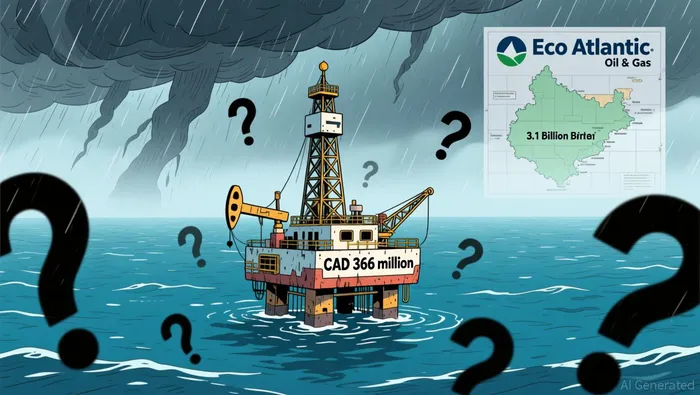
From a valuation perspective, here's the calculation. Eco's market cap is approximately CAD 366 million (roughly US$220 million). The company has zero production and US$5.1 million in cash. The entire valuation rests on the market's belief that these Atlantic Margin licenses - Namibia blocks, the Guyana Orinduik Block it already holds, and now the PL001 and Canje assets - will eventually yield commercial discoveries. That belief has already moved the stock up nearly sevenfold in a year. The question is no longer whether the market has improved its view of Atlantic Margin exploration. It's whether there's enough remaining optionality left in these assets to justify what the stock already reflects.
While it's true that the geographic positioning is compelling - PL001's proximity to Sea Lion infrastructure and Canje's location in the Guyana-Suriname Basin are both genuine advantages - proximity to a successful field doesn't guarantee a discovery. Exploration risk remains total until the first well is drilled. The 3.1 billion barrels figure is a prospect inventory estimate, not a resource estimate, and the gap between the two is enormous. Prospects are geological hypotheses. Resources are measured quantities. PL001 has neither.
Even if both assets deliver - a PL001 discovery that mirrors Sea Lion's geology and a Canje extension on favorable terms - Eco is still the minority non-operator partner in both. Navitas operates PL001 with 65%. ExxonMobil operates Canje with 35%. Eco's share of any upside is diluted before the market dilutes it further.
All things considered, this is not a value investment. It's a high-conviction exploration ticket that existing shareholders are funding through 22% equity dilution. If you believe in the Atlantic Margin thesis and can tolerate binary exploration risk, Eco has stacked more lottery tickets across the right geographies. But the cash position is thin, the assets are unproved, and the stock price has already priced in a tremendous amount of optimism. There are no cash flows here to anchor a margin of safety, no balance-sheet durability to test, and no fee-based insulation to count on. For a deep-value investor who needs operating data and a discount to intrinsic value, Eco Atlantic remains a story, not a position.
For existing shareholders, the decision isn't about whether JHI is a good asset - it's whether the 22% dilution price buys enough optionality to compensate. With US$5.1 million in cash and no revenue, the company will need more capital to drill these prospects. Future dilution is not a risk. It's a planning assumption.
I rate Eco Atlantic a Hold. The exploration upside is real, but the current share price has already absorbed most of the good news, and the capital structure leaves little room for error.