

The weird fact here is not that El Niño is coming. The weird fact is that the market pricing El Niño is currently going in the wrong direction.
Corn futures are down 11.71% over the past month, sitting around 420.00 cents a bushel. Soybeans are down 8.01%, roughly $11.16 a bushel. Wheat is down 7.20%, near $5.88. These are the exact commodities you'd expect to rip higher if a climate event is about to tighten global supply. Instead, the grain complex is repricing lower at the moment scientists are putting 90 percent certainty–98% odds on El Niño emerging this summer and persisting through the Northern Hemisphere winter.
That was weird. Or it should be.
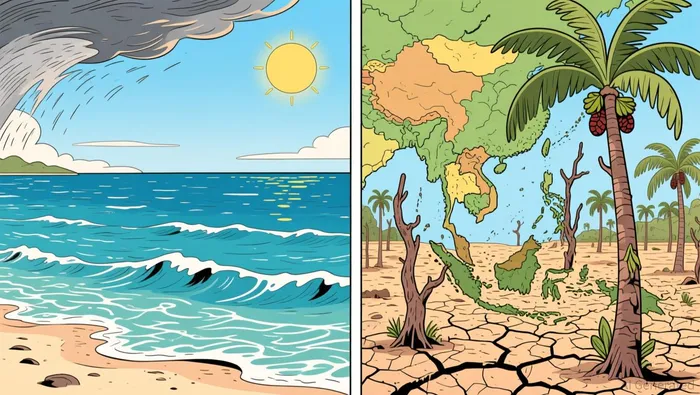
The basic point is that El Niño is not one risk. It's two different risks wearing the same name, and the financial markets have latched onto the one they can trade and largely ignored the one they can't.
Here's the split. El Niño suppresses Atlantic hurricane activity by increasing wind shear - the atmospheric tearing force that breaks storms apart before they strengthen. NOAA just put a 55% chance of below-normal Atlantic hurricane season. That's the side the market hears. Insurance-linked securities - bonds that pay investors unless a catastrophe occurs - have been in a soft pricing environment with fresh capital flooding in. Reinsurance demand is up roughly 10% at the April renewals, but spreads are falling because everyone expects a quiet hurricane season. The $50 billion ILS market is pricing El Niño as tailwind, not threat.
Meanwhile, El Niño does something else. It dries out Southeast Asia and northern Australia, suppressing monsoons and baking palm oil plantations and rice paddies. Indonesia, the world's largest palm oil producer, could see output fall by 2 million metric tons this year compared to 2025. Palm oil prices are already up 17.18% over the past month, and some analysts are projecting global crude palm oil hitting $1,500 a tonne by the second half of 2026.
But here's the plumbing detail that makes the whole thing interesting: the palm oil impact arrives with a 6-to-15-month lag. The drought stress you see in June shows up in harvest data months later. The commodity futures market front-loads news, then moves on. By the time the supply squeeze actually materializes, the forward curves may have already rotated past the people who priced the headline and no one is sitting on the risk.
So you have a financial system where one half of El Niño's risk is being sold off as cheap (hurricane ILS, where capital is abundant and spreads are compressed) and the other half is about to hit real supply but hasn't found a liquid expression in grain futures yet (corn, soy, wheat all trending down despite the climate signal).
This is basically a risk transfer from one side of the weather book to the other, but the transfer mechanism is asymmetrical. Hurricane risk has a deep liquid market - cat bonds, weather derivatives, parametric insurance products. Drought risk in Southeast Asian palm oil doesn't. You can buy a catastrophe bond tied to a Saffir-Simpson threshold in an afternoon. You can't buy a futures contract on Indonesian palm oil yields. You can trade Malaysian ringgit-denominated crude palm oil futures in Kuala Lumpur, but that's a thinly traded market relative to the CBOT grain complex, and most Western portfolio managers don't have a book for it.
The dialogue goes something like this:
Hurricane investor: El Niño means fewer storms, so I can sell protection cheaper and still earn a carry. This is a gift.
Palm oil grower: El Niño means our trees produced less fruit six months ago, so we're shipping less now, and we have no liquid instrument to hedge against it because nobody builds weather derivatives for smallholder supply chains.
One side of this has a market. The other side just has weather.
There's a secondary wrinkle that makes the grain side even more confusing. Some analysts argue that El Niño actually helps U.S. corn and soybean yields in the Midwest by delivering warmer, wetter conditions during the growing season. If that connection holds, corn yields could run roughly 4% better than expected - hitting around 190 bushels per acre. So the U.S. grain story is genuinely mixed, which gives the futures market a structural excuse to stay flat or drift lower even as global supply tightens elsewhere.
A study published earlier this year found that El Niño negatively impacts yields across 22 to 24% of global harvested area while simultaneously benefiting 30 to 36% of it. That's not a uniform shock. It's a redistribution. And redistribution doesn't show up cleanly in a single futures ticker.
The thing that should keep people awake isn't whether El Niño is real. It's that the financial expression of this climate event is going to be lopsided. The hurricane side has pricing, liquidity, and institutional buyers. The crop side in Southeast Asia has physical supply disruption and no corresponding derivative market for anyone to express a view.
Palm oil is particularly interesting because it sits at the intersection of food supply, biofuel mandates, and energy prices. Indonesia has been pushing toward B50 biodiesel blending - 50% palm oil in diesel - which locks enormous domestic demand into the system before El Niño even arrives. If supply then falls by 1 million-2 million metric tons on top of that, the price response could be violent. But it'll arrive quietly, not as a futures spike on a Tuesday, but as a series of physical short notices and tight cash markets that don't show up on your Bloomberg terminal until they're already happening.
The structural implication is straightforward: El Niño 2026 is going to be a stress test for the parts of the weather-risk market that have no financial plumbing. The hurricane book will be fine - maybe too fine, if the soft ILS pricing proves wrong. The crop book in Southeast Asia will feel it in real terms, through supply, not spreads. And the people who are supposed to be hedging that risk - traders, processors, food companies - will find themselves short a market that doesn't exist.
That's the machine. Not a weather event, exactly. A liquidity gap between two halves of the same climate shock.