

Do you know what the Italian manufacturing PMI is telling us that nobody wants to sit with? That the inflation regime isn't cyclical. It's not a bump. It's a structural break, and it's being written in real time.
In April 2026, the input cost inflation index in the Italian manufacturing PMI - a measure of how fast factory costs are rising, where above 50 means prices are increasing - accelerated to 75.4 from 69.0 in March. That is a four-year high. Italian producer prices surged 6.8% year-over-year in April, the steepest increase since early 2023. Gas costs are roughly 70% above pre-crisis levels, electricity roughly double.
This isn't an Italian problem. It's a European problem that Italy is feeling first because Italy has no domestic energy and runs on imported gas.
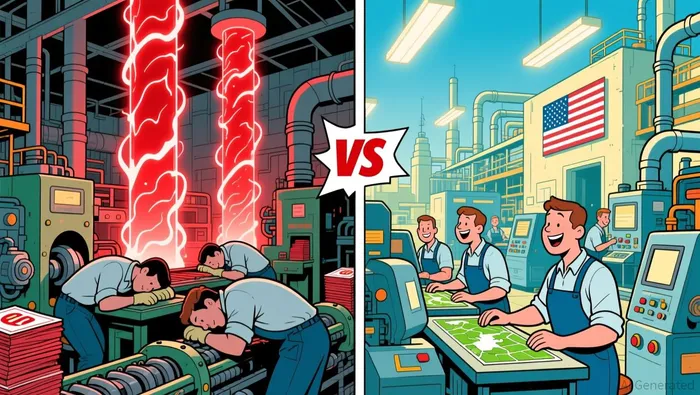
But here's the thing. This isn't just another supply shock we'll ride out. And the divergence between what's happening in Europe and what's happening in the United States should decide how you think about your portfolio from here.
1. The shock is structural, not transitional
The European Commission's Spring 2026 forecast expects EU energy inflation to peak above 11% in the second quarter of 2026 and remain above 10% for the rest of the year. The ECB projected headline eurozone inflation to jump sharply to 3.1% in Q2, driven entirely by the energy component. Goldman Sachs estimates that higher oil and gas prices will lower Euro Area industrial production by nearly 2% by the end of 2027 relative to pre-conflict trends.
What matters most: this is not a temporary disruption. This is a Middle East conflict that has turned energy from a stable input into a geopolitical risk premium baked into every month of European industrial output. The European electricity market is still tied to gas pricing, which makes geopolitics a structural vulnerability, not a quarterly surprise.
I believe this is exactly the scenario I've been arguing for - policymakers tolerating structurally higher inflation because growth, employment, and debt service create fiscal dominance that makes the old 2% target impossible to maintain. The energy shock isn't creating that regime on its own. It's exposing that the regime is already here.
2. The Atlantic divergence is the signal
While the eurozone manufacturing PMI fell to 51.4 in May from 52.2 in April - barely above the contraction line - the S&P Global US Manufacturing PMI climbed to 55.3, its strongest expansion since May 2022. The ISM Manufacturing PMI held at 52.7 in April, near levels not seen since the post-pandemic boom.
This matters because the ISM is a leading indicator. It tells you where demand is heading, not where it was. American manufacturers are expanding output while European manufacturers are being squeezed by input costs they cannot absorb.
And yes, US manufacturing input costs surged too - the PMI input prices index climbed to its highest level since 2022 in May. The global manufacturing input price index jumped by nine percentage points over two months through April, the sharpest spike since 2022. The difference is that US manufacturers have pricing power that European manufacturers don't. They can pass costs through because the US economy has the energy independence and demand resilience to absorb it.
3. Pricing power is the only filter that matters
This is where the analysis goes from macro to portfolio. When costs rise everywhere, the companies that survive and grow dividends are the ones that can raise their own prices without losing customers. Everything else gets squeezed.
European manufacturers - particularly in energy-intensive sectors - are discovering that they don't have pricing power when their input costs double and their export markets are weakening. Italian producer prices are up 6.8% because energy costs are flowing through. But can Italian factory owners pass that on? The PMI data shows output contracting. That tells you the answer.
Energy companies, by contrast, are the ones setting the price. They are not victims of the energy shock - they are the shock. This is the core insight: in a world where energy inflation runs above 10% for the rest of the year, the companies that produce energy are the only ones with structural pricing power.
4. What to position for, what to avoid
I don't think investors are being paid to chase European cyclical recovery. The eurozone PMI is falling, industrial production is projected to decline, and energy costs are structural, not seasonal. From an income and risk/reward point of view, the setup is clear.
Energy - both producers and midstream infrastructure - belongs in the core inflation-hedge sleeve. These are companies that provide what the economy cannot function without, and they set the price rather than taking it. If energy inflation stays above 10% through year-end, as the European Commission expects, energy cash flows stay elevated for the duration.
US industrials with pricing power - defense, logistics, companies tied to reshoring and infrastructure spending - are the real-economy beneficiaries. The US manufacturing PMI at 55.3 tells you demand is there. ISM new orders remain solid. The question is whether individual companies have the balance sheet and competitive moat to grow dividends through this regime.
The names to avoid are European manufacturers without pricing power and any dividend stock whose payout depends on stable input costs. A high yield means nothing if the cash flow can't cover it when energy runs hot for twelve more months.
5. The compounding case in a hot-inflation world
This is not a bet on one event. The Middle East conflict could de-escalate. Energy prices could fall from current levels. The European Commission's scenario models a prolonged crisis with oil at $180 per barrel, which is an upper-bound, not a base case.
But even in a less extreme scenario, the structural forces remain: deglobalization, demographics, the energy transition, and fiscal dominance all push inflation above the old target. The energy shock is the accelerant, not the cause. Removing the accelerant doesn't restore the old regime.
What this means for the compounding case is simple. A dividend stock that can grow its payout at 8% per year while inflation averages 3-4% creates real income growth. A dividend stock that can't raise prices because it lacks pricing power will see its yield erode in real terms regardless of how high the nominal rate looks today.
That is where the opportunity starts. Not in chasing yield. Not in owning everything. In identifying the companies with pricing power, balance-sheet strength, and mission-critical positioning that can compound income through a regime that most investors still want to pretend is temporary.
The Italian PMI is the canary. The question is whether you're going to act on what it's telling you.