

Entergy's AI thesis depends on growth turning into regulated capital deployment
Entergy's AI story is bullish only if the buildout stays ahead of local pushback. That is why its 2026 Investor Day on June 9 mattered. Management turned a broad AI-power narrative into a balance-sheet question, outlining about 13% per year electric-sales growth driven by data centers coming online across its system.
Why bulls see an infrastructure-layer opportunity
Bulls see more than higher sales. They see large, anchor customers that can justify new generation and grid assets inside a regulated framework. Entergy has already said it plans to build roughly 2 GW of gas-fired generation for Meta's initial Louisiana data-center phase, at a cost of about $2 billion. For AI-focused investors, that is the kind of visible, balance-sheet-backed demand the utility complex has been looking for.
Why bears see a permitting and politics problem
Growth this steep can quickly become a local politics problem. In East Tennessee, officials are trying to curb what kind of utilities they use, where they go and how they look. In rural Goochland County, Virginia, residents fought for months against proposed industrial expansion tied to a gas plant and data-center development before the board voted to move forward.
That is the real boundary condition for the stock. If permitting and community tolerance keep moving, the 13% growth path can re-rate Entergy as an AI infrastructure platform. If local fights delay projects, the market may start discounting execution risk instead of rewarding the growth story.
Why the utility case still works: large customers can change the cost burden
The key mechanism is not simply that AI load is good. It is how that load interacts with a regulated utility model.
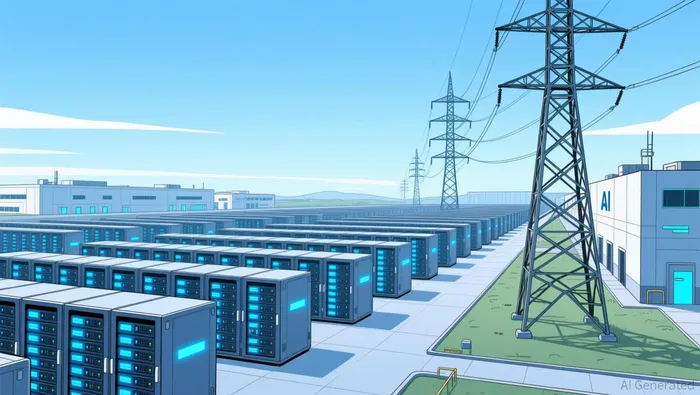
When a mega-data center connects to Entergy's grid, it does more than add megawatts. Entergy says large customers pay a bigger share of grid upgrades and maintenance than smaller residential and commercial users would otherwise help fund. The company says data-center connections could deliver $7 billion in savings over two decades across 2.3 million customers. That is the core bull argument: AI demand may help spread the infrastructure burden across a larger customer base rather than leaving it mostly on smaller users.
Why that matters for valuation
This is what turns raw demand into utility economics. Long-term data-center and industrial contracts can support new generation projects in a rate-base framework long-term contracts justify new profit-capped power generation projects. In plain English, the customer helps de-risk the build, the utility owns the asset, and regulators allow a regulated return on the infrastructure.
That is also why the pipeline matters now. Management said 2025 was another important year in securing significant electric service agreements with data centers and traditional industrial customers. For investors, that is the difference between a narrative and a pipeline that can start feeding earnings and rate base.
Scale is what makes the story different
Entergy serves more than 3 million customers, so even a limited number of very large data-center connections can materially change system economics. Management has outlined about 13% per year electric-sales growth from data centers coming online in its service territory. The point is not that Entergy needs to capture every AI project. It is that a few major anchors could expand investable assets while changing the cost structure across the system.
Local backlash is the main risk to the economics
The next question is not whether AI demand exists. It is whether local politics can slow the buildout enough to hurt timing, returns, and sentiment.
Faster growth changes the political math
Entergy is used to steadier utility growth. Management said recent years brought roughly 5% annual sales growth from industrial sales. The data-center story is much steeper. That matters because incremental growth usually blends into the background, while rapid growth turns a utility into a visible land-use issue.
A project can look clean on a spreadsheet and still become politically difficult once residents focus on traffic, visual impact, water use, and whether the local grid is being rebuilt for one mega-user. The Meta plan is a useful stress test for that risk. Entergy has said it may build roughly 2 GW of gas-fired generation for the initial phase at about about $2 billion. At that scale, delays can matter to returns, not just to headlines.
Community skepticism is becoming more visible
The deeper bear case is that communities are pushing back harder. In East Tennessee, officials are trying to curb what kind of utilities they use, where they go and how they look. In rural Virginia, residents fought for months against proposed industrial expansion before the board voted to move forward. Even when a project is eventually approved, that kind of fight can still matter in utility regulation because delays can raise costs, push back earning-in periods, and invite closer regulatory scrutiny.
There is also a broader community concern. Critics argue data centers can drive up electricity prices without returning durable and diversified job benefits. Entergy's counter is that large customers help lower power bills for everyone by taking on a larger share of grid costs. That argument may make sense system-wide, but locals will judge the project by their own experience first.
What to watch after Investor Day
The next phase matters because the story is shifting from demand headlines to execution. At its 2026 Investor Day on June 9, bulls want a clearer map from booked AI demand into rate-base deployment. Bears want proof that local fights will not slow the pipeline enough to hurt timing, returns, and sentiment.
Watch these signals next
- Contract visibility: Are new data-center and industrial agreements showing up as firm service commitments rather than expressions of interest?
- Rate-base deployment: Can Entergy turn that demand into authorized, under-construction, and early-revenue assets on schedule?
- Richland Parish timing: The about $2 billion build for Meta's initial phase is the clearest near-term stress test.
- Local acceptance: Does the argument that large customers help lower power bills for everyone gain traction, or do fears of higher electricity prices dominate the debate?
- Siting and power-source opposition: Watch for efforts like curbing what kind of utilities they use, where they go and how they look and whether more projects see fights resembling months of resident opposition before approval.
My stance: stay constructive, but only while project flow, permitting, and community tolerance keep moving together.
- Bull confirmation: firm contracts, steady capital deployment, and no new local delays.
- Bear invalidation: Richland Parish slips, or siting fights start delaying more projects than the market expects.