

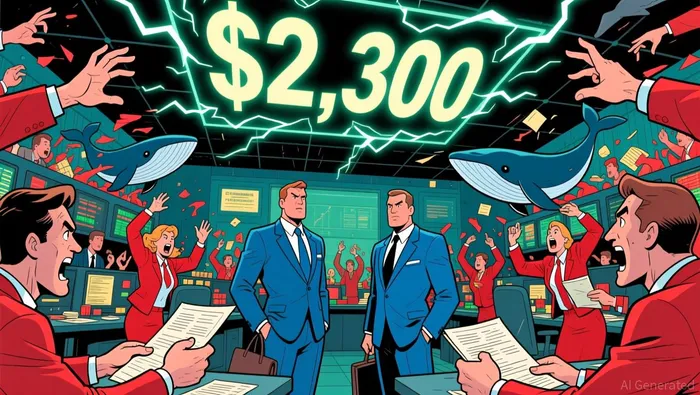
Ethereum's price remains stuck below the critical $2,300 level, with recent attempts to break higher met with firm rejection. The asset tested the $2,270 resistance zone, a level that aligns with its average onchain cost basis, and failed to hold above it. This dynamic is underscored by a 24-hour trading volume of $22.72 billion, which signals high activity but does not translate to upward momentum as sellers continue to dominate.
The market structure has visibly weakened. Ethereum has lost its parabolic support, a key technical feature that previously guided its recovery. Now, the path of least resistance appears lower, with the $2,350 level emerging as the critical reclaim zone. Bulls must successfully defend this area to prevent a deeper pullback toward the $2,200–$2,150 support zone.
This selling pressure is amplified by distribution from key onchain cohorts. The $2,300–$2,500 range is a known distribution zone housing the realized prices of both retail and whale wallets. Evidence shows retail investors have distributed roughly 1.5 million ETH in the past two weeks, while whale wallets have also made notable deposits to exchanges, adding to the selling supply.
The Onchain Battle: Realized Price vs. Open Interest
The $2,270–$2,500 range is a dense distribution zone, housing the realized prices of both retail and whale investors. This creates a natural ceiling where holders are likely to sell after breaking even, capping the upside despite aggressive buying pressure in the derivatives market. The zone has proven to be a key resistance, outweighing demand at every attempt to rise above it.
Yet, a powerful divergence is emerging in order flow. While price declines, open interest has climbed to 14.85 million ETH, its highest level since last July. This signals a rapid buildup of short positions, as bears are aggressively adding leverage. At the same time, the 30-day Taker Buy/Sell Ratio has surged to its highest reading since late January 2023. This metric shows that aggressive buyers are dominating the order flow on major exchanges, a sign of underlying accumulation.
This sets up a classic battle between onchain costs and macro liquidity. The realized price zone acts as a gravity well for selling, while the surge in open interest and the extreme Taker Buy/Sell Ratio point to a market where large buyers are stepping in to absorb supply. The outcome hinges on whether this aggressive buying can overcome the structural resistance from distribution or if the short squeeze will simply accelerate the next leg down.
Catalysts and Risks: Macro Liquidity vs. Onchain Accumulation
The immediate catalyst is a battle between macro headwinds and onchain accumulation. The Federal Reserve's sustained hawkish policy is pressuring risk appetite and liquidity, a direct headwind for Ethereum's price action. This macro pressure is evident in the 26% surge in daily trading volume as investors actively reposition amid volatility, a sign of risk-off flows that cap upside.
On the flip side, bullish institutional accumulation is building. The largest corporate ETH treasury, BitMine Immersion Technologies, added nearly 102,000 ETH last week, bringing its total holdings to 5.18 million ETH. This aggressive buying, combined with spot Ethereum ETF inflows of $62.83 million, provides a tangible floor of demand that could absorb selling pressure.
The technical setup is binary. A clean break above $2,400 opens the path to target $2,600. Failure to hold $2,211 support, however, would validate the bearish structure and likely accelerate a move toward $2,000. The outcome hinges on whether institutional buying can overcome the liquidity drain from macro policy.