

The question isn't where Ethereum's price ends up in 2026. The question is whether the underlying factor stack - flows, yield, network utility, competitive position - still supports the thesis or whether it has quietly eroded beneath the headline narrative.
Price predictions for ETH this year span from $1,700 to $3,500, depending on who you ask. That range tells you nothing about what to do with your portfolio. The actual signal lives in what's happened over the first five months of the year, and it's contradictory enough to warrant a proper breakdown.
The flow story: institutional money is leaving
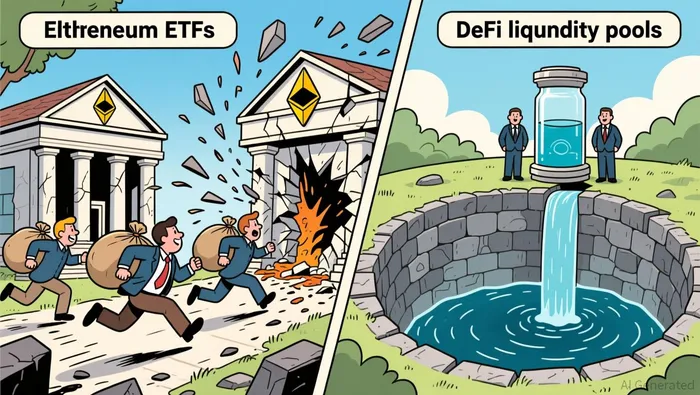
Ethereum entered 2026 at $3,001 before collapsing roughly 32% through the first quarter. By early June, the price sat near $1,978. The driver wasn't a network failure or a protocol collapse - it was sustained ETF outflows. Spot Ethereum ETFs posted approximately $413 million in net outflows during the first four months of 2026. A three-week stretch saw over $712 million leave. Both Bitcoin and Ethereum ETFs experienced a 13-session outflow streak... totaling roughly $4.4 billion.
What does that mean? Institutional capital that arrived in 2024 and 2025 to chase the ETF product launch is rotating out. The novelty trade has matured, and the flow profile has flipped. For a quant framework, this is the equivalent of a momentum factor grade dropping from A to D - not because the asset is broken, but because the directional force has reversed.
The yield story: compressed but not zero
Ethereum staking yields have compressed to approximately 1.83%, down from the 2–4% range that characterized the 2024–2025 period. The yield compression is partly a function of more validators entering the network as staking became easier through liquid staking protocols and exchange products. It's also partly deflationary - as more ETH gets staked, the circulating supply shrinks, which reduces the marginal yield.
Compare 1.83% to the current U.S. Treasury yield sitting near 3.8%, and the income case for holding ETH as a yield asset looks thin. That's not the point, though. The point is whether the yield component provides any ballast. It's not providing much right now. A sub-2% staking return on an asset that has fallen 30%+ in six months is net negative. The yield cushion that staking was supposed to deliver has shrunk alongside the price.
The utility story: this is where it gets interesting
Here's the number that breaks the bear thesis: Ethereum still holds approximately $55.6 billion in DeFi total value locked - that's the aggregate capital sitting in lending protocols, decentralized exchanges, and yield products built on the network. Compare that to Solana, the nearest structural competitor, which sits around $8 billion in DeFi TVL. Solana does handle more transactions and active addresses, and it has gained ground on raw throughput. But Ethereum's DeFi liquidity depth is nearly seven times larger.
In our book, that's a profitability-grade differentiator. Liquidity begets liquidity. The protocols that matter - Aave, Uniswap, Lido, the major stablecoin issuers - are still anchored to Ethereum and its Layer 2 ecosystem. Activity has migrated significantly to Ethereum's L2 solutions... which improved transaction speed and reduced fees. The network is processing more value on cheaper rails, and the base layer continues to accrue that value.
The relative valuation story: Bitcoin is winning the attention war
Bitcoin dominance - the share of total crypto market capitalization held by BTC - sits at 56.3% as of mid-June 2026. That's in the upper half of its multi-year range and reflects the outflow dynamic I described above. When institutions pull back from crypto broadly, they pull from Ethereum first. Bitcoin's ETF product was the first, it has the deepest liquidity, and it's the one that institutions treat as the "core" digital asset allocation.
The ETH/BTC ratio has been grinding lower. That's the real metric, not the USD price. When Bitcoin dominance climbs and ETH ETF outflows persist, Ethereum is being repriced as a higher-beta play within crypto, not as a standalone story. If BTC runs, ETH may follow - but it may not. The relative trade is what's moving the price, and right now the relative trade is anti-ETH.
What the factor stack says to do
Let me be direct about what the evidence hierarchy shows:
- Flows: Failing. Sustained ETF outflows over five months. Momentum is negative.
- Yield: Passing but weak. 1.83% staking return provides minimal income ballast.
- Utility/DeFi dominance: Strong. $55.6B TVL vs. Solana's $8B. Structural moat remains.
- Relative position to Bitcoin: Degrading. Rising BTC dominance, falling ETH/BTC ratio.
The structural case for Ethereum - DeFi depth, developer ecosystem, Layer 2 migration - is still intact. The flow case is not. That mismatch is the defining tension of 2026.
If you're holding ETH for the long-term thesis that Ethereum is the settlement layer for decentralized finance and that position is durable, the factor stack says hold. The utility numbers haven't collapsed. The TVL lead over competitors hasn't collapsed. The network upgrade cycle - Pectra, continued L2 scaling - is still moving in the right direction.
If you're trading ETH for momentum or short-term appreciation, the factor stack says stay away. The outflow regime hasn't reversed. BTC dominance hasn't cracked. There's no flow catalyst on the near horizon.
If you're building a diversified crypto sleeve for 2026 and need to allocate between BTC and ETH, the barbell answer is concentrated BTC with a smaller ETH satellite position. The relative risk-adjusted case favors Bitcoin while dominance is elevated and flows are negative for altcoins. If ETH ETF flows reverse - and that's the single data point worth watching, not any price target - the ETH position scales up. Until then, sizing reflects the factor mismatch, not the narrative.
The market's spread of predictions - $1,700 to $3,500 - captures the uncertainty. But uncertainty is usually a signal that the process needs more structure, not louder opinions. The structure here is simple: flows are the problem, utility is the floor, and the trigger for the next move is institutional capital changing its mind.