

Ethereum still leads by market cap, but the gap is narrowing
ETH still sits at #2, but the gap to the rest of the field is narrowing. As of late May, Ethereum's market cap was $254.88 billion. BNB and XRP were also in the conversation, each worth more than $80 billion, which makes them far more than long-shot challengers. They have liquidity, visibility, and enough scale to matter if investor preference shifts.
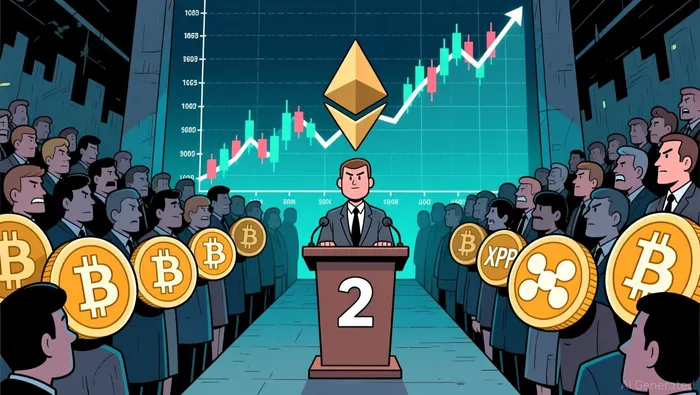
The "best smart-contract chain" label is no longer automatic
For years, ETH owned that story. Today, the market is clearly rotating toward large-cap assets with visible adoption hooks, not just historical prestige. That does not mean Ethereum is weak; it means the narrative edge is less secure than it once was.
Why this matters more now
Bitcoin and Ethereum still dominate the top-crypto conversation, but the field behind them is deeper than before Bitcoin and Ethereum continue to dominate rankings. If ETH loses some of the market's attention, the first beneficiaries are likely to be other liquid majors rather than obscure altcoins.
That is the real FOMO-versus-FUD split. Bulls still see ETH as the default blue-chip smart-contract asset. Bears see a leadership label that can fade if investors decide other large-cap stories offer better upside.
Ethereum's moat still rests on ecosystem gravity, not just age
The bull case is not that ETH is old, so it must stay on top. It is that Ethereum built the default layer first, and that head start still matters.
The EVM created a shared stack the market still uses
Ethereum launched as the first general-purpose programmable blockchain and gave the market the Ethereum Virtual Machine as a shared execution standard. Developers built tooling, abstractions, and workflows around the EVM, and capital followed because the application surface was already there. Over time, ETH also became the base collateral asset across much of the crypto economy.
That is why rival chains cannot win on speed alone. They may offer faster blocks, but they still have to rebuild the adoption flywheel from scratch: developers, liquidity, user habits, and integrations. Ethereum's job is simpler: stay good enough on UX and cost while the ecosystem gravity keeps pulling projects back to where the depth already is.
Network effects still matter more than raw throughput
The key watchpoint is not whether Ethereum is the fastest chain. It is whether the EVM stack remains the default development layer for new capital cycles. If activity in DeFi and dApp activity keeps routing through Ethereum's app graph, ETH holders still have a real mechanism to lean on.
Bears can attack price in the short term. But as long as competitors are still building adoption from zero while Ethereum scales an existing ecosystem, the bull case is more than nostalgia. It is a network-effects trade.
The bear case is not a broken chain; it is a less exciting one
The real bear case is not that Ethereum suddenly breaks. It is that ETH becomes stable enough to stay relevant, but dull enough to lose leadership.
The scarcity trade has weakened when activity is calm
Ethereum's post-Merge bull case leaned on scarcity: when the network got hot, fees burned, and ETH came under deflationary pressure during periods of high network activity. But that is also where the FUD starts. Persistent low gas prices in 2025-2026 have limited this deflationary pressure. Scaling made the network cheaper and more usable, which is good for adoption, but less helpful for the "scarcity spike" trade.
That matters because ETH does not need a collapse to lose its crown. It only needs to stop feeling like the hottest liquidity engine in crypto. If activity lives mostly on L2s and gas stays tame on mainnet, the market can keep treating ETH as infrastructure while rotating premium valuation into assets with fresher demand hooks.
Correlation can cap outperformance
There is another quiet risk: correlation. ETH has increasingly tracked risk assets outside crypto, with its correlation to the Nasdaq 100 frequently exceeded 0.65. If that pattern holds, ETH may rise with risk markets without delivering the kind of outsized crypto-specific momentum that helps a challenger pass it.
What bears need to see
The threat to ETH's #2 status by 2030 is not a broken chain. It is a less exciting one.
Ethereum's base case is still #2, but the signals matter more now
My base case is still that ETH holds #2 by 2030. But this is not a "just HODL and hope" call. The chain already has the moat from being the first general-purpose programmable blockchain and the base collateral asset across much of the crypto economy. What matters now is whether that legacy turns into fresh demand before the next cycle gives the market a new favorite.
Signals that support ETH keeping its spot
- 15-18% of supply staked suggests a meaningful share of ETH is committed to the network.
- ETH supply and issuance are transparent and predictable, so market participants can track scarcity rather than rely on vibes.
- The cleaner confirmation is straightforward: watch whether exchange balances keep drifting toward staked or off-custody states rather than back toward highly liquid trading balances.
What could flip the call
- If rival chains keep pulling activity, users, and liquidity into their own ecosystems, ETH risks becoming backend rails instead of the main stage.
- If competitors keep gaining ground while Ethereum remains large but less explosive, the market may start treating ETH as legacy infrastructure in the ranking game.
Could Ethereum realistically lose #2 before 2030?
By the metrics available today, a outright drop looks unlikely. ETH still sits comfortably ahead of the next credible challengers. But the margin for error is smaller than it was a few years ago. If competition keeps deepening and Ethereum's mainnet demand stays muted, #2 is defensible for now without being guaranteed.