

EU court review is a credibility risk for AVGO, not yet a deal-breaker
This is not the same as an order unwinding Broadcom's $61 billion acquisition of VMware. For AVGO investors, the first-order issue is credibility: a legal challenge is arguing that the European Commission cleared the deal without the kind of conditions that many market participants expected.
The bull and bear case are really about procedural risk
Bulls have a real procedural argument. The court is reviewing whether regulators need to revisit the deal, not automatically whether the merger must be unwound review whether regulators need to revisit the deal. If that bar is high, this remains headline risk rather than balance-sheet risk.
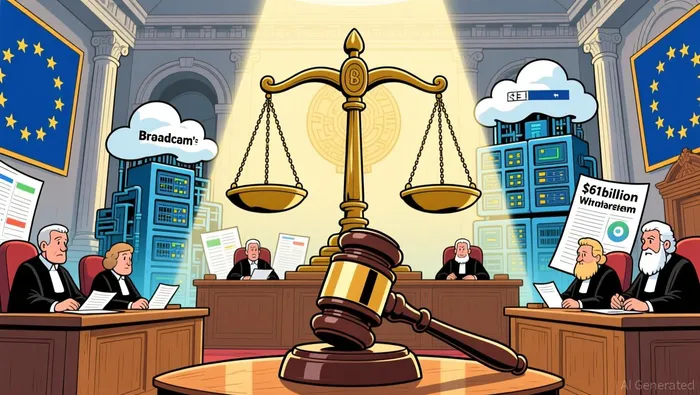
Bears, though, are not making a weak case. CISPE argues that the Commission itself acknowledged significant risks to competition but still approved the transaction without conditions. That is what gives the "no conditions" claim its force.
Why timing matters now
CISPE filed its complaint on 24 July 2025, and the court is moving toward a near-future hearing on whether the Commission must review its previous approval. That turns the case from abstract scrutiny into a calendar event.
The stakes are asymmetric. If the court does not push for a revisit, AVGO keeps its clean win. If it does, conditions or constraints could re-enter the picture later. That is not a guaranteed hit, but it is a repricing risk investors should monitor rather than wait for the market to price after the fact.
Why CISPE's 'no conditions' argument matters more than the courtroom drama
The lawsuit matters because it targets the Commission's conclusion directly. CISPE's case is that Brussels acknowledged significant risks to competition but still approved the merger without remedies, and now the court is reviewing whether regulators need to revisit the deal.
The complaint also carries weight because CISPE is backed by companies including Amazon Web Services. That does not guarantee success, but it helps explain why this case may stay on the radar beyond the initial headline.
The commercial question sits at the core of the legal one
The acquisition gave Broadcom control over VMware's virtualization software, a core tool for running multiple systems on one server and widely used by cloud providers in Europe. That gives Broadcom more leverage over pricing and contract terms, which can support short-term monetization.
The same dynamic is the source of the pushback. CISPE says Broadcom has terminated existing contracts with only weeks' notice, imposed sharp cost increases, and required mandatory multi-year commitments. Bulls can read that as aggressive monetization of a scaled enterprise stack. Bears read it as the start of customer friction that can move from procurement teams to regulators.
That is why the "no conditions" argument matters. The court is not automatically weighing an unwind. It is weighing whether the Commission's approval needs to be revisited. If that happens, the risk is not just political embarrassment; it is post-deal constraints that were not part of the original setup, such as access terms, pricing guardrails, licensing changes, or monitoring.
What changes the AVGO trade from here
The case is shifting from headline risk to calendar risk. The General Court has already taken the complaint and is expected to organize a hearing before deciding whether regulators need to revisit the deal. A full resolution is not due immediately; the practical watch window is the coming months.
The Google backdrop matters for tone, not direct equivalence. An EU court advisor said Google's appeal was unfounded and brought the company closer to a 4.124 billion-euro fine. That opinion is non-binding, but courts often follow it. The broader point is that EU antitrust enforcement can still produce large, visible penalties, so procedural momentum here should not be dismissed as noise.
What to watch
- Hearing cadence: How quickly the court moves from filing to hearing can signal whether it is treating the case as live.
- Scope of review: If the debate stays narrow and procedural, downside may be contained. If it broadens into the substance of remedies, the trade becomes less friendly.
- Customer-conduct evidence: Attention should focus on whether allegations about post-close behavior gain traction, especially claims that Broadcom terminated contracts with only weeks' notice and imposed sharper cost increases.
- Who is pushing this: CISPE is backed by companies including Amazon Web Services, which suggests the complaint may have staying power.
What would reduce the overhang
- The court refuses to engage the substance and lets the approval stand.
- The docket stalls, with no hearing and no momentum over the coming months.
- The review remains formal, and the Commission's original logic is upheld without any indication that remedies were missing.
Investors are not necessarily betting on deal death. The more immediate question is whether the EU approval was too clean. If the process stays alive but does not escalate into remedy risk, the market can still treat the deal as a monetization story rather than a structural overhang.