

The headline says peace. The mechanism says something else entirely.
European stocks ticked higher on May 18 as markets absorbed the latest round of optimistic language around a U.S.-Iran deal. The STOXX 600 closed at 610.17, up 0.54% on the day. The DAX added 357 points to 24,308. It looks like relief trading. It reads like investors are saying "the worst is over."
It is not as good as it looks.
The premise that European equities benefit from a U.S.-Iran peace deal needs to survive a single basic check: what would actually change in earnings, and for which companies? Not sentiment. Not risk appetite. The mechanical, per-unit effect on revenue, margin, or cost.
Run that test and the story collapses in two places - then reassembles in one the market is ignoring.
The geopolitical marketing machine
First, the word "peace deal" is propaganda before it's a headline. Trump called the ceasefire with Iran "on life support" on May 11. Clashes continued in the Strait of Hormuz even as Trump insisted the ceasefire "is still in effect" on May 8. Iran reviewed a U.S. proposal on May 6 but the terms - ending competing blockades on the Strait, lifting sanctions, releasing frozen funds - remain unresolved. A 60-day deadline expired without agreement, Israel launched strikes, and now we're in extended limbo.
This is not a peace deal. It is a fragile ceasefire that keeps breathing between political outbursts. Any astute market participant would have recognized that by now. The gap between the language used in market recaps and the language used in diplomatic cables is where retail investors lose money.
Iran is not a semiconductor market
The deeper problem: even if a full deal materializes, Iran is not going to become a customer that moves the needle for ASML, Infineon, or any other European semiconductor company. Sanctions have starved Iran's industrial base for over a decade. Investment has dried up. Technology transfer has been blocked. Managerial practices have atrophied. A 2024 study by the Clingendael Institute concluded that sanctions have structurally limited Iran's industrial resilience - not just slowed it, but reshaped its capacity ceiling.
Iran's semiconductor ambitions, where they exist, are military-adjacent and procurement-based - not the kind of high-volume, cutting-edge chip demand that ASML's lithography systems are built to serve. SMIC, China's chipmaker, was accused by U.S. officials of sending chipmaking tools to Iran's military. That's an equipment-smuggling story, not a customer-pipeline story. No foundry expansion, no fab program, no volume order book.
The market is reacting to a headline that would only matter if Iran were a buyer. It is not.
ASML reported Q1 2026 net sales of €8.8 billion with a 53% gross margin and raised its full-year 2026 guidance to €36–40 billion from a prior €34–36 billion range. Those numbers are driven by AI-capex demand from hyperscalers and memory foundries in the U.S., China, and Asia - not by any geopolitical settlement with Tehran. The same applies to Infineon, which posted Q1 FY2026 revenue of €3.66 billion with 17.9% segment margin, buoyed by automotive and industrial demand that has nothing to do with the Middle East.
You can check the customer lists. The connection doesn't exist.
The actual mechanism: energy cost relief
Here is what actually moves European earnings when Hormuz de-escalates: energy input costs.
The EU calculated that energy costs tied to the Hormuz crisis surged past $35 billion. Oil prices spiked toward $112 per barrel during the Strait disruption, before partially pulling back to around $104. EU energy prices jumped 4.9% in March compared to a 3.1% decline the month before, pushing inflation from 1.9% to 2.5%.
That is the per-unit framework. Every euro of energy cost that comes off Europe's industrial input bill flows directly into corporate margins across the continent. Manufacturers, logistics, chemicals, and automotive - the backbone of the STOXX 600 - all run on energy. When oil was pushing above $110, their cost curves moved up and earnings estimates moved down.
A ceasefire that holds reduces energy costs. Lower energy costs expand margins. Expanded margins improve earnings per share. That is the only mechanical chain that matters for European stocks in this scenario.
But here's the catch the market is not pricing correctly: the ceasefire is the same fragile arrangement that Trump described as "on life support." If it breaks, energy prices spike again and the entire margin improvement evaporates. The European bounce of 0.54% on May 18 is not a conviction signal. It is a conditional bet on a ceasefire that has already faltered multiple times.
The cross-currents
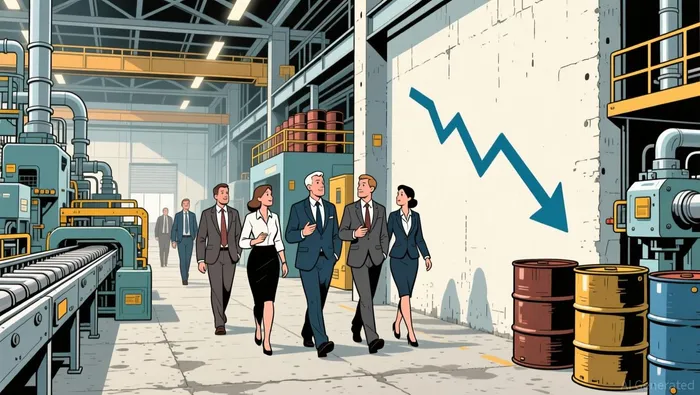
The cross-currents are three: energy cost relief is real if the ceasefire holds, Iran is not a technology market so the semiconductor angle is fiction, and the ceasefire itself is the weak link.
Directionally:
- Energy cost relief is the primary driver and the only one that touches actual per-unit economics. If Hormuz opens fully and oil retreats toward $75–80, European margins expand materially. If it stays at $100+, the relief is marginal.
- Semiconductor and tech re-rating is the secondary narrative but has no engineering foundation. Iran's sanctions-battered industrial base cannot absorb ASML tools or Infineon volume orders even if sanctions lift tomorrow. The timeline for rebuilding would be measured in years, not quarters.
- Ceasefire durability is the risk factor that determines whether either scenario plays out. With clashes still occurring in the Strait and Trump openly hostile to Tehran's negotiating posture, this is not a resolved condition. It is an open one.
What would resolve the ambiguity? An oil price move. If crude settles below $90 and stays there, the energy cost relief thesis gains traction and European cyclicals earn their bounce. If oil pushes back above $110, the bounce was premature and the market repriced a ceasefire that doesn't exist.
The implication
European stocks are not rallying because Iran is a semiconductor customer. They are rallying because energy costs might come down - and that possibility is worth something. But the magnitude of the move is wrong for the certainty of the outcome. A 0.54% index gain on a "life support" ceasefire is not a thesis. It is a bet.
For investors, the position is simple: watch the oil price, not the diplomatic language. The Strait of Hormuz sets the input cost for half the companies in the STOXX 600. Iran's chip ambitions set the input cost for none of them.