

The most profitable games in the world cost $0 to download.
Fortnite. League of Legends. Honor of Kings. These are not footnotes in the gaming business. Honor of Kings alone pulled in $1.68 billion in a single year. Riot Games - the company behind League - posted $434 million in profit in 2024, all from a game anyone can play for free. The global gaming market hit $197 billion in 2025, and the vast majority of that revenue flows through titles with no upfront price tag.
So the headline "it's gotten more expensive to be a gamer" is wrong. Or rather, it is only wrong in the way that matters.
The more interesting question is not whether gaming costs more. It is: what has the industry replaced the flat price with, and who actually pays?
Here is what happened. A few years ago, the default game cost $60. Then $70. Now Microsoft is moving first-party Xbox titles to $80 this holiday season. That is the price you see on the box. And it is also the price almost nobody actually pays - because most people don't buy boxes anymore.
The industry discovered something while doing things that didn't scale. It tested whether making a game free and selling skins, battle passes, and cosmetic items could outperform charging everyone the same flat fee. It could. Spectacularly. You get a much larger player base, and within that base, a small number of heavy spenders produce more total revenue than the box model ever did. The math is superlinear: a free game with 100 million players and a handful of enthusiastic spenders beats a $70 game with 2 million buyers. Even if most of those 100 million spend nothing at all.
That is the structure now. Most gamers pay zero. A few pay a lot. The average - if you include the zeros - comes out to $147 per year, up from $132 the year before. In the US specifically, each person who actually spends on games averages closer to $325. But that average hides the distribution. The revenue concentration is extreme. A small fraction of players generates most of the money. The rest are essentially advertising - their presence makes the game feel alive, which makes the paying players stay.
This is not inflation. It is a different product entirely.
Think of it this way. The old model was like a movie ticket: you paid once, you got the experience. The new model is like a free bar that makes its money from the people who order $18 cocktails every night. The non-drinkers aren't a loss. They're the crowd that makes the bar worth visiting.
The box price keeps rising because it is no longer the primary revenue stream. It has become a prestige signal and a convenience option for people who prefer to pay once and not think about it. Microsoft raising prices to $80 is not a sign that the company needs more money from traditional sales. It is a sign that traditional sales have been demoted to a secondary channel. The company can afford to price the box version higher because the real cash comes from the ecosystem - subscriptions, live service, microtransactions.
Video game subscriptions are projected to generate $11 billion in 2025, up from $6.6 billion just two years earlier. That is a 67% increase in two years. Subscriptions are the middle ground: not free, not $80, but a monthly fee that keeps you in the tent. Like the bar's cover charge.
So who is gaming more expensive for? The people who play free-to-play games and develop spending habits - the ones who buy every skin, every battle pass, every limited-time offer. Those costs compound in a way a flat $60 purchase never did. You knew what you were spending. Now the spending has no ceiling.
For the majority of players who never open their wallet? Gaming has never been cheaper. The barrier to entry is zero. That was the deliberate trade-off.
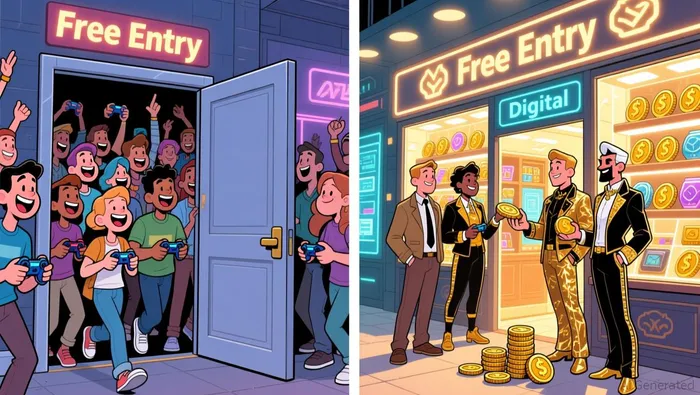
The headline got it backwards. Gaming hasn't gotten expensive. It has gotten unequal. The industry figured out how to extract far more from the people most willing to pay, while keeping the door open for everyone else to play for free. The winners are the companies. The losers might be the heavy spenders who find themselves in a product designed to make them spend more than they planned. The rest of us are just crowd.
The test is simple. Ask yourself how much you actually spent on games last year. If you play free-to-play titles - and most people do - the answer might surprise you. Either way, you now know the structure: the game is free because your attention has a price. You just haven't been asked to pay it yet.