

Stellantis moving Factorial cells into a development vehicle changes the story
This is no longer just a chemistry story.
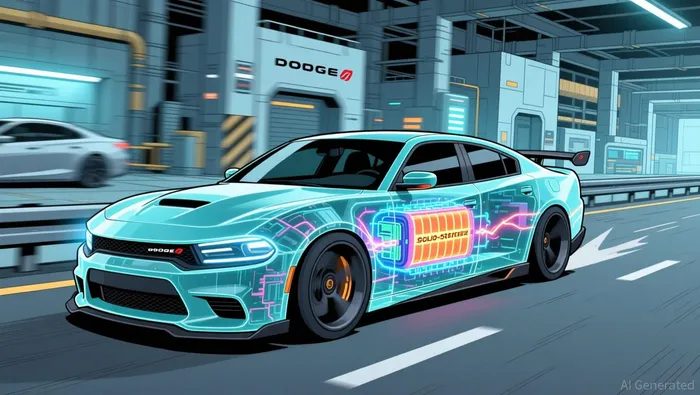
Stellantis has put Factorial's cells into a Dodge Charger Daytona development vehicle, marking the first automotive integration in North America and the first vehicle in the previously announced multi-stage development vehicle program. That is a meaningful validation step: the technology is now in a real vehicle architecture and entering real-world driving.
The market is already pricing the next steps
Factorial shares jumped 37% to $21.94 on the announcement and have already gained 119% over the past year. The market is no longer valuing the company only on lab-level promise; it is valuing progress toward automotive validation.
That cuts both ways. Bulls can argue the stock is rerating as the technology moves from cell testing into vehicle integration. Bears can argue the opposite: when a stock runs this far, even a normal development delay can hurt.
Why the specs matter - and why road testing is the real first exam
The headline numbers only matter if they translate into vehicle advantage
The Stellantis announcement matters because Factorial's cells previously showed 375 Wh/kg energy density, could charge from 15% to 90% in 18 minutes, and functioned from -30°C to 45°C. Those are the kinds of metrics that can affect range, charging experience, and system design.
Higher cell-level energy density is not just a lab stat. In a modified EQS, Mercedes said usable energy increased by 25% with roughly the same weight and size, helping the vehicle achieve more than 745 miles of real-world range. If Factorial can support similar gains at pack level, the opportunity extends beyond a single cell supplier.
Integration and manufacturing fit are now part of the thesis
Stellantis did not simply insert a cell sample. Its pack design uses a patented mechanical architecture built to accommodate solid-state cells, which makes the program more than a one-off demo.
Factorial also says its technology is 80% drop-in compatible with existing lithium-ion production lines. That does not guarantee smooth commercialization, but it does suggest lower switching costs if partners choose to scale the technology.
What still has to be proven
Impressive cell data is not the same as a commercial battery business.
The Mercedes test showed the chemistry can perform in real cars on real roads. It did not prove yield, cycle life, cost, or manufacturing repeatability. Stellantis is using its prototype program to validate automotive-grade performance, and road testing is still the mechanism for that proof.
So the key question is no longer whether the specs look strong. It is whether automotive-grade validation arrives with enough credibility to support customer confidence and future capacity spending.
What investors should watch next
At roughly a public-market valuation built on the recent run, Factorial is being judged on more than chemistry. It is being judged on whether automakers keep investing time, engineering effort, and capital behind the technology.
The proof points that matter most
- Watch whether road testing now underway produces evidence the market can underwrite. The important benchmark is whether the program keeps moving toward automotive-grade validation in performance, safety, and reliability.
- Watch integration depth. Stellantis has already built a patented mechanical architecture around the cells and adapted pack design and control systems. Deeper engineering alignment would matter more than another headline.
- Watch customer commitment. Factorial already has visible relationships with Mercedes-Benz, Hyundai, Kia, and Stellantis. The next step is not just awareness; it is more concrete program progression and partner involvement.
Why partner commitment matters
A battery company with scalable solutions still needs customers to share the burden of validation and scale-up. More partner involvement would reduce execution risk and make the commercialization story more credible.
What would weaken the setup
- Road testing reveals reliability or safety concerns before automotive-grade qualification looks credible.
- Stellantis remains at the development-vehicle stage without moving through the multi-stage program.
- Other customers keep interest visible but do not increase resource commitment, leaving Factorial to carry most of the development burden.
If the road-test program keeps progressing, the milestone will look more important in hindsight. If it stalls, the stock may have already priced too much of the promise.