

McDonald's replaces bundled "add-one-for-$1" deals with a flexible under-$3 menu to capture customers seeking specific items without rigid constraints. - Wendy's introduces seasonal innovations like the Cookie Dough Frosty while upgrading its spicy chicken sandwich to drive foot traffic and engagement. - Industry-wide value meals, ranging from $4 to $8, remain a critical defense against inflation as chains prioritize volume over high-margin individual items. - Operational shifts including AI ordering and high-protein menu expansions are key to maintaining margins while competing on price. - The current landscape suggests a strategic trade-off where perceived value drives volume, even if the absolute cost of entry for heavy bundlers remains unchanged.
The fast-food sector is undergoing a quiet but significant transformation in how it defines "value" for the modern consumer. As inflation continues to pressure household budgets, major chains are moving away from traditional bundling tactics toward more flexible, item-specific pricing strategies. This shift is not merely a marketing gimmick but a fundamental restructuring of how these companies approach their value propositions. The race is no longer just about the cheapest burger; it is about the architecture of the menu itself and how it aligns with changing consumer behaviors.
How Is McDonald's Reshaping Its Value Menu Architecture?
McDonald's has initiated a strategic pivot that moves away from the rigid "buy-one, add-one-for-$1" model that defined its value menu for years. Instead, the company is rolling out an expanded Under $3 Menu featuring over ten items, including the McDouble, McChicken, and 4-piece McNuggets, alongside a new breakfast bundle. A company spokesperson noted that this change was driven by customer feedback requesting flexibility and the freedom to order specific items without being forced into a bundle.
However, the financial implications for the consumer are nuanced. While the headline price of individual items has dropped, the removal of the $1 add-on deal means that the total cost for a multi-item meal may not decrease as significantly as the per-item pricing suggests. Experts describe this as an experiment in the "architecture of value offerings," designed to draw attention to existing value rather than drastically lowering the cost of entry for heavy bundlers. The $5 Meal Deal remains, but the McDouble version has been adjusted to $6, reflecting higher operating costs that the company is passing on in specific configurations.
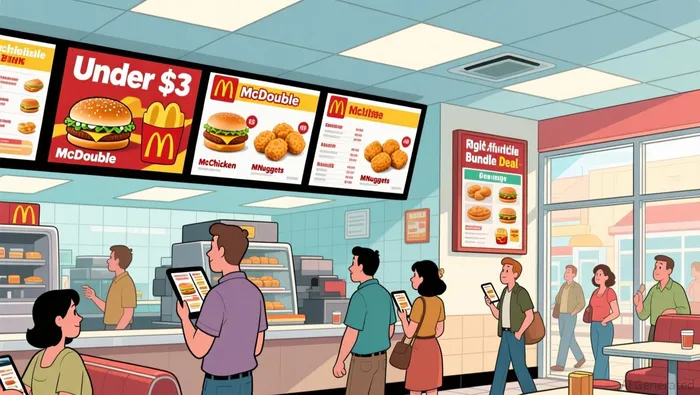
This structural change forces investors to look beyond simple price points. The strategy aims to capture customers who previously felt constrained by bundles, potentially increasing transaction frequency even if the average order value remains flat or slightly lower. By decoupling items, McDonald's can target specific hunger cues throughout the day—breakfast, lunch, and dinner—with a unified, flexible pricing tier that feels more accessible to a budget-conscious demographic.
Why Are Competitors Like Wendy's Launching New Seasonal Items?
While McDonald's restructures its core value proposition, competitors like Wendy's are leveraging seasonal innovation and product upgrades to drive traffic. On April 23, 2026, Wendy's announced a spring menu featuring six limited-time offerings, including the Cookie Dough Frosty Fusion and various watermelon-infused beverages. These launches are timed to coincide with warmer weather and a consumer appetite for bold, discovery-driven flavors. The company's Chief Marketing Officer emphasized that these changes reflect a desire to mix comfort with novelty to keep the brand top-of-mind.
Beyond seasonal gimmicks, Wendy's is also making structural changes to its core menu to enhance perceived quality without necessarily increasing prices. The chain recently updated its spicy chicken sandwich with a new marinade, crispy panko-style breading, and a potato bun based on extensive consumer focus groups. These improvements are part of a broader "Project Fresh" campaign aimed at operational efficiency and product quality. By upgrading the core sandwich lineup, including the Baconator and Dave's Single, Wendy's attempts to justify its premium positioning while still offering competitive value through its Biggie Deals.
These Biggie Deals, ranging from $4 to $8, serve as a critical anchor for budget-conscious consumers. The $4 Biggie Bites and $5 Jr. Cheeseburger Biggie Bag allow customers to bundle a sandwich, sides, and a drink at a fixed price point. This strategy aligns with industry-wide trends where chains use value meals to maintain volume amidst inflation. The focus on specific price tiers ($4, $5, $6) allows Wendy's to compete directly with McDonald's and Burger King while maintaining a distinct brand identity centered on fresh ingredients and seasonal variety.
What Do Rising Costs Mean for Fast Food Profitability and Margins?
The broader fast-food industry is navigating a complex environment where rising operating costs are forcing a re-evaluation of menu pricing and bundling strategies. A USA TODAY analysis of major chains in the Chicago market revealed that while many items remain under $5, the margin on these low-cost items is often razor-thin. McDonald's, for instance, offers a Ranch Snack Wrap for $3.79 and a 6-piece Chicken McNugget for $4.99, while Wendy's sells a Jr. Cheeseburger for $0.99. These low price points are essential for driving traffic, but they require high volume to sustain profitability.
Competitors are adopting similar tactics to counter inflationary pressure. Burger King supports its turnaround plan with $5 Duo and $7 Trio deals, while KFC has introduced a Value Feast lineup with meal boxes priced at $7, $9, and $11. Taco Bell maintains affordability through its Luxe Value Menu, offering 10 items under $3, and Dunkin' provides a $6 Meal Deal that competes aggressively on breakfast value. The consistency of these value offerings across the sector suggests a collective industry shift toward volume-driven growth rather than high-margin individual sales.
For investors, the key metric to watch is the balance between average check size and unit growth. As chains like McDonald's and Wendy's adjust their menus to remain competitive, the risk of margin compression is real. However, the data indicates that maintaining a strong value proposition is critical for retaining customers who are sensitive to price increases. The successful execution of these strategies will depend on operational efficiency, such as the AI-driven drive-thru upgrades McDonald's is implementing, and the ability to manage supply chain costs while delivering the perceived value that drives consumer loyalty.
The future of the fast-food sector will likely be defined by a dual strategy: maintaining aggressive value menus to capture price-sensitive consumers while simultaneously investing in technology and product innovation to drive higher-margin sales. As chains like Chipotle reintroduce high-protein options and others like Subway launch protein-focused wraps, the focus is shifting toward health-conscious value. This evolution suggests that the "value war" is not just about the lowest price, but about the best combination of price, quality, and convenience for the modern diner.