

Last week the Securities and Exchange Commission approved a Financial Industry Regulatory Authority rule change that eliminates the $25,000 Pattern Day Trader minimum equity requirement. That is weird. The old rule said if you made more than four day trades in five days in a margin account with less than $25,000, you got labeled a pattern day trader and couldn't trade for 90 days. The new rule replaces that with real-time risk-based margin standards. The immediate market reaction was predictable: retail broker stocks jumped, with Robinhood up 10% on the news, and small-cap stocks outperformed.
But the weird part isn't that the rule changed. The weird part is what it tells you about how modern market volatility actually works. When the S&P 500 dropped roughly 8% from its January high amid Middle East conflict and oil price spikes, then rallied 8.2% from its March lows in a matter of days, the obvious story was about investor psychology: panic, then calm, then buying the dip. The plumbing story is different.
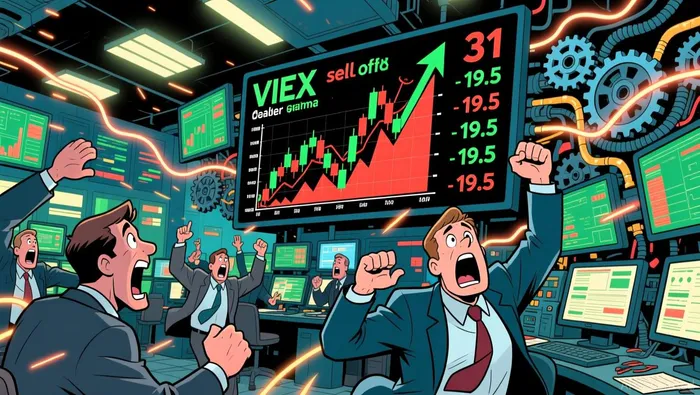
Start with the VIX. During the selloff, the fear index hit 31. By the time the bounce was underway, it had collapsed back to 19.5. That move from 31 to 19.5 isn't mainly a comment on fundamentals improving. It's a comment on options expiration, dealer gamma positioning, and the mechanical triggers that systematic strategies watch. When the VIX crosses below 20, a bunch of quant funds and risk-parity strategies get permission to buy. They don't ask whether the geopolitical situation is actually resolved; they ask whether their volatility target says it's time to re-risk.
The ETF flow data tells a similar story. During the quarter, overall ETF inflows slowed toward the end of the first quarter as market volatility spiked, but core equity ETFs kept attracting money. Investors rotated defensively-energy sector ETFs saw record inflows, commodity ETFs had their tenth straight month of inflows-but they didn't flee equities entirely. This looks less like a panic and more like a reshuffling. The money that stayed in core equity products wasn't making a bold statement about confidence; it was just doing what institutional mandates say to do.
The old finance version of this story would be about bank lending standards tightening and then easing, or about margin clerks calling for more collateral and then releasing it. The new finance version is about gamma, VIX targets, and ETF creation/redemption mechanics. But the basic idea is the same: when markets sell off hard and then recover fast, a lot of what you're seeing is the system's plumbing responding to its own signals.
Think about it like this. Dealer A sells a bunch of put options. When the market drops, those puts go deeper in the money, and the dealer's short gamma position means it has to sell more stock to stay delta-neutral. That selling pushes prices down further, which makes the puts even more in the money, which requires more selling. This is the short gamma trap. When those puts expire, or when the dealer rolls its position, the forced selling stops. Prices bounce. From the outside, it looks like "the market found a bottom." From the inside, it's mostly just expiration mechanics.
The PDT rule change fits into this pattern. By removing the $25,000 barrier, you change how retail traders interact with volatility cycles. More small accounts can day-trade freely. That means more of them might try to buy the dip-or panic-sell-during sharp moves. Their flows get aggregated by payment-for-order-flow brokers and routed to wholesalers. The brokers make money on the spread and on margin interest. The volatility feeds itself.
So when you see headlines about how the S&P 500 slid nearly 9% during the Iran conflict and then quickly recovered, and the lesson is supposed to be about staying invested through crises, the real lesson might be simpler. The recovery speed tells you more about how markets are wired now than about whether investors are brave or rational. It tells you that a VIX spike to 31 creates systematic selling pressure, and a VIX drop below 20 creates systematic buying pressure. It tells you that options expiration calendars matter as much as earnings calendars. It tells you that what looks like psychology is often just plumbing.
This isn't to say fundamentals don't matter. Oil prices spiking to $119 per barrel because Middle East conflict choked off a fifth of the world's oil supply is a real economic shock. But the timing and violence of the market's reaction-and the speed of its recovery-have as much to do with positioning and structure as with the shock itself.
The old advice about staying invested through volatility cycles still works, in a way. But it works for a different reason than the obvious one. It works because if you try to time these mechanical cycles, you're not really timing the economy or corporate earnings. You're timing dealer gamma, VIX expiration, and systematic rebalancing flows. And that is a much harder game.