

Summary
- The "fastest-growing ETFs" of 2026 are overwhelmingly AI-themed, semiconductor, and mega-cap tech funds - all pointing at the same handful of underlying stocks.
- The S&P 500's Shiller CAPE ratio sits near 38, the second-highest sustained reading in 50 years. Buying growth ETFs at these valuations is paying a premium for a narrative.
- The Magnificent 7 now represent 35–40% of the S&P 500. Owning three different "diversified" ETFs may mean you own the same 7 stocks three times.
- Energy ETFs are up nearly 30% year-to-date yet have seen periodic outflows - a disconnect that reveals how even winning sectors lose when the AI gravity well pulls capital.
- Gold ETF inflows surged to a record $89 billion annually early in 2026 but stalled by May. The defensive trade remains incomplete for investors who haven't locked in their allocation yet.
I've been very surprised that the response to ETF growth leaderboards has been so unironic. The financial press runs its annual "fastest-growing ETFs" list with the same confidence it applies to earnings beats - as if fund flows are evidence of quality rather than evidence of behavior.
The thing you need to understand is that ETF growth does not mean a good idea is winning. It means money is moving. The question is where that money is concentrated, what it's buying, and whether the valuations it's accepting make structural sense.
The answer to all three, in my opinion, is uncomfortable.
The False Narrative: More ETFs Equal More Diversification
The consensus story goes like this: the fastest-growing ETFs of 2026 are AI-themed funds like the iShares A.I. Innovation ETF (BAI) and the Global X Artificial Intelligence & Technology ETF (AIQ), which have attracted tens of billions in assets amid one of the fastest-growing sectors in global finance. Semiconductor ETFs like SMH have modestly outperformed broader tech peers due to concentrated exposure to mega-cap winners like Nvidia and TSMc. Bitcoin's IBIT became the fastest-growing ETP in history, crossing $80 billion in assets.
The narrative is: investors are smartly chasing the themes of the future.
The false narrative is: investors are diversifying.
They are not. The AI-themed ETFs collectively hold roughly $39 billion in assets as of spring 2026. That number sounds large until you realize that BAI, AIQ, and most of the other AI funds share enormous holding overlap. You buy two "different" AI ETFs and you still own Nvidia, Microsoft, and Amazon - just at slightly different weightings. That's not diversification. That's repackaging the same concentration with a new ticker.
The Valuation Problem
Here is the data that breaks the "just buy the fastest-grower" framework. The S&P 500's forward P/E ratio sits at approximately 20.7x as of early June 2026. More damning is the Shiller CAPE ratio - the 10-year earnings-average valuation metric that smooths out short-term earnings cycles - which hit approximately 37.9 in April 2026. That is the second-highest sustained reading in the 50-year history of the dataset.
What this means for the reader: when you buy a mega-cap tech ETF or an AI thematic fund at these levels, you are paying a historically extreme multiple for the privilege. Even if AI revenue growth remains exceptional - and I believe the cross-pollination across the tech stack is real and structural - the margin for error at a CAPE near 38 is nearly nonexistent. The market is pricing perfection.
The Magnificent 7 - Apple, Microsoft, Alphabet, Amazon, Meta, Nvidia, and Tesla - now represent 35–40% of the S&P 500 index. When the fastest-growing ETFs are all tech-forward, the effective concentration in your portfolio can exceed what any single fund prospectus would suggest. BlackRock itself has published material on managing mega-cap concentration risk - even the fund industry recognizes the problem.
The Energy Contradiction
Now consider what's happening in energy. The Energy Select Sector SPDR ETF (XLE) is up approximately 31% year-to-date through June 2026. It tracked closely with the energy sector's broader rally, fueled by geopolitical disruption in the Middle East and supply constraints.
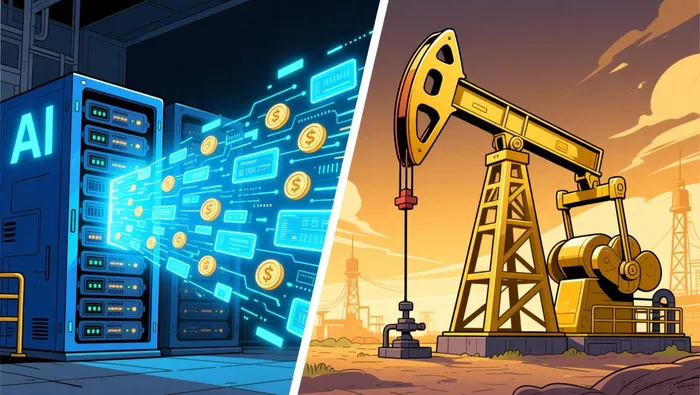
Yet energy funds saw $2.1 billion in outflows following a ceasefire-driven oil price pullback. Roughly $13 billion flowed into U.S.-listed energy equity ETFs in Q1 2026, with XLE absorbing $5.1 billion of that total - and then some of it left again when the narrative shifted.
This is the contradiction: energy is delivering triple-digit percentage gains and single-digit dividend yields, but capital keeps flowing toward AI because the narrative is sexier. The EIA itself forecasts Brent crude peaking in Q2 2026 before declining to $76 per barrel in 2027 on rising supply. That being the case, the New Age of Energy Abundance thesis I've maintained for years - that fracking, horizontal drilling, and AI-driven optimization have structurally expanded supply - is playing out in real time. The short-term spike doesn't invalidate the long-term trend.
For investors who can tolerate volatility, energy still offers the best combination of yield and free cash flow generation in the market. But the flows tell you that most investors don't care about yield. They care about who's winning the story.
Gold: The Incomplete Hedge
Gold tells another part of the story. Annual gold ETF inflows surged to $89 billion in early 2026 - the largest ever recorded - pushing global gold ETF assets under management to an all-time high of roughly $559 billion. Gold prices reached record highs as geopolitical risk, central bank buying, and inflation hedging demand converged.
However, by May 2026, global gold ETF flows slowed to a trickle. AUM declined 2% month-over-month to $604 billion, with Europe the only region registering inflows. The hedge was partially taken, but the commitment wasn't held.
This pattern is familiar: investors buy gold on the way up, sell into strength, and then are left exposed when the next shock arrives. For investors who lack a defensive allocation, gold still makes sense as a ballast position - but it must be held, not traded.
What to Actually Do
The fastest-growing ETFs of 2026 are not a watchlist. They are a concentration diagnostic. The funds attracting the most capital - AI themes, semiconductor baskets, mega-cap growth - are all different wrappers around the same 7 to 10 stocks, at valuations that leave almost no room for disappointment.
That being the case, here is how I think about positioning at current levels:
Your core should still be broad-market, but understand what you own. If your primary holding is an S&P 500 ETF like SPY, recognize that you already have 35–40% mega-cap tech exposure baked in. Layering on AI or semiconductor ETFs amplifies that tilt without adding diversification.
Energy dividends remain undervalued relative to their free cash flow. XLE's 31% YTD gain has not been enough to convince capital to stay, but the underlying companies - Chevron, ExxonMobil, ConocoPhillips - are generating record free cash flow with yields between 3.5% and 4%. Of the energy sector, I favor Chevron for its consistent dividend growth and secure production base.
If you want AI exposure without the thematic premium, buy the infrastructure, not the theme. Semiconductor ETFs like SMH and broad tech ETFs like VGT already give you concentrated AI upside through their mega-cap holdings. The standalone AI-themed funds add expense ratios and complexity for a marginal difference in holdings.
Defensive positioning is not optional at a CAPE of 38. Gold, international value, and cash are not boring. They are the parts of a portfolio that keep you functional when the concentrated trade reverses. For investors who can tolerate short-term volatility, an overweight to U.S. mega-cap value still makes sense. For those who cannot, the allocation should tilt heavier into defensive assets and cash.
The fastest-growing ETFs are telling you what everyone else is buying. The contrarian question - the one that matters - is whether buying the same 7 stocks through different wrappers, at the second-most-expensive valuations in 50 years, is actually a plan.
In my opinion, it isn't. It's a false narrative dressed up as diversification. The structural data says the same thing: the market is concentrated, overvalued, and dependent on flawless AI execution to justify what it's pricing in. The investors who build around free cash flow, dividend yield, and genuine diversification - not thematic overlap - will be the ones who survive when the narrative inevitably shifts.
For investors building a portfolio at current market highs, the allocation that makes sense is: broad-market core, overweight energy dividends for yield and free cash flow, a measured position in gold as a hedge, and a willingness to hold cash until the concentration trade resets. The fastest-growing ETFs can wait for a better entry.