

The paradigm is shifting. While the headlines chase trillion-parameter giants, the real adoption curve for enterprise AI is accelerating on a different track: small, efficient models. The market need is clear. Teams require models that are cheap to serve, fast at inference, and specialized for one concrete job like intent classification or entity extraction. Models in the 1B–8B parameter range offer this promise, but the path to making them work well is the critical bottleneck.
The problem isn't the model size itself. It's the complex, iterative adaptation loop that dominates the engineering effort. As one researcher noted, "Small models are cheap to run, but expensive to adapt." This loop extends far beyond simple fine-tuning. It involves collecting the right data, diagnosing failures, building effective evaluations, avoiding regressions, and deciding when an update is safe. For small models, these upstream decisions frequently dominate the final outcome. The process is non-monotonic and fraught with pitfalls, where a larger dataset can underperform a smaller, higher-quality one, and prompt issues can masquerade as modeling failures.
This creates a classic S-curve adoption challenge. The infrastructure for large models is mature, but the operational friction for small models is high. The result is a market where the potential for cost-effective, low-latency inference remains largely untapped. Fastino's core thesis is that specialized, task-specific small models trained on affordable hardware can outperform general-purpose giants on specific jobs. The startup's approach, backed by $17.5 million in seed funding led by Khosla Ventures, targets this exact gap. By building models that are faster, more accurate, and cost a fraction to train, Fastino aims to lower the barrier to entry for the next wave of AI deployment. The real innovation, however, may lie not just in the model architecture, but in solving the adaptation bottleneck that has kept small models from scaling.
Pioneer's Closed-Loop Architecture: A Paradigm Shift
Fastino's Pioneer isn't just another model; it's a closed-loop system designed to break the adaptation bottleneck. The architecture operates in two distinct modes, creating a continuous cycle that moves AI from static inference to dynamic, self-improving systems.
In cold-start mode, Pioneer acts as an autonomous agent. Given only a natural-language task description, it begins the entire model-building loop: it acquires relevant data, constructs its own evaluation benchmarks, and iteratively trains models. This is the first step toward lowering the barrier to entry, allowing teams to bootstrap a high-performing model without deep initial expertise.
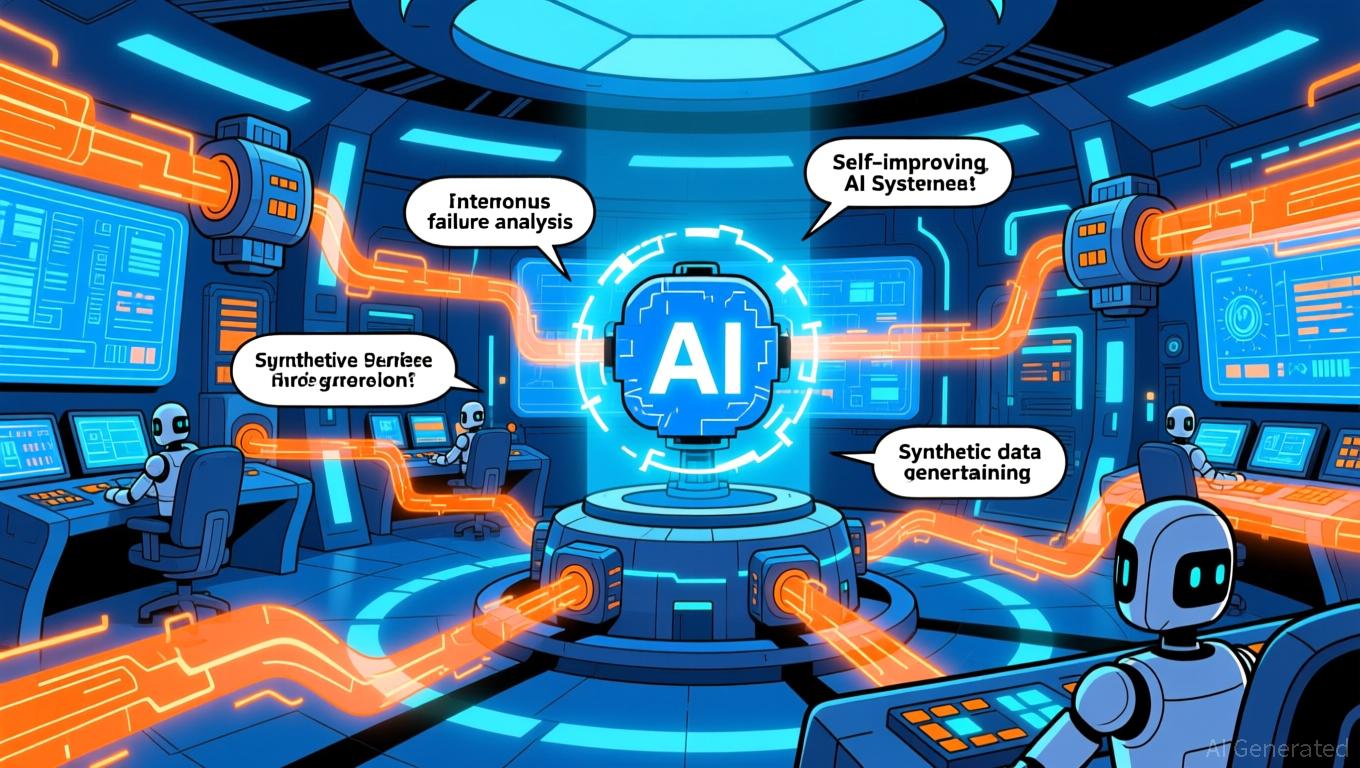
The real paradigm shift happens in production mode. Here, Pioneer treats deployment not as the finish line, but as the start of the learning cycle. It continuously monitors inference outputs, collects and labels failures, and uses those errors to diagnose specific failure patterns. The system then synthesizes targeted new data to address those gaps and performs a retraining run-all under explicit constraints to ensure it does not regress on previously solved tasks. This is adaptive inference in practice: the model improves in production instead of degrading.
The early results demonstrate the power of this closed loop. On a core intent classification task, Pioneer achieved a dramatic performance gain, lifting accuracy from 84.9% to 99.3%. Another benchmark saw Entity F1 scores jump from 0.345 to 0.810. Crucially, these gains came without any regressions across multiple evaluation scenarios. This combination of rapid improvement and safety is the hallmark of a system that has internalized the complex adaptation loop, turning it into a reliable, automated process.
Viewed through the lens of the S-curve, Pioneer represents a fundamental shift in the infrastructure layer for small models. It doesn't just build a better model; it builds a better process for maintaining it. By automating the non-monotonic, data-intensive work that has historically dominated small model engineering, Pioneer accelerates the adoption of efficient, specialized AI. The system turns a major operational friction into a self-reinforcing engine for performance. For teams looking to scale small models, the question is no longer about finding the perfect initial model, but about choosing a system that will keep it perfect in the real world.
Infrastructure Layer Positioning and Financial Build
Fastino's financial build signals serious confidence in its infrastructure play. The company has raised nearly $25 million, including a $17.5 million seed round led by Khosla Ventures. This early capital, backed by a firm with a history of betting on foundational AI bets, validates the startup's core thesis. Its business model is clear: it sells specialized small models and APIs as a service. Fastino isn't just a model shop; it's positioning itself as a provider of production AI infrastructure, offering a suite of task-specific models for enterprise workflows like data redaction and document summarization.
The value proposition is twofold. First, it delivers models trained on affordable hardware that are faster, more accurate, and cost a fraction to train than flagship alternatives. Second, its closed-loop Pioneer system automates the costly adaptation process that has historically plagued small models. This dual offering targets the critical infrastructure layer for the small model S-curve, aiming to replace the fragmented, manual workflows teams currently use.
The key risk is execution. Pioneer must reliably reduce the total cost of ownership for small models enough to justify a switch from established fine-tuning and monitoring tools. The early performance gains are promising, but the system needs to demonstrate consistent, measurable cost savings and time-to-value in real enterprise deployments. The crowded market-competing with established players like Cohere, Databricks, Anthropic, and Mistral-means Fastino must not only build a better loop but also convince teams to adopt its closed ecosystem. For now, the funding is a vote of confidence in the paradigm. The next phase is proving that Pioneer can operationalize the exponential potential of small models.
Catalysts, Risks, and the Path to Exponential Adoption
The path from promising prototype to exponential adoption hinges on near-term milestones that prove Pioneer's value in the real world. The first critical test is successful enterprise deployments that demonstrate a clear reduction in time-to-market and lower operational costs for model adaptation. Teams need to see Pioneer not as a theoretical loop, but as a practical engine that cuts weeks off their iteration cycles and eliminates the manual labor of monitoring and diagnosing drift. The early benchmarks are a strong start, but the real validation will come from public case studies showing sustained performance gains and cost savings in production workflows.
The primary threats to this adoption curve are operational friction and competitive pressure. Pioneer itself may introduce high initial setup complexity, requiring teams to reframe their entire model lifecycle around a continuous loop. There is also a risk of overfitting on synthetic data generated by the system's own failure analysis, a subtle but dangerous pitfall in closed-loop learning. More broadly, the larger players in the AI stack-those with established enterprise sales and integration ecosystems-could integrate similar automation into their platforms. Fastino's advantage lies in its specialized focus, but these giants have the resources to replicate the core functionality, turning the closed-loop architecture into a commoditized feature rather than a differentiator.
What to watch is the adoption rate of Pioneer by Fastino's enterprise customers and any public benchmarks showing sustained performance gains. The company's waitlist and early access program are initial signals, but the real data will be in the deployment logs and the feedback from teams using the system day-to-day. The key metric is not just initial accuracy, but the model's ability to maintain or improve performance over months as tasks evolve and data drifts. If Pioneer can consistently deliver on its promise of adaptive inference, it will accelerate the small model S-curve by solving the most persistent bottleneck. If it falters on usability or gets replicated, the path to exponential adoption will be blocked. The next phase is about proving the paradigm in practice.