

The FOMC minutes dropped May 20 alongside Nvidia's earnings - and the market chose to only read the first one.
The April meeting minutes revealed the hawkish shift that's been building: a majority of Fed officials warned they would likely consider raising rates if inflation persists. Four dissents at the April meeting, the most since 1992. The message was clear enough. Growth stocks sold off. Semiconductor names got hit. Rate-sensitive valuations got punished.
But the same day, Nvidia reported $81.6 billion in revenue - up 85% year over year - with data center revenue of $75.2 billion, up 92%. The company guided Q2 revenue to $91 billion, plus or minus 2%. And despite all of this, the stock trades at 24.6x forward earnings, with a PEG ratio of 0.66.
The PEG ratio divides the P/E multiple by the earnings growth rate. A PEG of 0.66 means Nvidia is trading at less than two-thirds the multiple you'd expect if the market fairly priced its growth. That is not a "rate risk" problem. That is a math problem the market hasn't solved.
The narrative is interest rates. The story is earnings growing faster than multiples compress.
Here's what's actually happening.
1. The inflation number is real - but it doesn't change the business model.
April CPI came in at 3.8% year over year on May 12, up from 3.3%. Core CPI sat at 3.9%, the 34th consecutive month above the Fed's target. These are not trivial numbers. They killed near-term rate cut hopes and set up the hawkish tone in the FOMC minutes.
But here's what this does not do: it does not change the fact that hyperscalers have contracted AI infrastructure spending into multi-year commitments. Nvidia's $75.2 billion data center quarter was not aspirational - it was a report of what already happened. The Q2 guidance of $91 billion is what management expects next. Rate anxiety does not retroactively cancel signed contracts.
2. The semiconductor selloff was macro noise, not business deterioration.
Semiconductor stocks did something not seen since the dot-com bubble burst - they hit the most overbought reading in years, then got whipsawed by the CPI and FOMC print. The PHLX Semiconductor index fell 3% on one day, bounced 2.6% the next, then got hit again on May 17 as hot CPI data wiped out rate cut hopes across the sector.
This is a multiple story, not an earnings story. The companies are executing. The macro is the distraction.
3. Micron's setup is the same pattern, starker still.
Micron has seen its stock surge more than 500% over the past year on exploding HBM (high-bandwidth memory) demand - the memory chips AI accelerators need to function. Despite that run, the stock trades at roughly 11x forward earnings with a PEG ratio near 0.07. A PEG that low means the market is pricing Micron as if its earnings aren't going to grow, even though the company is in the middle of a memory cycle that historically runs years, not months.
When the same macro panic that hit Nvidia also hit Micron, the disconnect widened. A company trading at 11x earnings during an AI memory supercycle is not expensive. It's cheap, with a side of panic discount.
4. The forward multiple gap is the real headline.
Nvidia at 24.6x forward earnings with 85% revenue growth. Micron at 11x with a 500% stock surge still leaving the PEG near zero. These are not valuations that reflect the earnings trajectory.
Higher rates do compress multiples. That's textbook finance. But when earnings are growing at 85%, a multiple that shrinks from 25x to 20x still leaves you with a stock that grew 65% on an earnings basis. The math works both ways - the market just keeps reading one direction.
The break condition.
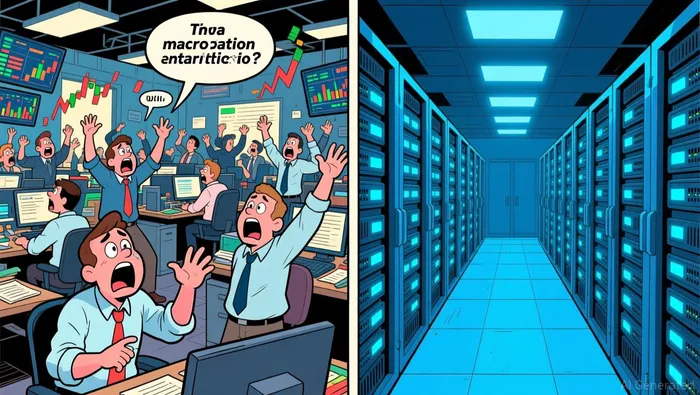
The gap between rate anxiety and earnings power closes when inflation prints cool enough to put rate cuts back on the table, or when the next round of earnings shows growth decelerating. Until then, the market is running two stories simultaneously: a Fed story that says "sell growth" and an earnings story that says "buy growth." One of them has to lose.
The risk is clear. If inflation stays above 3.5% and the Fed actually raises rates, the multiple compression could outpace earnings growth for long enough to make this painful. But that's a macro call, not a company call. Nvidia's backlog and Micron's HBM sellout are not contingent on the Fed's mood.
At 24.6x forward earnings on 85% revenue growth, Nvidia doesn't price in the deceleration the market fears - it prices in none of it. At 11x, Micron prices in a memory cycle that's already in the rearview. Both are cheap by the metrics that actually determine whether a stock makes money.
The Fed minutes are real. The earnings are real. The market just can't hold both in the same headline.