

The macro-wranglers are in a panic. You should be looking at data center teardowns.
The FOMC minutes from the April 28–29 meeting dropped on May 20, 2026. The committee held rates at 3.50%–3.75%. Inflation remains elevated, partly from tariff-driven price pressures. Some members dissented in favor of cuts. The financial media has declared a "big shift" and warned that a "historically pricey stock market" may be upended.
It is not as good as it looks - because the entire framing is backward.
The S&P 500's Shiller CAPE ratio (price-to-10-year-average earnings, the standard long-term valuation gauge) sits at roughly 41.6, more than twice its long-run average near 17.3. Only the December 1999 dot-com peak reads higher. The forward P/E is 20.9. The market is historically expensive. That part is true.
But the reason it will bend or break has nothing to do with what 12 Fed governors wrote in a committee minutes document. It has everything to do with the gap between the AI infrastructure spend that justifies these multiples and the physical buildout that cannot deliver on schedule.
The Warsh productivity delusion
Kevin Warsh, sworn in as Fed chair on May 13, has built a policy thesis: AI will drive productivity gains, productivity is disinflationary, therefore the Fed should cut rates to support the transition. He was once known as a rate hawk. Now he is pitching rate cuts based on a technology that has not yet produced measurable macroeconomic productivity gains.
This is the kind of CEO-grade technological faith that BTH has been warning readers about. An astute semiconductor analyst knows that AI infrastructure is not a productivity engine - it is a capital expenditure engine. The productivity gains, if they materialize, will lag the buildout by years. But the capex is hitting the balance sheets now.
Big Tech - Alphabet, Microsoft, Amazon, and Meta - is on track to spend between $635 billion and $665 billion in their respective 2026 fiscal years on AI infrastructure. Some estimates push the combined total to $725 billion, up 77% from last year. Meta alone raised its 2026 spending forecast to $125–$145 billion.
That is the denominator of every AI stock thesis right now. The market is pricing in flawless execution of $700+ billion in infrastructure spend that generates meaningful revenue returns within a reasonable timeframe.
Except the infrastructure isn't being built.
Half of 2026's data centers won't come online
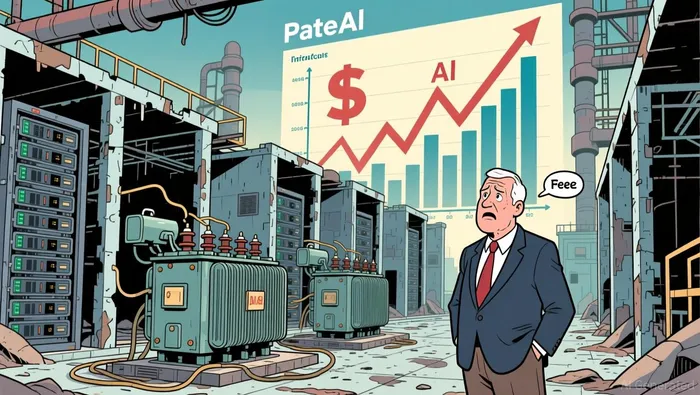
According to Bloomberg, roughly half of the planned U.S. data center builds for 2026 are projected to be delayed or canceled. Of approximately 12 gigawatts of new U.S. data center capacity planned, about 7 gigawatts are at risk. The reasons are physical, not financial: transformer shortages, grid interconnection delays, and power constraints that no amount of capital expenditure can solve overnight.
The average cost to bring a 250-megawatt AI data center online is roughly $12 billion, inclusive of the equipment inside. You can throw $725 billion at the problem. You still cannot manufacture electrical transformers faster than the grid can absorb them.
This is the contradiction the Fed minutes narrative entirely misses. The market is pricing in an AI infrastructure buildout that is physically stalling. The Shiller CAPE of 41.6 assumes these data centers ship on time, get loaded with GPUs, and start generating revenue. They aren't.
Why tariff inflation matters more than you think - for semiconductors
The Dallas Federal Reserve estimated that tariffs increased 12-month core PCE inflation by approximately 0.80 percentage points through March 2026. Fed research showed tariffs raised core goods PCE prices by 3.1% through February 2026. The FOMC minutes acknowledged that tariff-related inflation effects may ease in the second half of the year - but "may" is not "will."
This matters for the semiconductor supply chain because a significant portion of AI infrastructure hardware - from components in servers to the chips themselves - moves through global supply chains that are increasingly tariff-exposed. The disinflation Warsh is counting on depends on AI productivity outpacing these cost pressures. So far, the cost pressures are visible and the productivity is not.
The cross-currents
The cross-currents are: (1) Warsh's dovish rate-cut bias, which could ease financing costs and temporarily support overextended valuations; (2) tariff inflation, which is still elevated and structurally embedded in goods pricing; and (3) the physical collapse of half the planned 2026 data center buildout, which directly threatens the revenue assumptions underpinning AI chip demand.
Directionally, factor three dominates. If 7 GW of planned capacity goes dark, the GPU and networking equipment that was ordered for it sits in someone's inventory - or gets canceled. Either way, the demand thesis for AI infrastructure semiconductors takes a hit that no rate cut can repair.
The minutes are a distraction. The data center teardowns are the thesis change.
The investor implication is clear: the S&P 500's CAPE of 41.6 is being sustained by capex commitments that are physically failing to execute. The market needs to price in that not all of the $725 billion in Big Tech infrastructure spend will translate into shipped racks, loaded GPUs, and revenue-generating AI services. When that repricing happens - and it will - it won't be because the Fed changed its mind. It will be because transformer delivery schedules and grid interconnection timelines are not swayed by monetary policy.