

Beyond The Hype has been tracking Ferrari's EV strategy since the company first signaled it was entering the electric arena. The pattern was visible early: Ferrari treats EVs as brand exercises, not volume plays. The Luce launch confirms that thesis.
The headline you're reading right now says "Ferrari launches €550,000 electric speedster." There are two problems with that sentence. Both matter.
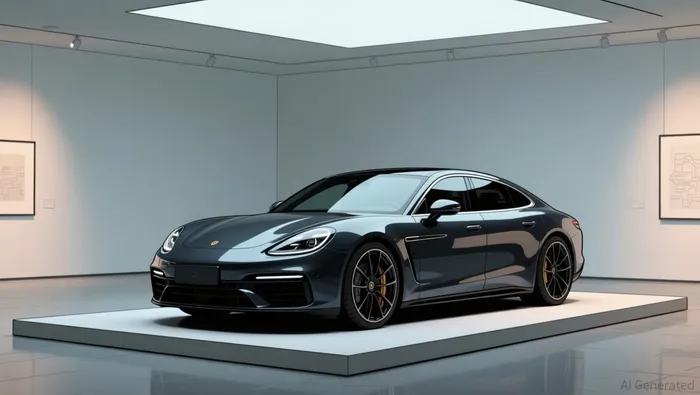
First, it's not a speedster. The Ferrari Luce is a five-seat luxury sedan - a full-size luxury sedan with four doors, not a two-seat track toy. It doesn't even look like a Ferrari in any traditional sense. Car and Driver classified it as a hatchback. Ferrari's own marketing calls it "a new chapter" and "a new icon, in the making." That is PR-speak for: we built something so different from our DNA that we need to ask you to believe it's still us.
Second, the price tag buys you design, not engineering. At €550,000 - roughly $640,000-$647,000 - the Luce costs more than a Porsche Taycan Turbo S and approaches LaFerrari territory. You are paying Ferrari prices for a first-generation EV whose battery technology, charging architecture, and performance figures are exactly what you'd expect from any well-funded OEM in 2026. Nothing in the spec sheet proves Ferrari has an EV advantage. It proves they hired good people and spent enough money.
The Jony Ive factor is an interior job
Jony Ive's name is doing heavy lifting in the marketing narrative. He co-founded LoveFrom, the design collective that collaborated with Ferrari - along with Marc Newson - on the Luce's cabin. Ive eliminated carbon fiber from the interior, killed the touchscreen, and installed glass panels and analog-digital hybrid dials where competitors cram screens.
This is good design. It's also entirely irrelevant to whether the Luce is a competitive electric vehicle. Ive designed the interior. He did not engineer the battery pack, the powertrain, the thermal management system, or the weight distribution. He made a $640,000 car feel more like an Apple Store than a garage.
Any astute engineer would have recognized this immediately: interior design is a premium accessory, not a platform advantage.
The specs are competent, not differentiated
Ferrari claims the following for the Luce:
- 1,000+ horsepower across four electric motors
- 0 to 62 mph in just 2.5 seconds, top speed 193 mph
- 122 kWh gross battery pack with claimed 195 Wh/kg energy density
- 330 miles range (WLTP European test cycle)
- 350 kW DC fast charging, 10–80% in roughly 20 minutes
- 880V architecture, 75% carbon fiber chassis
- Rear-wheel drive layout
Read that list against any other 2026 EV flagship - the Lucid Air Sapphire, the Porsche Taycan Turbo GT, the Rimac Nevera - and you'll find nothing that separates the Luce at an engineering level. The 195 Wh/kg energy density Ferrari touts as "setting a new industry standard" is precisely what commercially available LMFP and high-end NMC cells deliver in 2025-2026. That's not Ferrari innovation; that's Ferrari buying what's on the shelf.
The 330-mile WLTP range translates to roughly 250-260 real-world miles in EPA terms. That's acceptable. It's not remarkable for a car priced at a quarter-million euros over a comparable Porsche.
The specs say "we kept up." They don't say "we led."
Here's what Ferrari won't put on the spec sheet
Last June, Reuters reported that Ferrari delayed its second EV model from 2026 to at least 2028 because of "zero" demand from customers. An insider source described customer interest as essentially "zero." That is not a company scaling an EV strategy. That is a company hitting the brakes on one.
Consider the full picture: Ferrari plans to launch 20 new models between 2026 and 2030. The Luce is one of five debuts in 2026, but the second EV has already been pushed two years out. Ferrari's revenue target is €9 billion by 2030 - up from €7.1 billion in 2025 - implying 6-9% annual growth. That growth doesn't come from EVs. It comes from continuing to sell 13,000-14,000 combustion-engine Ferraris per year at ever-higher margins through personalization and option packages.
The Luce exists to check a box. It exists to show that Ferrari can build an EV if someone forces them to. It does not exist because Ferrari believes electric cars are the future of their business. Their own internal demand data says otherwise.
What the stock already knows
Ferrari shares (RACE) have traded around $347 in recent sessions - down sharply from the €480 range that characterized 2024 and early 2025 before falling below €300 in January 2026. The market didn't panic because the Luce is bad. The market priced in the reality that Ferrari's EV story is a footnote, not a growth engine.
Q1 2026 gave Ferrari a $2.69 EPS beat against $2.37 consensus, with revenue of $2.14 billion beating estimates by nearly 17%. The driver? Strong personalization demand on combustion models. Not EVs.
The investor-grade read
The cross-currents here are clear:
- Ferrari is a profitable, cash-rich company with pricing power in its core combustion segment. That hasn't changed.
- The Luce is a technically competent first-gen EV that costs as much as a limited-edition halo car because it is one. It will not move volume.
- Ferrari has already signaled it does not plan to build many EVs, by delaying the second model and targeting modest overall growth.
- The stock's decline from its peak reflected the market recognizing that the EV narrative doesn't add to Ferrari's valuation - and the Luce launch doesn't reverse that.
You decide which was marketing fluff and which one was analysis.
The Luce is not evidence that Ferrari is conquering the electric future. It's evidence that Ferrari can afford to treat its first EV as a €550,000 art project instead of a platform bet. For a company with Ferrari's margins and its customer base, that may be the rational play. But it means the stock's trajectory continues to be driven by combustion-engine production volumes, pricing discipline, and how long the brand premium holds - not by whether the Luce can keep up with the Taycan on a spec sheet.
The market already knows this. The Luce won't change its mind.