

Here is the thing about iOS 27: it is being built for a phone that does not exist yet. Or maybe it does, and it just can't come out in September because the hinge keeps failing.
The competitor headline - that iOS 27 is "filled with hints" about Apple's foldable - is technically true and practically useless. The real story is not what software features are hiding in the code. The real story is that Apple is trying to enter a hardware category where the incumbent is still not making money on every unit, the physics of folding glass are apparently unresolved, and Apple's own trial production is stalling over the same mechanical component that has dogged Samsung since day one.
Let's start with the basics. The foldable iPhone, which the reporting calls the "iPhone Ultra," is supposed to launch in September 2026. It has a 7.8-inch inner display, a liquid metal hinge, and when you open it up, iOS 27 is supposed to give you something that looks a lot like an "iPad-like interface when opened" - split-screen multitasking, two apps side by side, the whole thing. That is what the iOS 27 feature list is actually preparing for. Not "hints." Preparations.
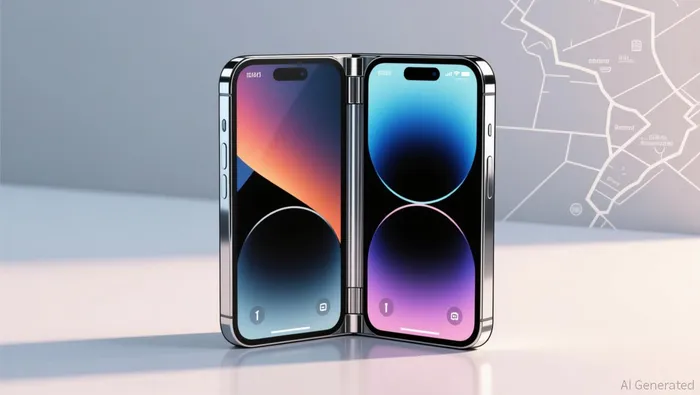
The weird part is not that Apple is building software for a device that hasn't shipped. That's what software companies do. The weird part is the hinge.
As of mid-May, Apple's trial production of the foldable ran into what the reports describe as a "significant engineering challenge" centered on the hinge mechanism and surface-mount technology issues during pre-assembly. One leaker pointed to a potential delay all the way to 2027. Apple has pushed back and says September is still on track - an April report said Apple had built in a two-month production buffer - but you can feel the tension in the supply chain.
Why does the hinge matter enough to carry the whole story? Because the hinge is the economic unit of the entire foldable category. It is the thing that determines cost, reliability, margin, and whether the device is a premium product or an expensive experiment. If the hinge does not work, the phone does not ship. If the phone does not ship in September, iOS 27 ships with half its reason for existing.
Now, let's put this in a frame. The foldable phone market is something that Samsung spent roughly six product generations teaching itself about. The Z Fold 7 launched last year at $1,999 - a $100 increase over the previous generation - and even that came after Samsung was reportedly absorbing costs to keep prices in check. A Kotaku report from November described Samsung's foldable strategy as a "zero-profit gamble". Then, in April of this year, Samsung quietly raised the price of the 1TB Z Fold 7 from $2,420 to $2,500, mid-cycle. That is the signal of a company still trying to figure out the math.
The Galaxy Z Flip 7 pre-orders were up 25% from the prior generation in the US, with carrier pre-orders up nearly 60%. That sounds good until you remember that Samsung is apparently losing money on each Galaxy Z Trifold it sells. The category is growing - analysts project 20-30% year-over-year growth in 2026 - but the economics are still a construction site.
Apple's entry is supposed to be the moment that changes that. Counterpoint Research projects Apple will capture 28% of the foldable market in 2026 alone, approaching Samsung's lead. IDC expects the overall market to grow 30% year-over-year, driven by Apple's first foldable. UBS has modeled an entry price as low as $1,800 - cheaper than Samsung's current flagships. Samsung Display, which is apparently shipping around 11 million sets of inner and outer panels for Apple's foldable, is one of the main beneficiaries of an Apple that funds its rival's component business while trying to displace its rival's product.
That is a funny triangle. Apple pays Samsung Display for screens. Samsung Electronics loses money on foldable phones. The market grows because Apple finally ships one.
Here is the structural frame: the foldable phone is a margin play that has not yet found its margin. Samsung built the category at a loss, betting that volume and supply-chain maturation would eventually make the economics work. The evidence so far - mid-cycle price hikes, zero-profit gambles, loss-making Trifolds - suggests the economics are still not there. Apple, the company with the highest hardware margins in the industry, is now walking into the same mechanical problem (the hinge) and the same cost structure (Samsung-sourced panels) at roughly the same price point.
So the question is not whether iOS 27 will work on a foldable. It is whether Apple can sell a device that costs more than $1,800 in a category where the pioneer cannot make money, with a supply chain that runs through the pioneer's display division, and a hinge that is apparently too hard to manufacture at the scale Apple demands.
Some of the reporting is optimistic. Apple reportedly solved the crease problem - the visible line running down the middle of every current foldable - which would be the kind of quality advantage that justifies Apple's pricing premium. Apple also reportedly has a wider design than competitors, which may mean a different hinge geometry and different failure modes. The iPhone 17 lineup saw record-breaking demand, which suggests Apple's customer base is still willing to buy whatever Apple puts in front of them, even at premium prices.
But here is what the reporting does not tell us, and it is important to say that out loud: nobody knows what Apple's cost of goods looks like for this device. Nobody knows whether the hinge can be manufactured at Apple's quality standards and Apple's volume requirements. Nobody knows if September 2026 survives the next month of production data.
The simplest model is this: if Apple ships on time at $1,800+, the foldable market roughly doubles in scale and Samsung Display becomes richer while Samsung Electronics gets competitive pressure it may not survive profitably. If Apple slips to early 2027, iOS 27 ships with software features no one can use yet, the narrative turns from "Apple validates the category" to "Apple is as bad at timing as ever," and Samsung gets another full year to harden its lead in a category it barely makes money on anyway.
Either way, the hinge decides everything.
The iOS 27 feature list is the wrong lens. The features - split-screen multitasking, adaptive app layouts, iPad-like interface when unfolded - are just Apple finally admitting that the foldable is a tiny tablet that fits in your pocket. That is not a revelation. It is the definition. The interesting question is whether Apple's version of the tiny-pocket-tablet is economically viable, or whether it is just another example of Apple entering a category late, paying Samsung to build it, and hoping its brand carries a category that Samsung couldn't make carry itself.