

The European Commission announced Chips Act 2.0 on June 3 - a policy package designed to make Europe "technologically sovereign" in semiconductors and AI. That announcement should be the frame for anyone thinking about European AI investment this month. Not penny stocks.
Penny stock watchlists are what you write when you don't understand the supply chain. The real story in Europe's AI infrastructure isn't cheap, unknown companies hoping for a narrative tailwind. It's a handful of companies already sitting at the choke points of the global AI buildout - and a policy push that's trying, imperfectly, to multiply their moats.
The one company the rest of Europe's AI depends on
ASML raised its 2026 revenue forecast in April to €36–40 billion, up from the previous €34–39 billion range. The stock has surged roughly 35% year-to-date, with a market capitalization near €670 billion. It is, by far, Europe's most valuable company - and the only company on the continent that no major chipmaker can do without.
Here's why that matters. ASML is the sole supplier of extreme ultraviolet (EUV) lithography machines - the equipment that prints the circuit patterns on the most advanced AI chips, including Nvidia's H100, H200, and Blackwell GPUs. There is no alternative. If you want to manufacture chips at 5nm, 3nm, or beyond, you go through ASML. That is not a competitive advantage. That is a monopoly enforced by physics - the EUV technology is so complex that no other company has replicated it, and the capital cost to even try runs into the tens of billions.
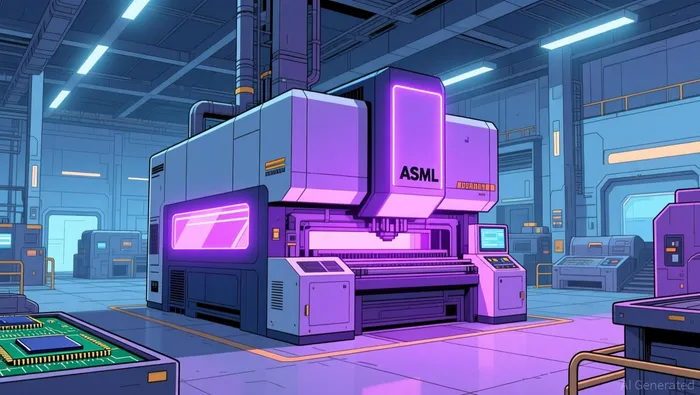
The raised guidance tells me something about the direction of AI capex that is more reliable than any analyst estimate. ASML doesn't guess. Its machines take months to build and are booked years in advance. When it lifts a guidance range, it means its customers - TSMC, Samsung, Intel - have already committed to more orders than expected. The AI infrastructure build-out is not slowing; the equipment layer is confirming it.
Chips Act 2.0: what it is, and what it isn't
The Commission's Chips Act 2.0 proposal aims to strengthen Europe's semiconductor ecosystem beyond the emergency-response framework of the original Chips Act. It's part of a broader "tech sovereignty package" that includes AI governance and investment measures.
But here's the distinction the market tends to miss: policy sovereignty and supply-chain reality are not the same thing. Chips Act 2.0 can incentivize fabs, design houses, and packaging facilities in Europe. It cannot replicate ASML's EUV moat through legislation. The act is a multiplier on existing strengths, not a creation engine for new monopolies.
What this means for investors is that the beneficiaries of Chips Act 2.0 will be companies already embedded in the supply chain - ASML at the equipment layer, Siemens at the industrial infrastructure layer, and smaller semiconductor equipment and materials suppliers that ride the wave. The act doesn't create new winners from scratch. It subsidizes the ones that are already winning.
I've seen too many "European AI play" articles that treat policy announcements as if they transform overnight into earnings. They don't. The pipeline from subsidy to revenue is three to five years, and even then, execution risk is real. Listen to what management teams say about capacity and orders, not to what Brussels promises about strategic autonomy.
The private startups retail investors can't buy
European AI chip startups raised significant funding this year. Euclyd, a Belgian company building a dataflow-based chip architecture called Craftwerk, is seeking at least $100 million in a major funding round. Their approach is structurally different from GPUs - instead of spending energy shuttling data between processor and memory, the architecture moves computation closer to where the data lives, which theoretically delivers higher efficiency for inference workloads.
That architecture distinction is exactly the kind of product-level detail that matters. If Euclyd or similar startups can deliver inference chips that are materially more efficient than GPUs at scale, they could erode the CUDA moat from the inference side - the same dynamic that makes AMD interesting in the US market. The training-to-inference transition is where architectural alternatives have the best shot at gaining share.
But here's the constraint: these companies are private. Retail investors looking for "European AI stocks to watch" can't buy them. The capital that gets early access to this layer is venture money, sovereign wealth, and strategic corporate investors - not the public markets. By the time an AI chip startup IPOs, if it IPOs, the architecture question will either be resolved or the company will have failed.
This is what separates the European AI story from the penny stock listicle: the interesting companies aren't cheap, they're not public, and they're not on anyone's watchlist because they don't exist on an exchange.
The power bottleneck nobody is solving with stock picks
The World Economic Forum published an analysis in May pointing to what it calls Europe's constraint: "speed to power." Europe remains a complex environment for building data centers at speed, with electricity prices higher than in the US and grid infrastructure that wasn't designed for the power density of AI workloads.
The EU has set a target to triple its data center capacity by 2035. But you can't legislate power plants into existence on a timeline that matches hyperscaler capex. Big Tech is estimated to spend roughly $650–700 billion globally on AI infrastructure in 2026, and Europe's share of that spending is constrained not by policy ambition but by whether the grid can handle it.
This power bottleneck is a supply-side constraint that changes how I think about European AI infrastructure allocation. It means European data center operators and power-infrastructure companies could benefit from the squeeze - but it also means Europe won't host a proportional share of the inference workloads that are going to define the next phase of the AI cycle. That workloads distribution question matters more than any penny stock screener.
Where the capital goes
The debate isn't whether Europe has AI investment opportunities. It is whether those opportunities look like what the penny stock watchlists promise. They don't.
If I'm allocating capital to European AI infrastructure, I'm looking at ASML first - not as a growth stock but as the toll booth on every advanced AI chip that gets manufactured. The raised guidance, the monopoly economics, the fact that Chips Act 2.0 reinforces rather than threatens its position: that's a supply-chain conviction, not a valuation play. The stock at €670 billion market cap with a trailing P/E near 58x is not cheap, but the moat is structural, and the order pipeline is the leading indicator on AI capex that I trust more than consensus estimates.
Siemens is the secondary layer - industrial AI infrastructure that benefits from both the Chips Act ecosystem and the broader digitization of European manufacturing. Q2 FY2026 showed 6% comparable revenue growth to €19.8 billion, which is steady but not explosive. Siemens is an AI adapter, not an AI core play.
The penny stocks? I'd avoid them. In a market transition this fast, cheap companies with no architecture, no supply-chain position, and no developer adoption are expensive traps regardless of what the screener says.
The break condition for this view is simple: if ASML's order pipeline starts decelerating - if the EUV bookings slow while its competitors' capex doesn't - then the supply-chain thesis weakens. Until then, the equipment layer tells me the AI build-out is still accelerating, and Europe's most valuable asset is the only company that can sell the machines to build the future.
The question isn't whether European penny stocks will surprise you this month. The question is whether you're positioned in the companies that are already supplying the buildout - or chasing narratives that the market has already priced into the wrong places.