

The immediate financial footprint is stark. The Ethereum-based NFT marketplace Foundation has permanently ceased operations, with its founder citing a failed sale as the reason. The platform had facilitated roughly $230 million in primary sales since its launch, a significant volume that now represents stranded liquidity and a broken value chain.
This closure is not an isolated incident but part of a broader, accelerating trend. Over 20 crypto projects have shut down in the first quarter of 2026, including other NFT platforms like Nifty Gateway and MakersPlace. The pattern points to a market in consolidation, where the capital and user growth of previous cycles have dried up.
The event itself was a drawn-out unraveling. Ownership was transferred to buyer BlackDove in January, but due diligence revealed the buyer would build its own platform instead. With no viable alternative sale, Foundation's infrastructure was spun down, marking the end of a curated art venue that hosted landmark auctions.
The Flow Impact: Liquidity and Volume Collapse
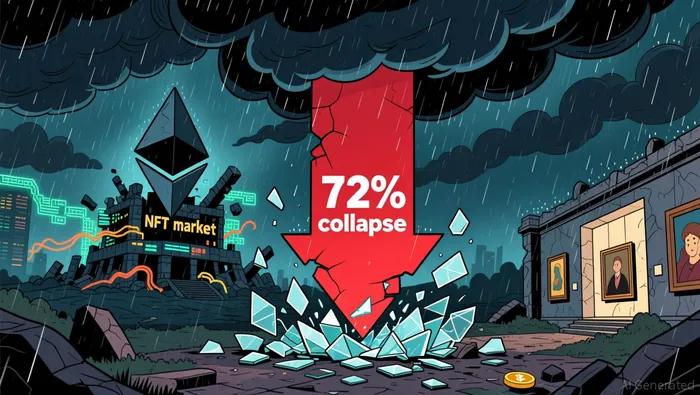
The shutdown removes a dedicated venue for new NFT issuance, likely compressing primary market volume. Foundation had facilitated roughly $230 million in primary sales, a flow that now ceases. This contributes to a market already in severe contraction, where total market capitalization for NFTs experienced a massive 72% collapse throughout 2025. The loss of this platform accelerates the death spiral of a sector where approximately 96% of all NFT collections are now considered "dead".
Despite this collapse in NFT-specific liquidity, Ethereum's price action shows remarkable resilience. The network's native token is trading above $2,300, with recent data showing it at $2,343.40 earlier today. This stability is notable given the broader crypto market's sensitivity to platform failures and the recent permanent closure of the Ethereum NFT marketplace Foundation.
The divergence suggests Ethereum's value is being supported by flows beyond the NFT sector. The network's utility as a decentralized computing platform for DeFi, stablecoins, and other applications appears to be absorbing the shock. The price resilience, even as NFT volume and market cap evaporate, points to a core layer of demand that is decoupling from speculative art tokens.
The Catalyst: What to Watch for Market Recovery
The path to recovery hinges on a few critical flow metrics. First, watch for a sustained increase in NFT trading volume on the surviving major platforms. The market's ability to consolidate liquidity into a few dominant venues like Magic Eden and Blur will signal whether the sector is stabilizing or simply bleeding out. A volume rebound would be the clearest sign of capital returning to the primary market.
Second, monitor Ethereum's price stability as a leading indicator. The network's recent climb above $2,100 marks a key technical milestone, but a decisive break below that level could signal deeper risk-off sentiment spilling into the NFT sector. Ethereum's price is the bedrock for all on-chain activity; its resilience is non-negotiable for any NFT recovery.
Finally, the scheduled shutdown of Magic Eden Wallet on May 1st will be a crucial test. This event will reveal whether liquidity is merely consolidating within the Solana ecosystem or if it is fleeing the entire NFT category entirely. The market's reaction to this specific closure will provide a real-time read on the health of the remaining liquidity pools.