

Fox agreed on June 15, 2026 to buy Roku for $160 a share in cash and Fox Class A stock, valuing the streaming platform at about $22 billion in enterprise value. Monday's market reaction turned that headline into a sharper question for Fox shareholders, because the deal asks them to finance a larger connected TV platform while accepting new debt, a fixed stock exchange ratio and a closing process that runs into 2027.
Price action gave the announcement its first market verdict. A Reuters market page carried by Investing.com listed FOXA down 16.85% and ROKU down 1.92%, while a Reuters-distributed report carried by The Edge had earlier put Roku near $144.60, below the $160 offer. The spread does not cancel the strategic logic, but it shows the market treating streaming scale as something Fox still has to fund, integrate and defend before the headline premium becomes cash value. For the two tickers, FOXA is the acquirer equity and leverage exposure, while ROKU is the target spread and stock-leg exposure.
Streaming scale is the prize Fox is buying
Buying Roku would move Fox from owning live sports, news and Tubi content into owning a larger distribution and data layer. The companies said the combination would create the third-largest U.S. television player by share of viewing and keep Roku as an open, partner-friendly platform, with Roku reaching more than 100 million global streaming households.
Roku's SEC-filed first-quarter shareholder letter showed platform revenue of $1.13 billion, up 28% year over year, including advertising revenue of $612.7 million and subscriptions revenue of $518.5 million. Fox is buying a home-screen advertising channel and subscription marketplace at a moment when linear-TV reach keeps moving toward connected TV interfaces.
Strategic fit still needs economic discipline. Fox's portfolio gives the combined company live NFL, MLB, NASCAR, Big Ten, FIFA World Cup, Fox News and Fox Business programming, while Roku brings the operating system, home screen and first-party viewer relationships. A stronger ad platform would be the payoff; a weaker outcome would leave Fox with a larger balance sheet and the same pressure from cord cutting.
Fox's share price now sets part of Roku's payout
The $160 headline price is not all cash. Fox said each Roku share would receive $96 in cash plus 0.9693 Fox Class A shares, with the stock portion valued at $64 based on a $66.03 ten day volume weighted average price through June 10. Once the market marked Fox shares lower, the fixed exchange ratio made the stock leg part of the deal risk rather than a static number because Roku holders receive a share count, not a guaranteed $64 stock payment.
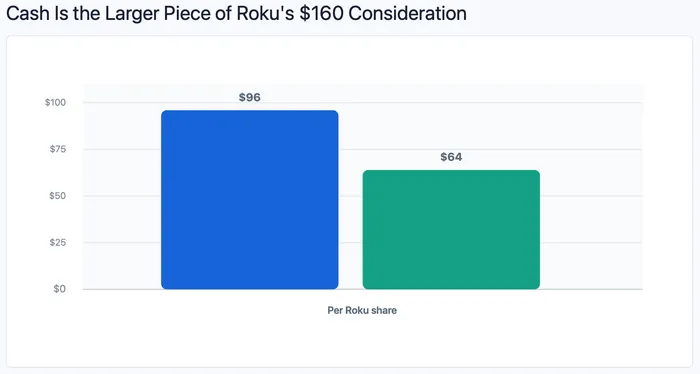
Source note from Fox and Roku transaction terms. Symbols FOXA and ROKU. Date range announced June 15, 2026 with stock reference price as of June 10, 2026. Interval transaction term. Basis $96 cash consideration and $64 Fox Class A stock reference value, not Monday trading price. Fox and Roku transaction terms
Roku's discount to the offer is therefore a useful signal, not a contradiction. A target can trade below a signed cash and stock bid when the stock component moves, when approval timing is long, or when the market assigns risk to financing and execution. Here, Roku shareholders would own about 27% of the combined company, so their final value depends partly on whether Fox can make the merged advertising platform worth the equity dilution.
For Fox shareholders, the same structure cuts both ways. Paying $96 in cash limits how much new stock Fox issues, but the remaining stock component still hands Roku owners a material claim on the combined company. The market reaction suggests Fox has to show that control of Roku's interface and data can earn more than the dilution costs.
Synergies need to offset leverage and dilution
Fox gave the market a financial bridge, but not yet a full operating bridge. The companies said the transaction should be accretive to free cash flow per share by the second full year after closing and should produce about $400 million of run-rate cost synergies, with additional revenue upside. Those numbers set the hurdle for a deal that moves Fox deeper into advertising technology, subscriptions and connected TV discovery.
Financing explains why the market did not simply price the acquisition as a platform win. Fox expects to fund the cash portion with new debt and cash on hand, backed by $12.0 billion of fully committed bridge financing, and said pro forma net leverage should be about 2.8 times at closing after giving 50% credit for run-rate cost synergies. The first S-4 and debt disclosures now matter because they will show how much flexibility Fox keeps for sports rights, buybacks and streaming investment.
A supportive read is that Fox is paying for a scarce connected TV operating system while keeping Roku open enough to avoid alienating streaming partners. The weaker read is that Fox is buying distribution at a moment when every large media owner wants better ad targeting, and the industry already has consolidation pressure from larger studio and network combinations. Without revenue synergy detail, the $400 million cost line carries more of the near-term burden than it should.
Regulators and shareholders still own the calendar
The deal is not closing tomorrow. Fox and Roku said the transaction requires Fox and Roku shareholder approvals, U.S. and certain non-U.S. regulatory approvals, and other customary conditions, with closing expected in the first half of calendar 2027. That timeline leaves several months for Fox's share price to affect the implied value of the stock consideration.
Approval mechanics help but do not remove timing risk. Anthony Wood and related entities that hold at least a majority of Roku voting power agreed to support the transaction, and LGC Holdco agreed to support the Fox share issuance. AP also noted that the acquisition still needs shareholder and regulatory approval, with Roku continuing as an open, partner-friendly platform after the transaction.
Regulatory risk is not only about whether Fox can buy Roku. The more practical question is whether Fox can own a major TV interface while keeping enough partner neutrality to preserve Roku's distribution value. Any condition that limits data use, content placement or platform economics would change the revenue-synergy case even if the deal still closes.
Filings and ad data become the next checkpoints
The next evidence does not come from another headline premium. It comes from the Form S-4, the financing details, shareholder votes, regulator comments and Roku's advertising trend. Roku's own first-quarter letter already gives a baseline by showing advertising revenue up 27% year over year to $612.7 million, with 60.5% advertising gross margin.
Fox can improve Monday's market read if filings show manageable debt terms, clear cost actions, protected Roku partner access and credible ways to sell ads across live sports, Tubi and the Roku home screen without weakening the platform's neutrality. A tougher tape would come from a wider deal spread, lower Fox shares, slower ad momentum, heavier leverage terms or regulatory conditions that narrow the data and discovery benefits.
The market has not rejected the idea that Fox needs Roku. It has put a price on the path from scale to cash flow. Until the filings and ad disclosures make that path more concrete, the deal is less a victory lap for streaming consolidation than a financing and execution hurdle attached to one of connected TV's most valuable distribution assets.