

The Fragrance Foundation held its 2026 awards ceremony at Lincoln Center on June 11th - a gilded evening where Honorine Blanc received the Lifetime Achievement honor and Michael Edwards took home the Game Changer Award. The industry shows up to celebrate. But for investors, the story isn't what happens on stage. It's what's happening off it: the most dramatic operational split between two publicly traded fragrance houses in a generation.
Coty, once the prestige fragrance growth story, is now trading at a $2 billion market cap - near a 52-week low of $1.93, down over 37% year-to-date. Estée Lauder is running the opposite tape, with a $32 billion market cap, operating margins surging 360 basis points to 15% in the latest quarter, and fragrance division sales growing double digits year-to-date.
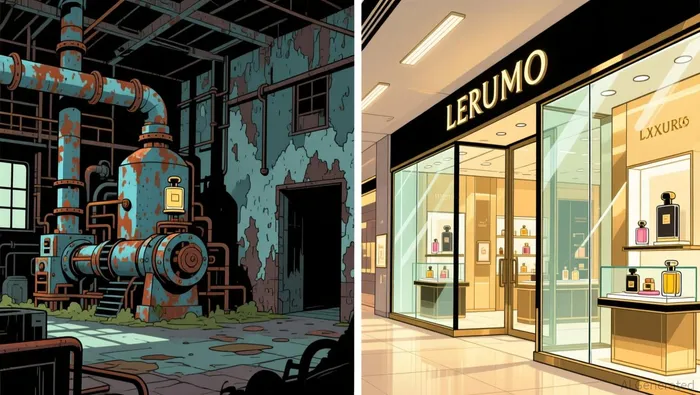
Same category. Same awards night. Two completely different businesses. Here's where the market has each one right - and where it might be getting it wrong.
Coty: the write-downs don't lie
The structural problem at Coty isn't sentiment. It's the $362 million brand impairment the company recorded in Q3 of fiscal 2026. That write-down hit its mass beauty portfolio - brands like Rimmel, Covergirl, and Max Factor that together generate about $1.2 billion in annual revenue. A $362 million hit on a $1.2 billion revenue base means the market is telling Coty those brands are worth a fraction of what they used to be.
This isn't a one-quarter blip. Coty's Q3 FY2026 revenue declined, same-store sales fell 7%, and the company faces multiple securities class action lawsuits. The prestige fragrance franchise - Gucci, Burberry, Marc Jacobs - that once carried the growth narrative is showing deceleration. In Q1 FY2026 management promised mid-to-high single-digit U.S. prestige fragrance growth. By Q3, the company was cutting through a channel inventory correction that had forced it to "rightsize" retailer stock.
The valuation has collapsed to reflect this. Coty trades at roughly 0.9 times revenue and about 5.7 times EV/EBITDA (enterprise value divided by earnings before interest, taxes, depreciation, and amortization - a rough proxy for cash earnings power). On a pure multiple basis, the stock is cheap. But cheap on what? A business that just admitted $362 million of its brand portfolio is impaired, that's seeing negative comparable-store sales, and that's entangled in litigation?
The free cash flow is still there - Q2 FY2026 delivered $513 million - but that's the second half of the fiscal year when the Q3 stumble suggests the momentum has stalled. The question isn't whether Coty can generate cash in a good quarter. It's whether the prestige fragrance engine can restart or if the mass brand decay is going to keep accelerating.
My take: Hold. The valuation has absorbed a lot of pain, but the operating signals - the write-down, the 7% comparable-store decline, the inventory correction - point to a business still working through structural weakness. There's no visible catalyst that changes the trajectory. The next earnings report in late summer will either show the turn or confirm it. Until then, "cheap" doesn't mean "Buy" when the growth story has cracks in it.
Estée Lauder: margin expansion is the real fragrance story
Estée Lauder tells a different story entirely. In Q3 FY2026, organic net sales grew 2%, EPS jumped 40% to $0.91, and operating margins expanded from 11.4% to 15%. The margin move is the headline. A 360-basis-point expansion in one quarter means the company is earning significantly more operating profit on roughly the same revenue base. That's the kind of operating leverage that turns flat top-line growth into outsized earnings growth.
And the fragrance division - Jo Malone, Tom Ford Beauty, Le Labo - is the growth engine. For the first nine months of FY2026, organic fragrance sales grew double digits. Management raised full-year EPS guidance twice: first to $2.05–$2.25, then again to $2.35–$2.45. The company also raised its organic sales growth outlook to approximately 3% for the full year.
Now, the stock isn't cheap. At roughly 37 times earnings, Estée Lauder is trading at a premium. But the Shiller PE (a 10-year earnings average-based multiple that smooths out cyclical distortion) sits at 23.6 - well below its 10-year median of 51.6. The stock has fallen enough from its peak that the multiple is no longer stretched by historical standards, even if it's not bargain-bin territory.
The risk here is the growth rate. Two percent organic growth is recovery, not reacceleration. If the next few quarters show growth falling back toward flat or negative, the 37x P/E becomes a problem. But right now, the margin trajectory - 15% and rising - gives the valuation room to breathe.
My take: Buy. The combination of margin expansion, double-digit fragrance growth, and a Shiller PE below its decade-long median creates a risk/reward that favors the upside. The stock still trades at a premium, but the premium is justified by the operating leverage and the catalyst clock: Q4 earnings in mid-August should carry the momentum forward or expose a stall.
The contrast in one frame
Metric
Coty (COTY)
Estée Lauder (EL)
Market cap
~$2B
~$32B
Stock price
~$2.00 (52-wk low)
~$87
Latest quarter revenue growth
Decline
+2% organic
Fragrance division growth
Decelerating
Double-digit (9-month)
Operating margin
Under pressure
15% (+360 bps)
Valuation signal
Cheap on broken growth
Premium but below historical PE
Brand health
$362M impairment
Jo Malone/Tom Ford/Lab accelerating
Rating
Hold
Buy
What to watch next
For Coty, the next earnings report is the inflection point. If the prestige fragrance portfolio shows stabilization and the mass brand decline plateaus, the $2 billion market cap might be a floor worth testing. If the write-downs continue or litigation escalates, the stock has room to go lower. Monitor the Q4 FY2026 results, the guidance for FY2027, and any updates on the class-action lawsuits.
For Estée Lauder, the August Q4 earnings call is the catalyst. The thesis holds if organic growth stays at or above the raised 3% full-year target and if margin expansion continues. If growth decelerates back toward zero, the 37x P/E becomes the vulnerability.
Bottom line
The Fragrance Foundation Awards are about celebrating the category. The investing reality is that fragrance is no longer one story. Coty is a turnaround that hasn't turned - the valuation reset has been brutal and deserved, and there's no evidence yet that the next phase is better. Estée Lauder is a margin machine that's finally showing what fragrance growth looks like when it works: double-digit division growth, 15% operating margins, and guidance that keeps getting raised.
Buy the one that's earning its multiple. Sit on the one that hasn't earned it back yet.