

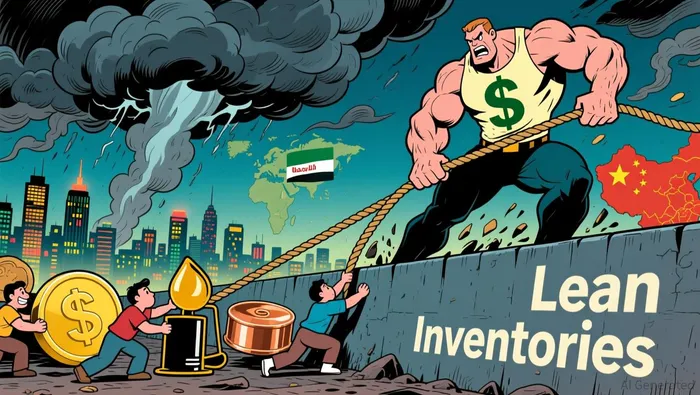
Commodity markets are navigating a pivotal transitional phase in the supercycle, where competing forces are establishing a defined trading range. The key dynamic is clear: elevated real interest rates and a strengthening US dollar are imposing a ceiling on prices, while structurally lean inventory levels are providing a floor that prevents deep corrections.
The US dollar's safe-haven bid is intensifying amid geopolitical friction. Recent escalation in the Middle East has seen the dollar strengthen, pushing the pound down to $1.331 and weighing on dollar-denominated commodities as markets slide on report US to send more troops to Middle East. This dynamic is not a short-term blip but reflects a broader dollar cycle that has turned decisively higher, creating a persistent headwind for commodity prices globally.
Simultaneously, the cost of capital remains a structural constraint. UK borrowing costs have surged to their highest level since 2008, with the 10-year bond yield climbing sharply as inflation shock looms. While this is a UK-specific manifestation, it signals a global shift in the risk-free rate environment. When real rates are elevated, the opportunity cost of holding non-yielding assets like commodities rises, dampening investor demand and capping upside potential.
Yet, a collapse in prices is being staved off by tight physical markets. Inventory positions across key industrial metals and energy remain lean, a legacy of years of underinvestment relative to demand. This scarcity creates a hard floor; any price weakness is rapidly met with physical buying, preventing the kind of deep corrections seen in previous cycles. The result is a market trapped in a range-pulled upward by real economy scarcity but held down by financial headwinds.
China's evolving economic structure adds another layer to this backdrop. While its economy grew 5.0% in Q1 2026, beating expectations, the composition of that growth is shifting industrial production growth was led by high-tech manufacturing. This structural move away from property-heavy growth toward advanced manufacturing alters the long-term demand profile for commodities, suggesting the supercycle's center of gravity is changing even as near-term financial forces dominate.
China's Structural Demand Shift: Property Weakness vs. High-Tech Strength
China's economy grew 5.0% in Q1 2026, beating consensus forecasts of 4.8% beating consensus forecasts of 4.8% and keeping the full-year target within reach. But beneath this solid headline lies a critical structural transformation reshaping commodity demand for years to come.
The industrial engine is firing on new cylinders. High-tech manufacturing expanded by 12.5% while electric vehicle production surged 48%, driving the 6.1% overall industrial production growth. This is the new demand architecture taking shape-advanced manufacturing and green technology driving industrial activity rather than the property and infrastructure boom of the past decade.
Yet this structural shift cuts both ways. The property sector, which historically anchored iron ore and copper demand through relentless construction, continues its downturn. The high-tech surge has not yet offset that traditional weakness. For commodity markets, this creates a defining tension: the demand profile is changing faster than the supply response can accommodate.
Monetary conditions reflect the PBOC's recalibration. Money supply growth holds at 7.2%, consistent with moderate easing directed toward manufacturing and green investment rather than property. Inflation remains stubbornly below 1%, signaling weak domestic consumption demand despite stimulus efforts. The March trade surplus narrowed to $51 billion as tariff front-loading effects faded.
The implication for commodities is clear: the supercycle's demand center of gravity is migrating. High-tech and EV supply chains demand different metals in different proportions-more copper for electrification, less steel for concrete. This transition creates a structural gap that lean inventories may struggle to fill, even as dollar strength and real rate headwinds keep prices range-bound. The cycle is turning, but the new equilibrium has not yet emerged.
Miner P&L Impact: Margin Compression in a High-Cost Environment
The macro backdrop now translates directly into miner profit and loss statements, creating a defining tension for companies with significant China exposure. The thesis is straightforward: margin compression is the likely outcome as weak Chinese demand fails to offset elevated input costs from energy price shocks.
Brent crude climbed to USD103.10 per barrel, reflecting ongoing supply concerns from Middle East tensions. For miners, energy and fuel costs represent a material portion of operating expenses-particularly for energy-intensive operations like copper concentrators and alumina refineries. When oil holds above $100, these cost bases become structurally higher, squeezing margins unless commodity prices fully transmit the increase.
Sterling's position adds a layer of complexity. The pound eased to USD1.3491, a level that historically provides some hedge for UK-listed miners repatriating dollar-denominated earnings. Yet this currency advantage is being overwhelmed by the cost side of the equation. Even with a weaker pound, the magnitude of energy cost inflation is outpacing any FX tailwind.
The demand side tells an equally challenging story. China's inflation remains stubbornly below 1%, reflecting weak domestic consumption demand despite policy stimulus. This is critical for miners: when the world's largest commodity consumer runs deflationary pressures, it signals that demand is not just slowing-it's structurally constrained. The high-tech manufacturing surge and EV production boom are real, but they are not yet large enough to offset the property sector's drag on iron ore and steel demand.
The result is a pincer movement. Costs are being pushed higher by geopolitical energy shocks, while the primary demand engine-China's construction-heavy economy-continues its gradual disengagement. For mining giants with significant China exposure, this creates a valuation constraint: earnings growth assumptions must be recalibrated downward, not because the supercycle is over, but because the cost structure has shifted unfavorably relative to demand.
This is where the cycle's transitional nature becomes personal for investors. The range-bound price environment means miners cannot rely on commodity price appreciation to offset cost inflation. Instead, they must absorb the squeeze or pass it through-which requires demand that simply isn't there in force yet. The margin compression is not a temporary blip; it is the structural cost of a demand transition occurring in real time.
Catalysts and Trade-Offs: What Defines the Path Forward
The margin compression thesis faces a critical test: near-term catalysts are skewed negative, but the path forward contains competing forces that could either validate or undermine this outlook. For miners, the coming months will be defined not by a single direction but by elevated volatility as these forces clash.
The immediate risk remains geopolitical. Oil holding above USD103.10 per barrel keeps input costs structurally elevated, while the Strait of Hormuz remains a flashpoint-Iran has vowed not to reopen the waterway while the US naval blockade continues, and Revolutionary Guard forces have seized container ships attempting transit Iran said it will not reopen the Strait of Hormuz. These are not background risks; they are direct cost drivers that can spike energy expenses overnight.
Yet within this tension lie potential relief valves. A resolution to Middle East hostilities could unwind the energy premium that is squeezing margins. Similarly, Chinese stimulus that proves stronger than expected-beyond the current M2 money supply growth at 7.2%-could accelerate the demand transition and close the structural gap left by property's decline. The March trade data shows the system is already adjusting: the trade surplus narrowed to $51 billion as tariff front-loading faded, and bilateral trade with Iran collapsed 90% amid the conflict Bilateral trade with Iran collapsed 90%. These shifts signal how quickly the demand map can redraw itself.
The structural demand shift ensures that whichever catalyst dominates, volatility will be the constant. High-tech manufacturing and EV production are real demand sources, but they operate on different timelines and use different metal mixes than the property sector they are replacing. Miners should expect price swings that reflect this uncertainty-upside from supply disruptions or stimulus surprises, downside from continued property weakness or dollar strength.
For investors, the trade-off is clear: the range-bound environment persists, but the boundaries are shifting. The floor provided by lean inventories remains, while the ceiling imposed by real rates and the dollar is subject to change if geopolitical risks recede. The key watchpoints are straightforward: monitor Middle East developments for cost signals, track Chinese stimulus implementation for demand signals, and watch for any acceleration in the high-tech demand transition that could close the structural gap. Until then, elevated volatility is not a risk-it is the environment.