

The CSRC Action Is Being Priced as More Than a Fine
A RMB1.85 billion proposed penalty is not just a one-time charge. Combined with a more than 30% pre-market drop, the market is treating the episode as a three-part hit: to earnings and balance-sheet expectations, to Futu's credibility with regulators, and to the revenue stream tied to the affected mainland-linked activity.
Why the sell-off was so sharp
The immediate damage is financial. A roughly USD271 million proposed fine, plus confiscation of illegal gains, is large enough to matter even for a fast-growing fintech. More important, the CSRC is also proposing that related entities rectify or cease the activities at issue. That turns the case into a business-scope problem, not a simple compliance slip.
Why the scare has become a longer overhang
Reuters reported a two-year grace period for winding down illegal business, with reporting saying clients could only sell existing holdings and withdraw funds during that window. That is why the story shifted from a one-day shock to a multi-quarter uncertainty.
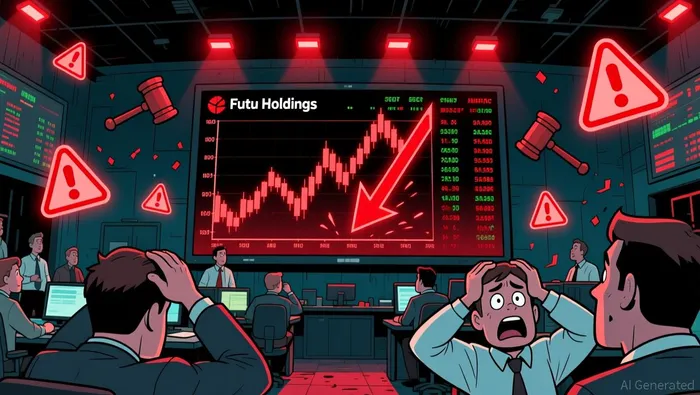
The market is not pricing the fine in isolation. It is also pricing weaker new-money inflows, lower conversion, and reduced wallet share from the affected user pool. Bulls can argue that overseas growth will offset some of that damage, but until the CSRC process narrows, investors still have to fund the upside case while the downside remains open.
Futu's Operating Base Still Supports a Rebound
That said, the bull case is not pure wishful thinking.
Scale and growth matter
Before the regulatory shock, Futu reported 3.37 million funded accounts, 29.2 million users, and HK$1.23 trillion in client assets. That is a meaningful base that could absorb a worse-than-expected headline if the final regulatory outcome turns out narrower than the market fears.
The company also had a strong recent growth record. In Q3 2025, revenue jumped 86.3% year over year and non-GAAP net income rose 136.9%, while client assets reached $159.5 billion and funded accounts climbed to 3.13 million. That does not remove the regulatory risk, but it does show Futu is not a broken platform chasing a story.
Why the market is still waiting
The problem is timing. Even with that scale, investors are waiting for clarity. Reuters said regulators unveiled a two-year plan to comprehensively crack down on cross-border securities, futures, and fund activity, with a two-year wind-down period for existing business. That stretches the overhang far beyond a typical fine-and-move-on case.
A strong user base and prior growth can limit permanent impairment, but they do not remove the need for regulatory clarity. Until investors see a narrower remedy, tighter compliance, and evidence that international growth can offset mainland friction, the market is likely to stay cautious.
Tree Line's Exit Signals Caution, Not Necessarily a Full Breakdown
One way to judge the overhang is to look at who is reducing exposure. Institutions often cut risk before the legal paperwork is fully finished.
What the latest filing shows
Tree Line fully exited Futu, selling 370,000 shares in an estimated $57.52 million trade. That was not a trivial satellite position: the stake had been 13.8% of Tree Line's AUM the prior quarter. A full exit like that is usually a risk signal, even if it is not definitive proof of a broader institutional trend.
The broader backdrop makes the signal clearer. Futu had fallen 20% over the past year, while the S&P 500 had risen about 28% over the same period. That divergence suggests at least some holders were already treating the stock as higher-risk before the latest regulatory headlines.
There is also no clean evidence yet of a fresh insider-sale wave. The company's latest disclosure centers on the CSRC penalty pre-notification and a personal fine on the CEO, not on management selling stock. So the immediate alignment issue is less about executives cashing out and more about outside capital waiting for the scope of the two-year grace period for winding down to be better defined.
Into the next earnings report, the main questions are: - whether management quantifies the financial impact of the CSRC action - whether it shows tighter compliance and cleaner cross-border operating boundaries - whether institutional positioning improves after a major fund fully reduced its exposure
What Would Make a Rebound More Credible
A rebound looks more trustworthy when the open regulatory question narrows. Until that happens, a bounce still may reflect short-covering more than sustained institutional buying.
The clearest signposts are practical: - a final ruling that is narrower or less disruptive than the worst market fears - evidence that the wind-down does not wipe out a material share of future revenue - price action that holds up through broader risk-off sessions instead of fading immediately
If those pieces start to line up, the bearish case weakens. Until then, Futu's rebound still looks constrained by the CSRC overhang.