

Bank of Ghana cuts the payment rails behind crypto USD wallets
This is primarily a funding and settlement disruption, not a blanket verdict on crypto.
The Bank of Ghana has ordered banks, mobile money operators, fintechs, and payment providers to immediately stop working with cryptocurrency platforms operating unauthorised foreign currency wallet services. In practice, regulated institutions may no longer support the funding, operation, settlement, or customer access tied to unapproved dollar wallets. Because those rails are how local cedis typically enter the system, the directive hits the main on-ramp rather than a peripheral niche.
The scale matters. Regulators say Ghana's virtual-asset ecosystem now encompasses more than 3 million users. At the same time, the Bank of Ghana has said no cryptocurrency company has been approved to run foreign-currency wallet services. The result is a broad disruption to a widely used channel, not a narrow compliance action.
There is also a policy tension. Parliament passed the Virtual Asset Service Providers (VASP) Bill, 2025, which legalizes cryptocurrency trading and related activities but still requires licensing. The central bank's current order says that law does not yet create an approved path for the specific foreign-currency wallet function at issue. That leaves the market in a transitional phase: regulation is moving forward, but the licensed infrastructure is not yet in place.
Why the wallet layer matters more than trading access
The squeeze hits payment rails first
The BoG did not target a single platform. It ordered institutions to stop arrangements that facilitate funding, operation, settlement, or customer access for unauthorized foreign-currency wallets. That reaches the underlying plumbing: bank transfers, payment cards, card-acquiring infrastructure, and settlement rails. In practical terms, users can expect slower funding, slower withdrawals, and less reliable access to dollar balances.
When that wallet layer is cut from formal payment rails, the friction is immediate. Users lose fast funding, easier settlement, and straightforward access to the USD balances many rely on for trading or transfers. Crypto markets do not need a full ban to feel pressure; they only need the USD wallet ramp to close.
Why there is no obvious workaround
The second reason this matters is that displaced demand has nowhere obvious to go. The BoG said the relevant crypto platforms have not been authorised to run these foreign-currency wallet activities, and it did not identify an approved operator to absorb that demand. It also warned that institutions still supporting them may face supervisory or enforcement actions.
For a market estimated at more than 3 million users, that is a meaningful liquidity shock rather than a niche compliance issue.
What a bullish recovery would require
The more constructive read depends on timing. If licensing moves quickly, the crackdown can be seen as clearing out unlicensed dollar wallets so a formal framework can replace them.
Watch three things: - whether the regulator signals a clear path from the current crackdown to approved wallet operators, - whether any institution is cleared to take over settlement for displaced users, and - whether licensing arrives before users shift away from dollar wallets altogether.
If licensing is slow, the market may face a liquidity vacuum. If it is fast, the cleanup could become a rerating setup.
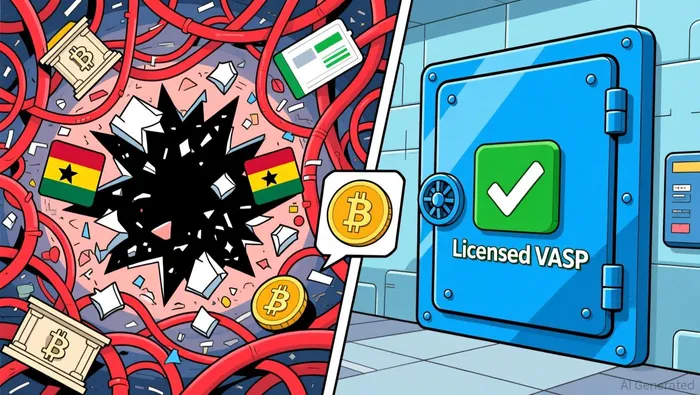
What to watch next: licensed rails, flow, and whether the squeeze eases
Why the near-term case still looks cautious
The near-term case remains cautious because the relevant crypto platforms have not been authorised by the Bank of Ghana to undertake such activities. That matters even after Parliament passed the Virtual Asset Service Providers (VASP) Bill, 2025. A framework law does not restore transaction flow if licensed VASPs are not yet operating to replace the channels now subject to immediate severance of ties.
The first signs that pressure is easing
After a more than 3 million users rollout, the next thing to watch is whether a legal replacement channel appears. The key signal is not another generic compliance headline, but evidence that approved payment or wallet rails are taking over funding, settlement, and customer access.
What would weaken the bearish read
The clearest invalidation would be licensed VASPs taking over the rails while usage holds. If approved operators begin serving that demand under the new regime, compliance-ready players are likely to be priced first. If licensing arrives but activity still falls, the market is still absorbing the full effect of the crackdown.