

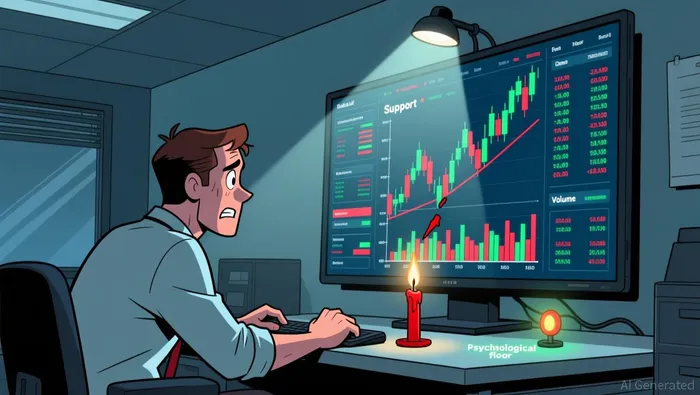
GameStop (GME) stock news has been dominated by the turbulent aftermath of Ryan Cohen’s reported $56 billion acquisition proposal for eBay, a deal that has sparked intense skepticism from high-profile investors like Michael Burry and Steve Eisman. Amid this fundamental noise, the chart is screaming a technical warning: GME has decisively broken below its 60-day range low of $22.03. The stock closed at $22.05, sitting precariously on the edge of the $22.00 psychological floor. This is a binary setup. The breakdown has trapped recent buyers, but the volume profile suggests the move might be fragile, leaving traders to decide whether this is the start of a slide toward $20 or a liquidation-induced false break.
Why is GME stock moving today?
The catalyst for today’s -4.83% move is the collision between a massive speculative deal and market reality. While Cohen’s $125-per-share offer for eBay initially fueled meme-stock fervor, the pushback from heavyweight critics has cast a pall over the transaction’s feasibility. Burry’s public opposition and Eisman’s warnings about debt leverage have turned the narrative from "acquisition euphoria" to "debt reality check."
Technically, the move is a structural break. Price has fallen below both the 60-day range low ($22.03) and the 20-day low ($22.73), invalidating the previous consolidation pattern. Crucially, the stock is now trading well below its 20-day moving average ($24.75) and 50-day moving average ($23.95). While these averages are still sloping upward, the gap between the current price and the MAs suggests an overextension to the downside. This creates a classic "dead cat bounce" scenario if buyers step in, but until then, the trend has shifted from range-bound to bearish momentum.
What makes this setup particularly tricky is the volume. The stock traded at the 20th percentile of its 20-day volume average. This is a weak confirmation signal. It lacks the heavy participation of a true capitulation breakdown, but it also lacks the conviction of a strong institutional sell-off. In practice, low-volume breakdowns are often prone to quick reversals, especially when they occur in a post-market or thin-liquidity environment. The move is technically bearish, but fundamentally unconfirmed by volume.
What traders should watch next at the $22 pivot
The immediate trade focus is the $22.00 level. This is not just a psychological number; it is the invalidation level for the bearish breakdown thesis. If GME holds $22.00 and reclaims $22.73 on high volume, the breakdown is dead, and a short squeeze toward the MA20 at $24.75 becomes the likely path. On the flip side, a sustained close below $22.00 with increasing volume confirms the bearish continuation, opening the door for a drift toward $21.00 and potentially $20.00.
The primary scenario for the next session is a "failure reversal." The data suggests a 45% probability that the breakdown lacks follow-through and results in a quick retraction. This is driven by the weak volume and the extreme distance from the moving averages. If the stock opens flat or slightly higher and holds above $22.03, the bearish case weakens significantly.
Traders should monitor the opening 30 minutes closely. A rapid drop below the intraday low of $21.68 would signal accelerated downside and a failure of the $22 support. Conversely, a surge in relative volume (greater than 1.5x the 20-day average) would be the strongest confirmation of direction. Without a volume spike, expect a choppy, indecisive session where the stock grinds sideways or offers a weak bounce that fades into resistance.
The trade idea: Breakdown risk or fake-out bounce?
The core trade idea is conditional and hinges on the $22.00 pivot. For trend followers, the setup is a breakdown retest. The bias is bearish, but entry should be reserved for a retest of the $22.00-$22.50 zone that fails to hold, or a confirmed break below $21.68. The downside risk extends to $21.00 and $20.00, but these targets are speculative without volume confirmation.
For contrarians, the low volume breakdown offers a risky short-term bounce opportunity. The RSI is at 47.16, indicating neutral momentum with no oversold signal yet, which leaves room for further downside. However, the statistical deviation from the MA20 ($24.75) is significant. If price reclaims $22.73, the bounce could be sharp. The invalidation level for this bounce thesis is a close below $22.00.
Ultimately, the lack of broad market tailwinds means GME’s move is driven by internal selling pressure and deal skepticism rather than systemic risk. This makes it a pure technical trade setup. The bottom line is that the breakdown is real, but the conviction is low. Until volume confirms the direction, the $22.00 level is the only line in the sand that matters. Watch GME support and resistance levels closely; a break of $22.00 is the trigger for the next leg down, while a reclaim of $22.73 is the signal that the bears have lost control.