

Gold fell up to 1.9% to below $4,740 an ounce over the weekend, erasing last week's entire gain to below $4,740 an ounce. This is the paradox: renewed disruption in the Strait of Hormuz should have sent gold soaring as a safe-haven asset. Instead, the metal is being sold even as the "war trades are back on" according to Capital.com analyst Kyle Rodda.
The market had priced in the escalation. What actually happened was a stronger dollar and renewed inflation concerns that outweighed the safe-haven bid. The dollar rose as much as 0.3% pressuring gold priced in US currency, while oil and natural gas prices soared on the energy-supply fears. The IMF just cut its global growth forecast to 3.1% from 3.3% in its latest World Economic Outlook, a downgrade driven precisely by these Middle East tensions.
Here's the expectation gap: investors had loaded up on gold expecting a prolonged conflict to drive safe-haven flows. But the reality is that the inflationary impulse from the energy shock is proving more immediate than the safe-haven demand. As analyst Kyle Rodda noted, "Things are going to be heavily headline-driven today" highlighting the volatility setup. Gold has lost around 10% since the war began at the end of February according to market data-a clear signal that the market is pricing in a different narrative than the one playing out in real time.
The IMF's downgrade underscores this: higher energy costs are squeezing growth and forcing central banks to consider holding rates steady or even raising them a headwind for non-yielding bullion. That's the real story here-not that gold should have risen, but that it held on as long as it did given the macro headwinds now materializing.
What's Priced In vs. What's Actually Happening
Shipping through the Strait of Hormuz has been largely blocked since late February, with roughly 20 million barrels of oil daily affected-about 20% of seaborne oil trade roughly 20% of seaborne oil trade. That baseline disruption is no longer new information. It's the operating environment. Investors had loaded gold weeks ago expecting a prolonged, escalating conflict that would keep energy supplies permanently threatened. That expectation is now being arbitrageed away.
What's happened since then hasn't exceeded those expectations. Oil prices actually fell sharply today, with Brent down 4.37% to $95.02 and WTI down 7.32% to $91.84 renewing fears of energy-supply disruptions. That decline is telling: the market is signaling that today's escalation-vessels fired upon, a US Navy seizure, Tehran's U-turn on the "completely open" strait-represents a contained disruption, not a worsening of the fundamental supply shock. The war trades are back on, but gold is being sold because the disruption has been stable at a high level for weeks.
Instead, inflation concerns are now dominating the narrative. The IMF's growth downgrade to 3.1% from 3.3% in its latest World Economic Outlook underscores how the energy shock is translating into real economic headwinds in its latest World Economic Outlook. Higher energy costs are forcing central banks to consider holding rates steady or even raising them-a structural headwind for non-yielding bullion. The dollar rose as much as 0.3%, pressuring gold priced in US currency.
Gold's 10% decline since the war began at the end of February is the clearest signal: the market has already priced in the safe-haven narrative and is now rotating out as inflationary macro pressures take precedence. Investors who bought the rumor of escalation are selling the news because the reality didn't justify the premium. The expectation gap has closed-and gold holders are exiting because the war trades are now trading the wrong side of the market.
The Inflation Trade vs. The War Trade
Gold fell even as peace talks collapsed. That's the tell.
The latest escalation in the Strait of Hormuz-vessels fired upon, a US Navy seizure, Tehran's U-turn-has indeed jeopardized prospects for negotiations in Islamabad Tehran said there was no "clear prospect" for productive negotiations. By any traditional measure, this is exactly the kind of geopolitical shock that sends investors fleeing to safe havens. Yet gold dropped as much as 1.9% to below $4,740 an ounce, erasing last week's entire gain.
The market is telling you something critical: the inflation trade is overpowering the war trade.
Look at the currency and commodity data. The Bloomberg Dollar Spot Index rose 0.2% alongside gold's decline, signaling a strengthening dollar that pressures all dollar-denominated commodities. More telling is the divergence within precious metals: silver slid 1.7% to $79.50 an ounce, with platinum and palladium also down. This isn't a selective safe-haven bid-it's a broad commodity sell-off driven by macro pressures, not a geopolitical premium.
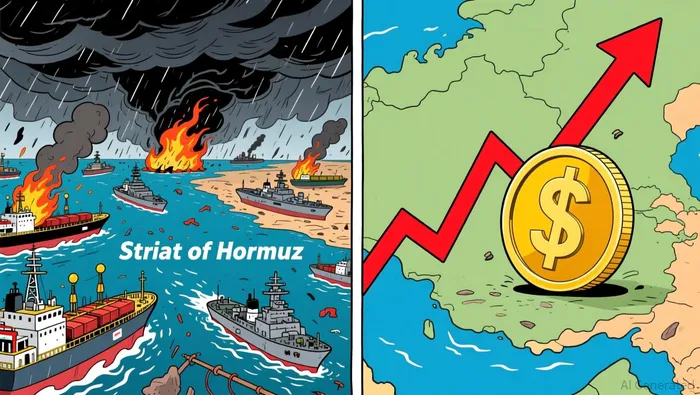
The war trades are back on, but gold is being sold because the market has already priced in the escalation. What's driving the sell-off now is the implied Federal Reserve response to persistent inflationary pressure from energy costs. The protracted conflict has triggered an unprecedented energy-supply shock that has intensified inflationary pressures, making central banks more likely to hold interest rates steady or even raise them-a structural headwind for non-yielding bullion.
Investors are now watching the Kevin Warsh confirmation hearing as the next catalyst. Any sense that Warsh would push for monetary easing later this year would likely support bullion, while greater caution around inflation-and a reluctance to cut rates-would be negative for gold.
Gold's 10% decline since the war began at the end of February is the clearest signal: the market has already priced in the safe-haven narrative and is now rotating out as inflationary macro pressures take precedence. The expectation gap has closed. Investors who bought the rumor of escalation are selling the news because the reality didn't justify the premium-and because the Fed's likely response to energy-driven inflation is far more damaging to gold than any wartime bid can compensate.
Catalysts and What to Watch
The market is now in a waiting game. With the war trades back on and headlines driving every move, analysts are bracing for two-way volatility as the narrative shifts between escalation fears and inflation realities potential for two-way volatility.
Here's the setup: any genuine de-escalation news-whether a credible ceasefire emerges or the Hormuz disruption eases-could trigger a sharp gold rebound. The logic is straightforward: remove the energy-supply threat, and the inflationary impulse fades faster than the safe-haven demand can rebuild. Gold would then have room to recover as the Fed's hawkish constraint lifts.
But the watchpoints right now are all on the inflation side.
US inflation data releases over the coming weeks will be scrutinized for any sign that energy prices are feeding into core measures. So far, the signal is mixed. Amundi's Lorenzo Portelli notes the inflationary impulse from the energy shock is "likely to prove temporary rather than persistent," with core inflation remaining "more subdued and better contained" than in 2022 inflationary impulse likely to prove temporary. That assessment, if confirmed by upcoming prints, could ease the Fed's hawkish constraint and create an opening for gold.
Fed speaker rhetoric will be equally telling. Investors are already zeroing in on the Kevin Warsh confirmation hearing this week Kevin Warsh confirmation hearing. Any indication that Warsh-or other Fed officials-would push for monetary easing later this year would likely support bullion. Conversely, greater caution around inflation and a reluctance to cut rates would be negative for gold, reinforcing the headwind from real yields.
Then there's the question of whether the Hormuz disruption is becoming structural. The market has treated this as a transient shock for weeks, but if oil prices stabilize or fall further while inflation expectations remain elevated, gold faces continued pressure. Higher real yields and a strengthening dollar-both products of that dynamic-would drain the safe-haven bid even as geopolitical tensions persist.
Gold's 10% decline since late February is the market's current verdict: the war trade is being arbitraged away faster than the inflation trade can be dismissed. The next move hinges on which catalyst breaks first-de-escalation that lifts the energy premium, or data that confirms the Fed's hands are tied.