

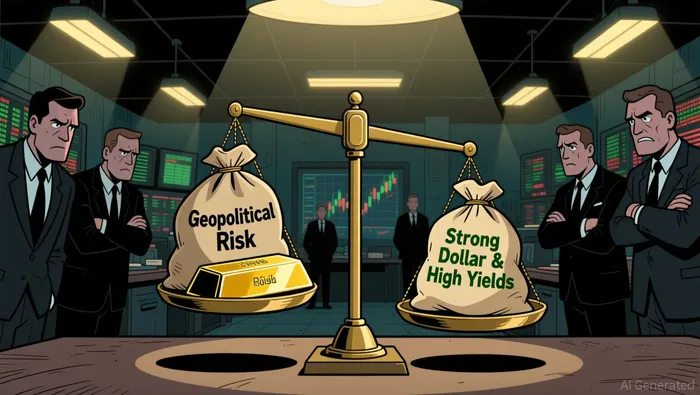
Gold is caught in a familiar tug-of-war, trading at $4,565 per ounce this morning. That's a slight gain from yesterday but marks a clear retreat from a recent peak above $4,750. The metal is now firmly ensconced in a $4,450 to $4,850 range, a zone that captures the market's indecision. The recent rally was fueled by a potent mix of geopolitical tension and a weaker dollar, but those tailwinds are now battling a more persistent headwind: a firm macroeconomic backdrop.
The catalyst for the climb was a surge in Middle East risks, with fears of a prolonged blockade of the Strait of Hormuz providing a classic safe-haven bid. That demand was amplified by a weaker dollar, which makes dollar-denominated gold cheaper for foreign buyers. Yet, this momentum has stalled. The market is now looking ahead to a new layer of geopolitical risk: a potential U.S.-China summit in late May. While the summit itself may aim for stability, the mere anticipation of high-stakes talks introduces fresh uncertainty. This creates a paradox: gold benefits from geopolitical hedging, but the market is wary of a resolution that could ease tensions and reduce safe-haven demand.
This cautious stance is reflected in the positioning of speculators. The latest CFTC Commitments of Traders report shows a market in a state of balance, waiting for a clearer signal. With speculative net positions neither overwhelmingly bullish nor bearish, traders are monitoring the range's boundaries rather than committing to a direction. The setup is one of patience over conviction, where rallies are likely to be faded and dips assessed near support. The key risk is that this stalemate becomes uncomfortable quickly; a decisive break above $4,850 or below $4,450 could trigger a sharper move in either direction. For now, the market is in a holding pattern, caught between the immediate pull of geopolitical risk and the longer-term pressure from a firm dollar and real yields.
The Long-Term Bull Case: Structural Demand and Policy Tailwinds
While the market debates the next move within its current range, the longer-term trajectory for gold is being shaped by powerful structural forces. The bull case rests on two pillars: a sustained surge in official demand and gold's enduring role as a hedge against the very macroeconomic conditions that are currently pressuring the market.
Central bank buying is the most visible and reliable structural support. Demand from official reserves is projected to average 585 tonnes per quarter in 2026, a figure that represents a significant and sustained flow of physical metal. This isn't a one-off event but part of a multi-year trend of reserve diversification away from the U.S. dollar. As J.P. Morgan's Natasha Kaneva notes, the long-term trend of official reserve and investor diversification into gold has further to run. This persistent demand acts as a floor, absorbing volatility and providing a steady baseline for price discovery. The sheer scale is notable: in the third quarter of 2025, combined central bank and investor demand hit around 980 tonnes, over 50% higher than the previous four-quarter average. That momentum is expected to continue, with the bank forecasting prices to push toward $5,000/oz by year-end 2026.
This demand is driven by a fundamental shift in the global monetary order. Central banks are actively seeking assets that are not subject to the same policy risks as U.S. Treasuries. Gold fits that bill perfectly, serving as a store of value and a form of protection against currency debasement. This role is not new, but its importance is being re-validated in an era of high fiscal deficits and aggressive monetary policy. The historical performance underscores its appeal; gold has gained 32.8% over the past year, a move that has been both a symptom and a driver of this broader repositioning.
The bottom line is that the current price range may be a temporary pause in a longer re-rating. The structural demand from central banks, coupled with gold's unique status as a non-yielding, inflation-hedged asset, provides a powerful tailwind. While geopolitical events and dollar strength can push prices up or down in the short term, these fundamental forces define the longer-term path. For investors, the setup suggests that the recent price action is more noise than signal, with the metal's underlying value story still intact and pointing toward the $5,000 target.
The Macro Constraints: Real Yields and the Dollar's Role
The current price range is a direct reflection of a tug-of-war between two powerful macro forces. On one side, persistent geopolitical risk and central bank buying provide a steady floor of demand. On the other, the market's long-term sensitivity to real yields and the U.S. dollar creates firm headwinds that cap rallies and generate volatility. This is the essence of gold's messy consolidation.
Gold's price is fundamentally a function of the opportunity cost of holding a non-yielding asset. When real yields-the return on U.S. Treasuries after inflation-rise, gold becomes less attractive. The market is watching this dynamic closely. Any sustained climb in U.S. Treasury yields would directly pressure the metal, as investors shift capital toward higher-yielding bonds. This is the primary cyclical constraint on gold's upside. For now, mixed U.S. data is keeping the Federal Reserve on a cautious path, but the door remains open for a shift that could see real yields rebound and reignite this pressure.
The U.S. dollar acts as the metal's direct counterweight. A stronger dollar makes gold more expensive for holders of other currencies, dampening international demand. Conversely, a weaker dollar provides a tailwind. The dollar's strength is itself driven by the same macro forces: real yields, U.S. fiscal health, and global risk appetite. This creates a feedback loop. If geopolitical tensions ease, risk appetite may rise, supporting the dollar and pressuring gold. If tensions escalate, the dollar could weaken, boosting gold. This interplay ensures that gold's path is rarely straightforward, as shifts in one variable often trigger countervailing moves in the other.
The bottom line is that the current $4,450 to $4,850 range is a battleground where these forces are in balance. The technical setup reinforces this, with the 50-day moving average and the 50% retracement zone acting as key levels. Bulls need to reclaim these to signal a break from the consolidation, but they face resistance from the firm macro backdrop. Traders are in a holding pattern, waiting for one side of this tug-of-war to gain decisive momentum. Until then, the market will remain sensitive to any data or policy shift that tilts the balance between real yields and the dollar.
Catalysts and Scenarios: What Could Break the Range
The market is waiting for a catalyst to break the current stalemate. Three key events could shift the balance decisively. The first is the outcome of the Trump-Xi summit in late May. The U.S. goal is to secure Chinese support for an Iran ceasefire and a return to the Strait of Hormuz, which would directly test the safe-haven demand that has been propping up gold. A successful de-escalation would ease a major geopolitical risk, potentially reducing the metal's appeal as a hedge and pressuring prices. Conversely, a failure or a summit that merely manages tensions without a concrete resolution could leave the risk premium intact, supporting the current floor.
The second major catalyst is U.S. inflation data and Federal Reserve commentary. This is the primary driver of gold's opportunity cost. Any data pointing to a sustained pickup in price pressures would reignite the debate over real yields, which are the metal's most persistent headwind. The market is watching for signals on whether the Fed will maintain its cautious stance or pivot toward a more hawkish posture. A shift in that narrative could quickly alter the macro backdrop, making bonds more attractive relative to gold and capping any rally.
Finally, a decisive break above the key resistance level of $4,850 would be the clearest technical signal that the consolidation is over. As outlined in the technical scenarios, reclaiming this zone would shift the setup toward a recovery mode, with the next major target at $5,024. This move would need to be confirmed by a break above the 50-day moving average and the 50% retracement zone, suggesting that the bullish structural forces-central bank demand and long-term diversification-are regaining control. The risk, however, is that such a breakout could be short-lived if it coincides with a rebound in real yields or a strengthening dollar.
The bottom line is that the path out of the range hinges on these external events. Geopolitical developments will test the safe-haven story, economic data will influence the real yield backdrop, and a clean technical break will signal a change in momentum. For now, the market remains in a holding pattern, but one of these catalysts is likely to provide the decisive push within the coming weeks.