

Gold hit $5,589 an ounce on January 28, 2026 - an all-time high born from central bank accumulation, de-dollarization anxiety, and geopolitical hedging that the market could not ignore. Then it pulled back roughly 16% to the $4,520 range, even though the fundamentals driving that rally haven't changed.
That gap between intact thesis and fading price action is the exact place where portfolio allocation decisions live.
The thesis hasn't broken. It has matured.
Central banks purchased an estimated 244 tons of gold in Q1 2026 alone, continuing a multi-year buying spree that began in earnest during 2025, when they accumulated 297 tons through the first 11 months. This isn't cyclical speculation. It's structural repositioning - central banks reducing dollar concentration in reserves and diversifying into assets that carry no counterparty risk.
The World Gold Council's April 2026 data shows global gold ETF assets under management at $615 billion, with holdings rebounding 45 tons to 4,137 tons. Flows flipped positive in April from all regions, with Europe leading. The institutional infrastructure around gold demand is still building.
So what changed?
Nothing structural. What changed is the market's attention economy - and that's where the opportunity cost question kicks in.
The $765 billion question
Goldman Sachs estimates $765 billion in annual AI capital expenditures in 2026, with Goldman projecting the number climbs to $1.6 trillion by 2031. Roughly 75% of aggregate hyperscaler capex this year is earmarked for AI infrastructure - GPUs, data centers, networking, power. That's not a forecast from two years ago. That's live deployment happening now.
Put plainly: while geopolitical analysts are writing about gold's safe-haven renaissance, the same capital pools are facing a choice between holding a store of value and participating in the largest infrastructure buildout in computing history.
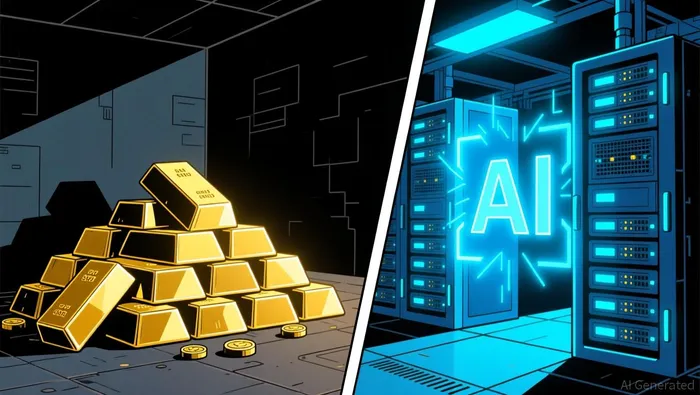
Gold doesn't pay interest. It doesn't compound. It doesn't produce earnings that scale with demand. Its entire return mechanism is someone else deciding to pay more later - whether that's central banks, panicked portfolios during crises, or speculative flows chasing momentum.
The AI infrastructure chain does all of that and more. It compounds through every new data center rack, every inference workload deployed, every enterprise migration to AI-native architectures.
Five years tells the story
Between May 2021 and May 2024, NVIDIA returned roughly 1,319% over five years. Gold returned 140% over the same period. That's not an argument against gold - it's an argument about what happens when capital allocates to productive technology versus a passive store of value during a generational shift.
NVIDIA also returned roughly 39% in 2025 alone. Gold's 2025 performance, while strong enough to push past $3,600 by September, didn't replicate the compounding trajectory of companies sitting at the center of the AI compute stack.
The debate is not whether gold remains important. It's whether the return profile of a non-yielding asset - one that has already returned 140% over five years - is still the best use of capital in a market where AI infrastructure deployment is entering its most capital-intensive phase.
The counterargument, honestly
Here's what the gold case does well: it hedges against exactly the scenarios that are hardest to price into any equity portfolio. A severe geopolitical escalation that disrupts supply chains. A dollar crisis that erodes reserve confidence. A systemic event that freezes credit markets and makes equities volatile for months.
Gold's pullback from $5,589 to $4,520 also created a wider gap between price and where major forecasters see it heading. Goldman Sachs raised its end-2026 gold forecast to $5,400 per ounce in January, citing continued central bank diversification. If that target plays out from current levels, that's roughly 20% upside.
But 20% upside over a potential nine-month hold - in an asset that produces no yield, no cash flow, no enterprise value - requires a very patient cost of capital. That's a holding, not a growth position.
So what about the ETF data?
There's a telling divergence in the fund flows that I find more interesting than the price chart. US-listed gold ETFs have posted $1.7 billion in net outflows year-to-date in 2026 - a reversal from 2025, when American investors poured nearly $50 billion into them. Meanwhile, non-US flows flipped positive in April.
This tells me the gold thesis is bifurcating by geography. US investors, sitting at the center of the AI capex boom, are rotating. International investors, particularly in Europe, are still buying the geopolitical hedge. That divergence is worth watching - if US outflows widen, it signals domestic capital is increasingly choosing productive tech exposure over passive commodity allocation.
Where I'd draw the line
I believe gold's geopolitical backdrop is real and will remain relevant. Central banks aren't reversing course. De-dollarization pressures aren't fading. But relevance to a thesis is different from relevance to allocation.
The question isn't whether gold will hold its value or retest highs. The question is whether a portfolio position in gold is displacing capital that could be deployed in the AI infrastructure chain - semiconductor foundries, networking equipment, data center REITs, cloud platforms - where capital is being consumed at $765 billion per year and growing.
Gold is a 2-5% portfolio insurance policy. It is not a growth engine. If geopolitical anxiety pushes you to allocate larger