

The headlines say gold's safe-haven status is permanently damaged - a precious metal that fell nearly 25% from their record highs despite an actual war. But the headlines are reading the old story. The numbers are already pointing at something different.
Gold hit around $5,500 an ounce in late January 2026. Then the United States and Israel have launched a strike campaign into Iran on February 28. A textbook safe-haven catalyst - except gold sold off anyway. It dropped below $4,126 an ounce in March, then recovered partially to the $4,500-$4,700 range where it's been oscillating since. As of yesterday, gold was trading around $4,573.
The market is still pricing gold as a broken insurance policy. But the mechanic that broke it was war-specific. It reverses when the war ends.
Here's what actually drove gold down: every time conflict intensified, oil spiked, which stoked inflation fears, which strengthened the dollar and killed hopes for Fed rate cuts. A stronger dollar and higher interest rates are gold's natural enemies - it pays no yield, and a strong dollar makes dollar-priced gold more expensive for foreign buyers. The safe-haven demand as investors are now flocking towards the US Dollar instead of gold. Investors pulled $13 billion out of physically backed gold ETFs in Q1 - the largest quarterly outflow on record. March saw $12 billion leave in a single month.
That is the mechanism. Not "gold doesn't matter anymore." The dollar did gold's job, and at a steeper price.
Now the mechanism is working backward. On May 24, Trump says that a deal with Iran is "largely negotiated". Reports on May 24 and 25 indicated the United States and Iran were nearing a broader peace agreement. Gold rose more than 1%... as optimism for a breakthrough in U.S.-Iran peace negotiations weakened the dollar and eased oil yesterday. Bloomberg reported gold holding those gains.
The chain is straightforward: peace talk credibility rises → oil prices come down → inflation expectations ease → the dollar weakens and Fed rate-cut probability returns → gold's structural enemies retreat. One by one.
This is where the second proof point matters. While Western retail and institutional investors were fleeing gold ETFs, central banks didn't follow. They bought 863 tonnes of gold in 2025 - near record levels. In Q1 2026, despite visible selling pressure during the quarter, central banks added another 244 tonnes, up 3% year over year. The World Gold Council reported that new central banks entered the buyer side in 2026. (I don't have Q2 central bank data yet - that's a gap. But three quarters of consistent buying at depressed prices is a floor, not a blip.)
Central banks don't buy gold to time headlines. They buy to reduce dollar dependency and build reserve insurance that no single government can debase. The price level at $4,500 didn't scare them off. It invited them in.
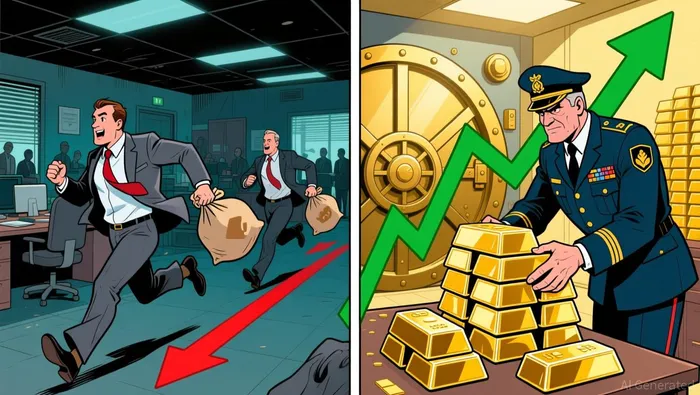
The contradiction is this: Western investors sold gold at the exact price level where sovereign buyers kept accumulating. That is the definition of a reset. The market bar is low. The structural buyer is still there.
I can be wrong again. But the setup is specific: if peace holds, the dollar-inflation headwind that crushed gold since March evaporates. The ETF selling has already run its course - you don't pull $13 billion out in one quarter and have another $13 billion to follow. What you have left is exhausted bears and central banks on the bid.
This isn't about excitement. It's about a mechanic that broke gold working in reverse, with a structural floor that never left.
What breaks the thesis? If the Iran negotiations collapse and hostilities restart at scale, the oil-dollar-Fed chain runs forward again and gold gets caught in the crossfire once more. Or if the Fed surprises to the hawkish side despite de-escalation - though that would be an unusual policy move. Watch the peace process, not the daily gold print.
Discipline over ego. If the deal falls apart, the case narrows. If it holds, the market is pricing the wrong story again.