

Gold near $4,600 reflects a clash between geopolitical support and rate pressure
Gold's drop to a near four-week low around $4,600 does not look like a collapse in safe-haven demand. It looks more like a market weighing two forces at once: geopolitical stress on one side, and higher-for-longer rate expectations on the other. The geopolitical case for gold is still there, but in portfolio terms, the macro camp currently has more leverage. Prediction markets imply only 1.4% odds of gold reaching $5,400 this month, while the more immediate backdrop is a market that still sees a meaningful chance of no Fed easing this year. For gold, a non-yielding asset, that matters as much as the war premium.
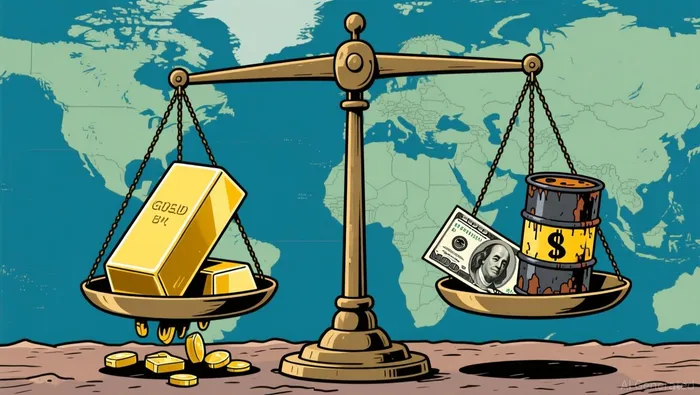
The mechanism is straightforward. Stalled U.S.-Iran talks have kept pressure on energy supplies, with Brent above $100 a barrel and the Strait of Hormuz still disrupting flows. Higher crude feeds inflation concerns, which in turn raises the odds of firmer policy and a firmer dollar. That is the same mix that can pressure gold even during a serious geopolitical crisis.
This week's Fed meeting matters because investors are looking for more than a hold. They are looking for a signal on whether de-escalation is close enough to ease inflation fears, or whether higher rates will keep capping gold's upside.
Why the same crisis is pushing gold in opposite directions
Gold clearly still has a war bid. The complication is that the same conflict is also keeping oil, inflation worries, and rate sensitivity in focus. When hostilities threaten energy flows, gold can benefit from safe-haven demand. But if that stress keeps crude elevated, the market can start discounting persistent inflation and harder policy instead.
Price action shows the tug-of-war
The clearest example is how quickly gold reacted to ceasefire headlines. When Trump moved to indefinitely extend the ceasefire with Iran, gold rose 0.9% to $4,755.11, as lower oil and softer inflation fears improved the setup. Then the narrative flipped again. After setbacks to peace prospects, a firmer dollar and higher oil returned, and spot gold slipped to $4,694.26. Later in the week, gold was still being weighed down by a stronger dollar and elevated oil prices even as the conflict remained the central event. That back-and-forth captures the market's current dilemma.
The bull case depends on the oil-rate chain easing
The bullish argument is not about ignoring rates. It is about timing. If the ceasefire holds long enough to ease the oil shock, the rate pressure may fade faster than strategic demand for gold does. That is why some traders are already reclaiming the narrative and framing the next major test around $5,000. Prediction markets still show only a 1.4% probability of reaching $5,400 this month, which suggests the near-term bar remains high. But if de-escalation starts to look durable, the later part of the year could tell a different story.
What keeps the near-term setup constrained
The nearer-term bearish mechanism is cleaner:
- A stronger dollar has made dollar-priced bullion more expensive for holders of other currencies.
- Brent above $100 a barrel keeps inflation worries in focus.
- Prediction markets still imply a 67% YES probability that there will be no rate cuts in 2026.
For portfolio construction, that is the key watchpoint. Gold can still diversify against tail-risk geopolitical damage, but as long as oil, the dollar, and rate expectations move against it, the metal's near-term upside stays constrained.
Gold's next move hinges on a range break and the oil-dollar-rate chain
At this point, the more useful question is not simple direction. It is what kind of move gold gets, and which driver the market chooses next.
The market is still in a decision range
Spot gold is trading around $4,703.77, with U.S. gold futures near $4,721.00. That leaves price inside a broader consolidation zone of roughly $4,607 to $4,860. More tightly, the market has been coiling between $4,775 and $4,655, with the technical read suggesting that range can persist for days or weeks until a cleaner signal arrives. That is not a breakout environment. It is a decision window.
What matters more than the next headline
The next catalyst is not the headline by itself. It is whether the headline changes the oil-dollar-rate chain that is already pressing on gold.
Within that framework, the range tells a useful story. A break above $4,775 would suggest the de-escalation trade is gaining conviction. A break below $4,655 would imply the market still believes the inflation-and-rates story outweighs the safe-haven bid.
How to read the setup
For allocation, the main point is simple: do not chase every geopolitical headline. Geopolitical fear can support gold, but the market is still letting the firmer dollar and fading hopes for near-term interest rate cuts due to higher oil prices continued to weigh on prices in the near term. If you want gold exposure, waiting for a confirmed range break or buying measured dips inside the band can help preserve entry quality while the market finishes choosing between de-escalation and another rate-led rejection.