

Gold isn't holding a trendline. It's holding a position - somewhere between $4,600 and $4,700 per ounce - roughly 16% off its January 2026 peak of $5,589. The pullback has traders drawing diagonal lines and looking for support. The question isn't where the next technical floor is. It's which gold exposure still looks like the better investment when you stack the actual factors against each other.
Because the real comparison set isn't a chart. It's physical gold versus the miners who extract it.
Physical gold: the baseline. No growth, no margin, no operating leverage.
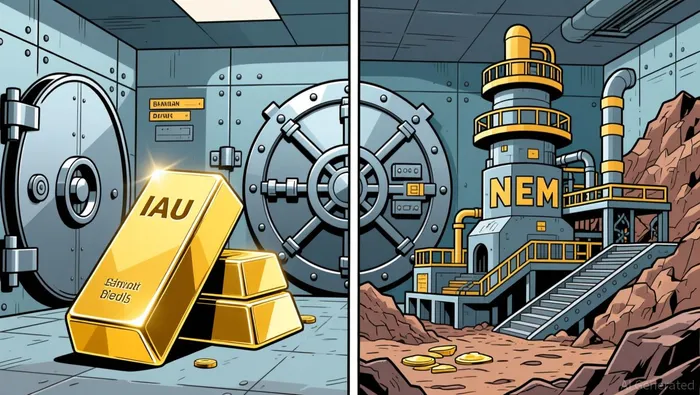
The SPDR Gold Shares trust (GLD) sits around $413 per share. The iShares Gold Trust (IAU), the cheaper alternative at 0.25% expense ratio versus GLD's 0.40%, tracks the same underlying commodity. Neither pays a dividend. Neither generates cash flow. They track spot gold - which means they get no upside multiple from operational efficiency, cost discipline, or production growth. The entire thesis is that the price of the metal goes higher.
It could. J.P. Morgan forecasts gold averaging $5,055 per ounce by Q4 2026. Central bank demand remains structural - Poland alone added over 20 tonnes to its reserves in 2026 as part of a multi-year plan to reach 700 tonnes. But that's a commodity forecast, not a stock thesis. Physical gold is the defensive sleeve of a precious-metals barbell, not a growth engine. When you buy GLD or IAU, you're buying insurance against currency debasement and geopolitical chaos. The factor grade for valuation is blank because there is no valuation. For growth, zero. For profitability, nonexistent.
The miners: operating leverage as a factor multiplier.
Newmont (NEM) is up approximately 118% over the trailing year. Agnico Eagle (AEM) has gained about 69% over the same period. The divergence is instructive. Newmont benefited from stronger earnings and aggressive M&A - it absorbed Newcrest in a major consolidation play - while Agnico traded at a premium: 24x trailing 2025 earnings and 18x forward 2026 estimates, roughly a 28-33% premium to larger, more efficient peers as of January. Agnico's current P/E sits at 26.29 as of late May, which is rich by any mining-sector standard where 10-15x was the norm before gold's run.
The GDX VanEck Gold Miners ETF - the broad basket - trades near $85 and has delivered roughly 73% returns over 12 months. The miner ETFs amplify gold's move in both directions. That's the operating leverage mechanic: when gold rises, miners' revenue rises faster than their costs, margins expand disproportionately, and earnings grow at a multiple of the commodity's price move. The inverse works too. Gold is down 16% from its peak. Miners have corrected harder. That's not a bug - it's the lever swinging the other way.
What the macro says, and what it doesn't.
The Fed held rates steady at 3.50-3.75% in March. No cuts in sight yet. A higher-for-longer dollar environment creates headwind for a dollar-denominated commodity. Russia has been selling gold, pushing its bullion reserves to a 4-year low by weight. These are background conditions, not thesis-killers. The central bank buying narrative isn't broken - it's geographically uneven. Poland and other emerging-market central banks continue accumulating; Russia is the outlier, not the rule.
The Fed's hold is a timing factor, not a direction factor. Rate cuts eventually support gold. Until then, the pullback is a function of the dollar staying firm and investors digesting the magnitude of the January rally. The 16% correction from $5,589 to the $4,600s is healthy in a trend that gained over 74% year-over-year from this point last year.
So which exposure do you use?
If you need the barbell's defensive weight - the name you hold when the economy staggers, the dollar wobbles, or central bank de-dollarization accelerates - physical gold via IAU (the cheaper wrapper) is the right vehicle. No earnings surprises. No execution risk. Pure commodity beta.
If you want growth exposure to gold's secular move with operating leverage doing the heavy lifting, Newmont is the higher-beta name and Agnico is the quality premium. Agnico at 26x earnings is expensive. Expensive relative to where miners traded before this cycle, yes. The question is whether the gold price runway justifies it. If JP Morgan's $5,005 average by Q4 is even directionally right, the earnings multiples reprice upward as margins expand on higher realized gold prices. If gold stalls in the $4,400-$4,600 zone, Agnico's premium gets tested.
The GDX ETF sits in between - broad miner exposure without single-stock execution risk, still leveraged to the commodity move. It's the lazy-man's operating leverage play.
The trigger that changes everything.
A decisive break below gold's 200-day moving average - analysts watching that level right now - would signal a deeper corrective phase, not just a pause. That matters more than any trendline. If the commodity loses its trend, miners get crushed through the lever. Physical gold holds up better but still bleeds. The barbell inverts.
Conversely, if gold reclaims the $4,800-$4,900 zone and holds, the miners lead the advance. Operating leverage turns back on.
Trendlines are a drawing exercise. Factor stacks are the actual work. The stack says: miners for growth conviction, physical gold for defensive ballast, and patience for the Fed's next move.