

Goldman Sachs now expects Federal Reserve rate cuts to arrive in December 2026 and March 2027, pushed back from earlier forecasts of September and December 2025. The driver is clear: energy-driven inflation remains stubborn, with core PCE inflation likely to stay closer to 3% than 2% for much of this year as energy cost pass-through effects persist. This keeps US yields elevated and removes the primary catalyst for dollar weakness.
Goldman's currency positioning reflects this yield differential. The bank's favored hedges are long the dollar against the Swedish krona, euro, and British pound Goldman's preferred positions include long dollar against the Swedish krona, euro and British pound. The dollar has already drawn support from haven flows since the US and Israeli attack on Iran in late February disrupted energy markets the dollar has found support in haven flows after the US and Israel attack on Iran in late February. The Bloomberg Dollar Spot Index rose 0.3% on Tuesday, its biggest gain this month, as oil prices climbed on continued Strait of Hormuz disruption risks.
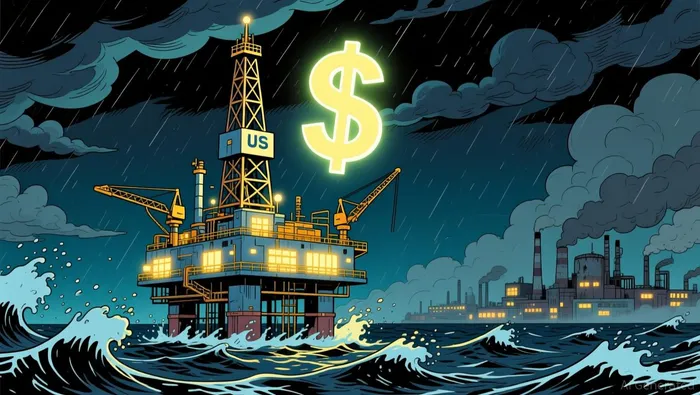
The structural advantage is real: the US is now the world's largest oil producer, which insulates the domestic economy from the energy shock in ways that leave Europe and Asia more vulnerable the United States benefits from its position as the world's largest oil producer. Elevated oil prices, rather than acting as a headwind, now feed back into a stronger fiscal and trade position that supports the currency. Goldman notes that sustained foreign exchange intervention is difficult to maintain without a corresponding shift in domestic macro policy, and no such shift appears imminent in Japan active interventions into the foreign currency market are hard to maintain in the long run without a shift in the macro policies. This suggests yen weakness-and by extension dollar strength-has further room to run.
European Exposure: Industrial Drag and the Electrification Response
European industrial output faces a measurable hit from sustained higher energy prices. Goldman Sachs Research forecasts a 2% reduction in industrial production by the end of 2027 compared to the pre-conflict baseline a 2% reduction in industrial production by year-end 2027. This drag compounds the structural disadvantage Europe faces as a net energy importer, contrasting sharply with the US position as the world's largest oil producer.
That pressure is accelerating a structural pivot. Power demand is projected to grow 2-4% annually by decade-end, with a hyper-electrification scenario pushing growth to 5% per year starting in 2030 2-4% annual power demand growth, reaching 5% under hyper-electrification. This isn't a cyclical bump-it's a generational shift in how Europe powers its economy, driven by both energy security imperatives and the mounting electricity needs of AI infrastructure.
For utilities with strong balance sheets, this sets up a multi-decade earnings super-cycle. Meeting this demand requires roughly €2 trillion in power generation investment over the coming decade-about three times past spending-rising to €3.5 trillion when grid upgrades are included €2 trillion in power generation investment, €3.5 trillion total electrification spending. The companies positioned to capture this wave are those with large exposure to power generation activities and the balance sheet strength to fund it. Regional divergence is already evident: nations with higher shares of renewables and nuclear have kept power prices stable, while gas-dependent markets face sharp price increases. The message is clear-electrification is no longer optional, and the utilities that move fastest will define the next super-cycle.
Policy Constraints and What Could Break the Thesis
The dollar thesis rests on a simple equation: higher US yields attract capital, and nothing signals "higher for longer" like an energy shock that keeps inflation sticky. But every thesis has its breaking point. The first constraint is policy inertia-specifically, the inability of central banks to counter dollar strength through FX intervention without domestic macro policy shifts. Goldman notes that sustained foreign exchange intervention is difficult to maintain without a corresponding shift in domestic macro policy, and no such shift appears imminent in Japan without a corresponding shift in domestic macro policy. For the yen, one of the biggest drivers of the broad dollar, such a shift doesn't look imminent such a shift doesn't look imminent. This suggests yen weakness-and by extension dollar strength-has further room to run unless Tokyo fundamentally changes course.
The second layer of risk lies in the two variables that could unwind the "higher for longer" narrative: labor market softening and faster-than-expected energy price declines. Goldman's revised Fed timeline now points to December 2026 and March 2027 for rate cuts, but the bank explicitly conditions this on clearer signs of easing monthly inflation data after the oil shock fades, along with additional softening in labor market conditions along with additional softening in labor market conditions. Without those developments, rate cuts could be pushed further into 2027. If energy prices collapse sooner than expected-say, through a rapid de-escalation in Middle East tensions-the inflation pass-through effect that currently supports dollar strength could evaporate overnight.
So what actually breaks the thesis? Watch two things. First, any shift in Japanese monetary policy toward normalization would directly challenge the yen carry trade and could trigger a rapid dollar unwind. Second, unexpected European demand destruction-where energy prices become so high that industrial activity collapses-could reverse the terms-of-trade advantage the US currently enjoys. The current setup favors the dollar, but these are the levers that could flip it.