

Goldman Sachs reported record Q1 2026 net revenues of $17.2 billion and earnings per share of $17.55, significantly beating analyst expectations driven by a 27% surge in equities trading.
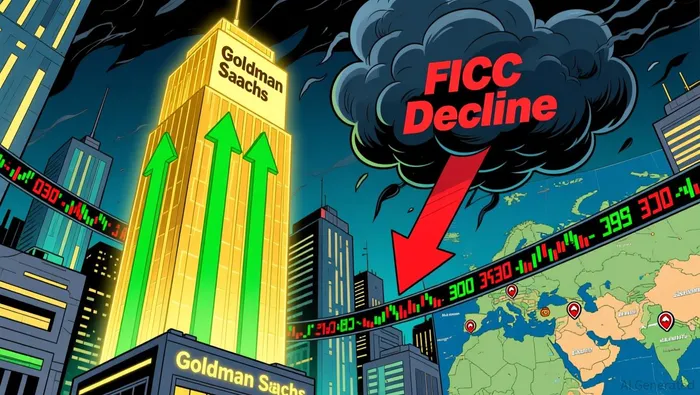
The stock fell in pre-market trading despite the beat as investors reacted to a 10% decline in FICC revenue and concerns over the sustainability of the equity boom.
CEO David Solomon highlighted the firm's ability to navigate geopolitical complexity, though the Iran conflict poses potential risks to future dealmaking and market stability.
Management maintained confidence in its diversified franchise while returning $6.4 billion to shareholders through buybacks and dividends.
Wall Street's trading giants are often the first to feel the pulse of market volatility, and Goldman Sachs Group Inc. (GS) is no exception. In the first quarter of 2026, the investment bank delivered a performance that shattered records, yet the market reaction was far from celebratory. The divergence between the bank's operational success and its stock price offers a compelling case study in how modern investors weigh immediate trading gains against long-term macroeconomic uncertainties. As institutional investors repositioned portfolios amid AI-driven disruptions and geopolitical tensions, Goldman's trading desks capitalized on the chaos, but lingering fears about fixed-income weakness and global stability kept a lid on investor enthusiasm.
Why Did Goldman Sachs Stock Drop After Beating Earnings Expectations?
The market's reaction to Goldman Sachs' Q1 2026 results highlights a classic case of "buy the rumor, sell the news" mixed with specific sector concerns. Despite reporting net earnings of $5.63 billion, a 19% increase year-over-year, and earnings per share of $17.55 that surpassed the consensus estimate of $16.47, shares dipped approximately 4% in pre-market trading. This counterintuitive move suggests that investors are looking beyond the headline numbers to the quality and sustainability of those earnings.
The primary culprit for the stock's decline was the performance of the Fixed Income, Currencies, and Commodities (FICC) division. While the equities business posted a record $5.33 billion in revenue, up 27% from the previous year, the FICC segment saw revenues drop 10% to $4.01 billion, falling short of analyst expectations by as much as $900 million. This weakness in interest rate products and the mortgage market signaled to some investors that the bank's broader trading franchise might be facing headwinds that could persist into the second quarter. Furthermore, the firm booked a $315 million provision for credit losses, which was more than double analyst estimates and the largest increase since 2020, raising questions about potential stress in the lending portfolio.
Additionally, the bank's decision to deploy excess capital into client financing activities, such as acquisition financing and prime brokerage, resulted in a decline in its Common Equity Tier 1 (CET1) ratio to 12.5%. While management argued this was a strategic move to support client needs and drive future growth, some market participants viewed it as a potential drag on returns on equity in the near term. The combination of these factors created a narrative where the strong equities performance was insufficient to offset the concerns regarding FICC volatility and capital efficiency.
How Did Goldman Sachs Equities Trading Drive Record Revenues?
The standout performer in Goldman Sachs' first quarter was undoubtedly its equities division, which generated $5.33 billion in revenue, marking the second consecutive quarter of record-breaking performance and surpassing the previous all-time high by over $1 billion. This surge was not merely a statistical anomaly but was driven by specific, high-volume activities that capitalized on the turbulent market environment of early 2026.
A key driver of this success was the significant growth in prime brokerage lending. As institutional investors and hedge funds sought to adjust their positions in response to AI-led sector disruption and geopolitical shocks, Goldman provided the necessary capital to facilitate these trades. The bank's prime brokerage lending grew substantially, supporting the high cash equity volumes that characterized the quarter. This lending boom allowed Goldman to earn robust financing revenues, which rose 36% to $3.7 billion, underscoring the bank's strategic shift toward deploying capital into client activities rather than holding it passively.
The volatility in global markets, exacerbated by the conflict in Iran which began in late February, played a crucial role in fueling this trading activity. Geopolitical uncertainty often leads to increased market churn, forcing traders to hedge positions and rebalance portfolios frequently. Goldman's traders were well-positioned to capture fees from this activity, benefiting from shifts in interest rates, bond prices, and currencies. The firm's ability to navigate this complex landscape while maintaining high client engagement demonstrates the strength of its diversified global franchise. However, the reliance on such volatility also introduces a risk factor; if markets stabilize or if the geopolitical situation de-escalates too quickly, the trading volumes that drove these record revenues could moderate.
What Are The Key Risks And Outlook For Goldman Sachs Stock Moving Forward?
Looking beyond the immediate results, investors are closely monitoring several risk factors that could impact Goldman Sachs' performance in the coming quarters. The most significant of these is the ongoing geopolitical tension in the Middle East. CEO David Solomon has warned that if the conflict in the Middle East persists, it could weigh on dealmaking and market activity, potentially slowing the M&A advisory fees that saw a 48% jump in the first quarter. Corporate clients often delay mergers and acquisitions during periods of high uncertainty, which could lead to a sequential moderation in earnings and revenue for the second and third quarters.
Another area of concern is the sustainability of the current trading boom. While the equities division posted record revenues, the market's reaction suggests skepticism about whether such high growth levels can be maintained. The firm's guidance for the upcoming quarters acknowledges this uncertainty, projecting sequential moderation due to typical seasonal patterns and macroeconomic headwinds. Investors will be watching to see if the firm can continue to generate strong returns even if trading volumes normalize.
Furthermore, the bank's exposure to private credit and wholesale loans remains a focal point for analysts. Although management clarified that the recent provision for credit losses was not related to private credit or FICC financing, the $315 million provision was the largest since 2020 and highlighted the potential for stress in the lending portfolio. The firm's strategic capital deployment into client financing has increased risk-weighted assets, which could impact future capital ratios and return metrics if not managed carefully. Despite these challenges, Goldman Sachs remains confident in its ability to generate attractive returns, supported by a diversified franchise and a strong position in asset and wealth management, where assets under supervision reached a record $3.7 trillion. The firm's commitment to returning capital to shareholders, including a 14th consecutive year of dividend increases, signals confidence in its long-term prospects despite the near-term volatility.
For retail investors, the Goldman Sachs case illustrates the importance of looking past headline earnings to understand the underlying drivers of revenue. The bank's ability to turn market chaos into profit is a testament to its trading prowess, but the stock's decline serves as a reminder that market sentiment is often driven by fears of the future rather than the success of the past. As the firm navigates a complex geopolitical landscape and evolving market dynamics, its ability to balance growth with risk management will be the key metric to watch in the quarters ahead.