

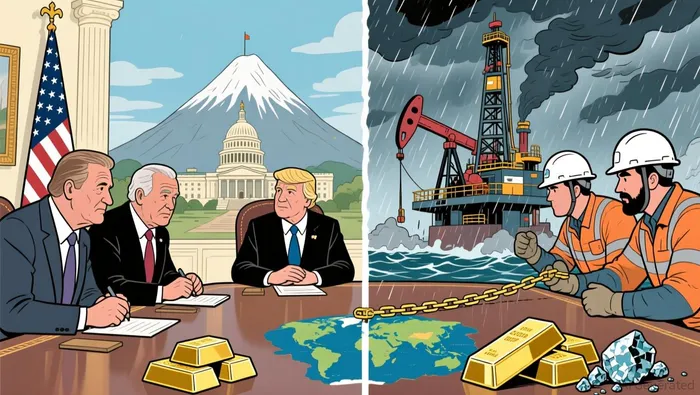
The Trump-Xi summit unfolds against a long-term backdrop of elevated geopolitical risk that has become a permanent fixture in commodity cycles. This is not a moment for grand deals, but a test of stability. Markets are not pricing reconciliation between Washington and Beijing. They are pricing the preservation of stable tension that allows capital flows and supply chains to continue functioning. The summit matters less for historic breakthroughs and more for reducing the geopolitical risk premium hanging over Chinese equities, the yuan, semiconductors, and global exporters. For commodities, this means the strategic pressure points of oil, rare earths, AI infrastructure, and agriculture are caught in a larger contest over economic control, where the market's only demand is that the temperature dial be turned down a few degrees.
This fragile equilibrium is under immediate pressure from a more visceral shock. The war in the Middle East, now in its third month, is a more direct inflationary force than any summit declaration. As U.S. President Donald Trump stated on Monday, a ceasefire with Iran was "on life support", with negotiations appearing fragile. That instability keeps supply concerns alive, directly supporting oil prices and adding a near-term inflationary jolt to energy and metals markets. The summit itself is occurring amid heightened geopolitical tensions, with both leaders expected to focus on maintaining a fragile stability rather than resolving core conflicts. The Iran war is a live wire that complicates any broader de-escalation.
Viewed through the lens of macro cycles, the market's setup is clear. It is pricing the survival of manageable tension, not its end. This caps the upside for risk assets and commodities, as any significant relaxation of the geopolitical premium would require more than a meeting. The base case remains one of suspended escalation, where existing trade barriers function like speed governors but are tolerated for the sake of predictability. The real inflationary pressure in the near term is not from a summit outcome, but from a war that refuses to end.
Direct Commodity Impacts: Trade, Tech, and Supply Chains
The summit's immediate impact on commodity markets will be channeled through a narrow set of policy levers. Analysts expect the meeting to focus narrowly on trade and export controls, including tariffs, restrictions on rare earths and semiconductors, rather than producing a sweeping reset in bilateral ties Goldman Sachs said. This tactical focus means the most direct commodity effects will stem from decisions on critical minerals and trade flows.
The rare earths deal is a prime example. A deal struck at the first Trump-Xi meeting in Busan last year remains in effect, and an extension is expected to be announced at the appropriate time. Rare earths are essential inputs for green technology and defense systems, so any agreement to expand China's supply directly influences the availability and price of these strategic materials. This is a concrete, measurable channel for commodity supply.
On the security front, the United States is seeking explicit agreement to restrict arms sales to Taiwan. This is a key demand that could influence regional stability and, by extension, energy security in the Asia-Pacific. While not a direct commodity price driver, the outcome will shape the geopolitical risk premium for oil and shipping lanes in the region.
For now, the market's expectation is for a tactical catalyst, not a structural shift. Goldman Sachs anticipates China could agree to step up purchases of U.S. farm goods, energy, and aircraft in exchange for avoiding further tariff hikes in exchange for avoiding further tariff hikes. This could provide a near-term boost to agricultural commodities and energy exports. Yet the overall setup remains one of managed tension, where these incremental agreements serve to preserve predictability rather than unlock a new era of cooperation.
Translating Risk to Price: Cycles vs. Momentum
The market's immediate reaction to the summit's setup reveals how macro risk translates into price action. Gold rose 0.5% on Tuesday as investors sought a safe haven amid the geopolitical uncertainty. This move is a classic cyclical signal: elevated risk premiums directly support precious metals as a store of value. At the same time, Asia-Pacific and European equity futures edged higher, reflecting a broader market pricing in the preservation of stable tension. This is the core dynamic. The market is not betting on a resolution, but on a continuation of the status quo that allows capital flows and supply chains to function.
Viewed through the longer-term lens of commodity cycles, this creates a clear but constrained setup. The macro backdrop-defined by managed U.S.-China rivalry and a Middle East war-sets the boundaries for price ranges. It caps the upside for risk assets and commodities, as any significant relaxation of the geopolitical premium would require more than a meeting. The base case remains one of suspended escalation, where existing trade barriers act as speed governors but are tolerated for the sake of predictability. This defines the directional bias: prices are likely to trade within a band anchored by these persistent risk factors.
Yet, momentum and positioning can temporarily push prices beyond these cycle-driven boundaries. The summit itself is a catalyst that can inject short-term volatility. The initial gold rally and the equity futures gains are examples of momentum building ahead of the event. If the summit outcomes are perceived as slightly more constructive than expected-say, a concrete deal on rare earths or a clearer signal on Taiwan-the risk premium could compress faster than the macro cycle allows, fueling a sharper rally. Conversely, if the summit fails to reduce tension, leaving the geopolitical risk premium elevated, it would cap any commodity rallies and reinforce the cycle's downside constraints.
The bottom line is that the macro cycle provides the target and the walls. Momentum provides the temporary push. For commodities, the cycle says the game is about managing tension, not ending it. The market's job is to price that reality, with the summit serving as a moment to test whether the temperature dial has been turned down-or if the risk of a sudden spike remains.
Catalysts and Risks: What to Watch for the Commodity Cycle
The forward view hinges on a few clear signals that will determine whether the geopolitical risk premium compresses or remains elevated. The most direct test is the U.S. demand for restrictions on arms sales to Taiwan. This is a key security issue the Trump administration is seeking to resolve, and its outcome will shape regional stability and energy security in the Asia-Pacific. Any explicit agreement or progress on this front would be a tangible sign of reduced tension, directly supporting the market's base case of manageable coexistence.
At the same time, the inflationary pressure from the Middle East war must be monitored. The U.S. Consumer Price Index data, due later in the week, will be a critical gauge of how supply concerns from the fragile Iran ceasefire talks are feeding into broader price pressures. If the CPI shows persistent inflationary jolts from energy and metals markets, it could complicate the Federal Reserve's rate path and, by extension, the real interest rate environment that underpins all commodity cycles.
The key risk, however, is that the summit fails to reduce tension. The market is not pricing reconciliation, but the preservation of stable tension that allows supply chains to function. If the meeting produces no concrete deals on critical minerals or trade, and the geopolitical risk premium remains high, it will cap any commodity rallies and reinforce the cycle's downside constraints. The base case of suspended escalation depends on this fragile equilibrium holding.
In practice, the summit is a test of whether the temperature dial has been turned down-or if the risk of a sudden spike remains. For commodities, the cycle says the game is about managing tension, not ending it. The market's job is to price that reality, with the summit serving as a moment to test whether the temperature dial has been turned down-or if the risk of a sudden spike remains.