

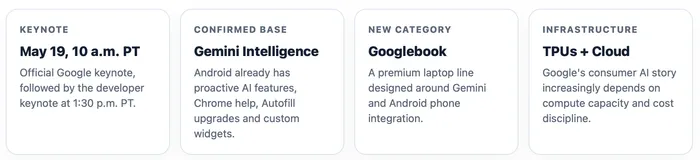
Google I/O 2026 opens with a product question that is larger than any single model release: can Google make Gemini the operating layer across the devices, browsers and cloud services people already use? The official I/O schedule puts the Google keynote at 10:00 a.m. PT on May 19 and the developer keynote at 1:30 p.m. PT, while Google's own Android preview has already disclosed several building blocks that are likely to frame the conference.
That means this I/O is less about whether Google has AI features and more about whether those features become product distribution. The company has already previewed Gemini Intelligence on Android, the new Googlebook laptop category, Chrome automation, Android Auto upgrades and a coming look at Android XR glasses. The keynote still has to answer the harder question: which of those are polished products with availability, partners and monetization paths, and which are still demonstrations of what the AI stack could become?
The first product layer is already visible: Android is becoming an AI interface
Google has already shown the clearest product direction before the keynote. In its Android Show preview, the company described Android as moving from an operating system into an "intelligence system," with Gemini Intelligence designed to automate multi-step tasks, use visual or screen context, improve Autofill, summarize and compare web content in Chrome, and create custom widgets from natural-language prompts. Google also said the features would roll out in waves, starting with select Samsung Galaxy and Google Pixel phones this summer and moving across watches, cars, glasses and laptops later in the year.
The important point is not that Android gets another assistant. It is that Google is trying to make Gemini a distributed action layer: book the ride, fill the form, summarize the page, convert spoken thoughts into cleaner messages, build the widget and connect the phone to the laptop. That is a more ambitious product design than a chatbot sitting in a separate app. It also gives Google a distribution advantage that pure AI app companies do not have: Android already sits on devices, Chrome already sits in the browsing flow, and Google accounts already connect mail, calendar, maps, payments and cloud files.
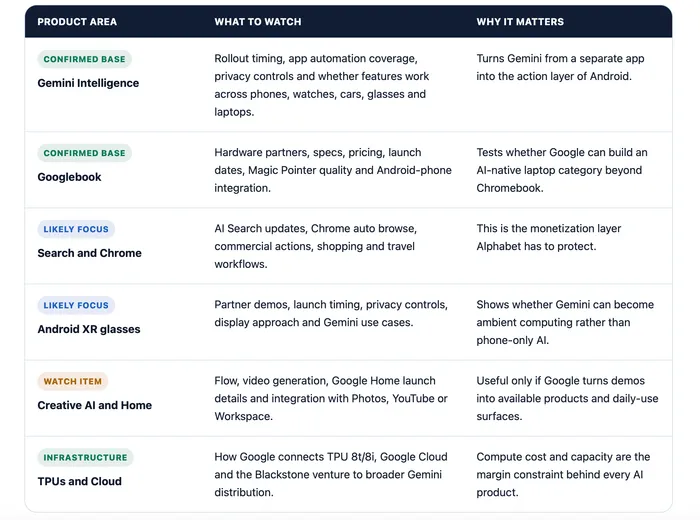
The keynote should therefore be judged by specificity. A demo of an agent placing a booking is less important than launch windows, app coverage, opt-in controls, failure handling and whether the feature can operate across enough real services to become habitual. If Google shows Gemini Intelligence as a polished product layer rather than a controlled-stage demo, I/O could reset how investors and developers think about the company's consumer AI position.
Googlebook is the clearest hardware surprise, but the question is whether it can escape the Chromebook frame
Googlebook is the product that may receive the most attention because it is a new device category rather than a feature update. Google says Googlebook brings together Android's app ecosystem and ChromeOS's browser strengths, with Gemini at the core. The company highlighted Magic Pointer, contextual suggestions at the cursor, natural-language widgets and closer Android phone integration, while saying more details will come later this year before devices launch in the fall.
The product logic is strong. A laptop is still where many people write, browse, shop, code, research and work with documents. If Gemini can act at the pointer level, use screen context, connect Gmail and Calendar, and build dashboards without moving the user into a separate AI app, Googlebook becomes a test of AI-native computing rather than a simple Chromebook refresh. The user should not need to ask, "where is the AI?" The interface should make the next action obvious.
The risk is that the category sounds more strategic than it initially feels. Google needs to show how Googlebook differs from a Chromebook with Gemini branding. Investors and developers should look for partner commitments, premium hardware requirements, pricing range, enterprise compatibility, Android app quality on laptop screens, battery and local AI capability, and whether Magic Pointer has enough context to become useful rather than intrusive. A fall launch without clear specs would keep Googlebook interesting but unproven.
Search, Chrome and Gemini are the monetization test
For Alphabet, the most important I/O segment may still be Search. WIRED's preview expects updates to Search, Android, Gemini and Android XR smart glasses, while Google's own I/O page and About Google page point viewers toward Search, Workspace, AI models and product features. The reason the Search section matters is simple: if Gemini changes how people ask questions, compare options and complete transactions, Google has to defend both user attention and the economics of search advertising.
Chrome is the bridge between the old search model and the new agentic interface. Google has already said Gemini in Chrome for Android can summarize, compare and help with browsing tasks, while Chrome auto browse can take care of more mundane work. The product tension is whether that improves search engagement or reduces the number of traditional search interactions. A useful AI assistant may answer faster, but the business model has to preserve commercial intent, advertiser placement and measurable conversion.
Android XR glasses could show whether Gemini becomes ambient computing
The hardware watch item beyond Googlebook is Android XR. Google's Android Show preview said viewers should tune into I/O for more Android updates and a sneak peek at glasses that will launch later this year. WIRED also pointed to Google's smart-glasses push and named partners such as Samsung, Xreal, Gentle Monster and Warby Parker, while Warby Parker is already collecting sign-ups for its AI-powered glasses.
Smart glasses matter because they shift Gemini from an app or browser assistant into an ambient interface. The potential use cases are obvious: voice, visual context, translation, directions, quick replies, reminders and live help while the user is doing something else. The hard part is product trust. Glasses have to handle privacy, battery life, comfort, camera norms, latency and the line between helpful and distracting. A strong I/O preview should not just show a futuristic demo; it should clarify partner timelines, app support, privacy controls and whether the first devices are display glasses, audio-first AI glasses or a mixed approach.
This is also where Google has to avoid treating hardware as a side show. If Gemini works across phone, laptop, car and glasses, Google can argue that it is building a multi-device AI interface. If the glasses segment is only a design tease, the product narrative remains Android-heavy and less transformative.
Creative AI and Home devices would test whether Gemini can leave the demo stage
Beyond the confirmed Android and laptop announcements, the keynote could use creative tools to show how Google thinks about consumer AI beyond productivity. WIRED flagged the possibility of more Google Labs updates, including the Flow music tool, potential video-generation news and a launch date for the Gemini-powered Google Home speaker that Google had previously teased. Those would be less important to Alphabet's near-term revenue than Search or Cloud, but they help answer a product question: can Gemini create new daily-use surfaces rather than only improving existing ones?
The key is availability. A creative AI model shown behind a controlled demo does not move the product story much. A tool with broad access, clear rights controls, reasonable latency and obvious integration into YouTube, Workspace, Android or Google Photos would matter more. The same applies to the Home speaker. Google already has a strong home-device footprint; the question is whether Gemini makes it feel like a genuinely better household interface or another voice assistant refresh.
The cloud and TPU story is the infrastructure backstop behind every consumer demo
The product keynote will likely focus on interfaces, but the capacity story is just as important. Google's Cloud Next announcements included two eighth-generation TPUs: TPU 8t for training and TPU 8i for low-latency inference, along with storage and networking infrastructure designed for agentic AI. Reuters also reported that Google and Blackstone will form an AI cloud venture, with Blackstone committing an initial $5 billion in equity to help bring 500 megawatts of data-center capacity online in 2027; the venture will offer data-center capacity and Google's TPUs through a compute-as-a-service model.
That infrastructure does not make for the flashiest I/O segment, but it underpins the entire product road map. If Google wants Gemini to operate across Search, Chrome, Android, Googlebook, glasses and Home, inference cost and latency become product constraints. The TPU story gives Google a way to frame AI as vertically integrated: models, consumer distribution, enterprise workflow, custom chips and financed data-center capacity. The investment risk is that more AI functionality raises capital intensity faster than monetization. The product upside is that Google has more control over the stack than companies relying only on third-party chips and rented infrastructure.
What would make this I/O feel like a real product reset?
A strong I/O would show a coherent product ladder. Gemini Intelligence handles tasks on Android. Chrome turns browsing into research and action. Search protects commercial intent. Googlebook brings Gemini to the desktop interface. Android XR extends the assistant into ambient computing. Google Cloud and TPUs explain how the company can support the load without losing the margin story. Each layer should reinforce the next.
A weaker event would have the opposite shape: impressive demos, uncertain availability, thin partner timelines and no clear connection between AI features and monetization. That would still make for a busy keynote, but not necessarily a stronger Alphabet product story. The difference is whether Google can turn I/O from an AI showcase into a product map that explains how Gemini reaches users, how developers build on it, and how the company pays for the infrastructure behind it.
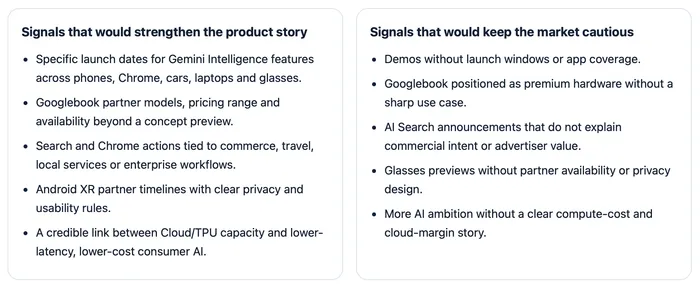
The practical headline for I/O is therefore not "what new AI model will Google show?" It is whether Google can make Gemini feel native across the products where users already spend time. If it can, this year's I/O becomes a distribution event. If it cannot, the keynote risks looking like another step in the AI demo cycle: technically impressive, but still waiting for product proof.