

Google and Blackstone announced a joint venture on Monday to create a new AI cloud company built entirely around Google's TPUs - custom chips Google has designed for its own use for over a decade. Blackstone is putting in $5 billion in equity and taking the majority stake. Google is a minority owner.
Think about that structure for a second. The company that invented the hardware is the smaller partner in a company whose entire reason for existing is to sell access to that hardware. That's not how chip companies normally behave.
NVIDIA doesn't take minority stakes in GPU colocation firms. Intel doesn't let private equity run its distribution channels. Usually the hardware maker controls the story because the hardware is the story.
So why is Google doing it?
The obvious answer is that Google needs Blackstone's data center muscle. Blackstone manages $1.3 trillion in assets and runs more data center capacity than any other private investor. Its data center platform is roughly $150 billion. The joint venture plans to bring 500 megawatts online by 2027 - roughly the power needed to serve a midsize American city. Google could build that itself, but Blackstone has the land bank, the power contracts, and the permitting relationships already in place.
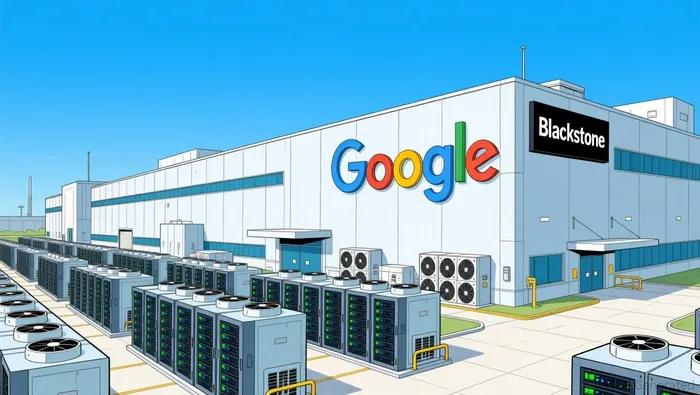
But that's not the interesting answer. The interesting answer is that Google is trying to solve a much harder problem than infrastructure: nobody outside Google has much reason to use TPUs instead of NVIDIA GPUs.
TPUs are great at what they do - matrix math for neural networks - and Google claims they can cut costs by up to 80% at scale compared to GPUs. They've been in production for over a decade. But the AI ecosystem is built around NVIDIA's CUDA software stack. Every major AI framework is optimized for GPUs first. If you're an AI startup or an enterprise building models, switching to TPUs means rewriting, retesting, and accepting a narrower vendor ecosystem.
Google's internal demand isn't the problem. Google Cloud revenue hit $20 billion in its latest quarter, up 63 percent, and AI compute growth there is outpacing rivals. But Google Cloud still holds only about 12 percent of the cloud market. More importantly, the neocloud players that have captured attention - CoreWeave, backed by NVIDIA with a recent $7.5 billion financing, and Nebius, also NVIDIA-backed with deals at Meta and Microsoft worth tens of billions - run on GPUs. The buyers are there. The vendors are there. They just don't buy TPUs.
This is where the Blackstone deal makes sense as a distribution strategy. Google doesn't just need data centers. It needs credible customers who trust someone other than Google to run the cloud - especially customers who are already wary of giving Google more of their AI workload. By making Blackstone the majority owner, Google gives customers a plausible reason to say yes: this isn't Google Cloud by another name. It's an independent operation running Google chips.
Google has already started opening the door. In April, it announced plans to sell TPUs directly to a "select group of customers" for their own data centers. Analysts estimate that every 500,000 TPUs sold to third-party centers could add roughly $13 billion to Alphabet's 2027 revenue. Google's been subsidizing the TPU ecosystem with its own balance sheet because the chips need external demand to justify the R&D spend.
The Anthropic deal is the closest thing Google has to proof this works. Anthropic locked in massive TPU capacity through Google Cloud. But that's one customer writing a very large check. The Blackstone venture is an attempt to generalize the model: create a standalone TPU cloud that can serve multiple customers who want GPU alternatives without going through Google Cloud's billing and controls.
There's a real risk here. The company could end up being a $5 billion experiment in teaching the industry to use a different chip. NVIDIA's moat isn't just the silicon - it's the software, the developer habits, the years of optimization baked into every AI toolchain. Blackstone doesn't solve that. Google's balance sheet doesn't solve that. Only customer adoption does.
I suspect the more revealing question isn't whether this company will succeed. It's what Google's willingness to be the minority partner says about how much it needs this to work. If Google were confident that TPUs would naturally capture market share through Google Cloud alone, it would keep the chips internal and the revenue stream controlled. The fact that it's letting Blackstone run the shop suggests the problem is demand-side, not supply-side. Google can build the capacity. It can't force the buyers.
The test is simpler than the valuation. Watch who signs up as the first customers in 2027. If they're companies already deep in the Google ecosystem, it's a distribution tweak. If they're companies that would otherwise be buying NVIDIA GPUs through CoreWeave or Nebius, then Google has actually cracked something. If nobody signs up, $5 billion in Blackstone equity becomes the most expensive market research Google has ever commissioned.
Either way, the structure tells you what the problem is.