

Recent reports from NOTUS, citing people familiar with the matter, indicate that the U.S. government is considering holding equity in major artificial intelligence companies to capture and distribute AI dividends. This move marks another bold attempt by the administration to build a "high-tech national team," following its direct investments in legacy chipmakers and quantum computing infrastructure. This raises immediate questions for the market: Which companies might be targeted? Will the Intel-style stock miracle be replicated? And crucially, how can ordinary investors participate in this AI national team layout through publicly traded companies?
Government's Dual Identity: Regulator and Shareholder
The mechanics of this potential government intervention reveal a shift from traditional oversight to direct participation. Senior U.S. officials are holding preliminary discussions with major AI companies regarding the potential for the government to buy shares. According to NOTUS, these talks center on having the firms voluntarily cede shares to the government, with the generated returns directed toward public purposes, such as a universal dividend payment to all American households. This development arrives precisely as industry leaders like OpenAI and Anthropic prepare for blockbuster initial public offerings. Furthermore, President Trump recently signed an executive order requiring leading AI developers to voluntarily submit their most capable models for government cybersecurity tests 30 days before public release. This 30-day testing mandate confirms that the administration is actively positioning itself with a dual identity: intervening in the sector simultaneously as a stringent regulator and a prospective shareholder.
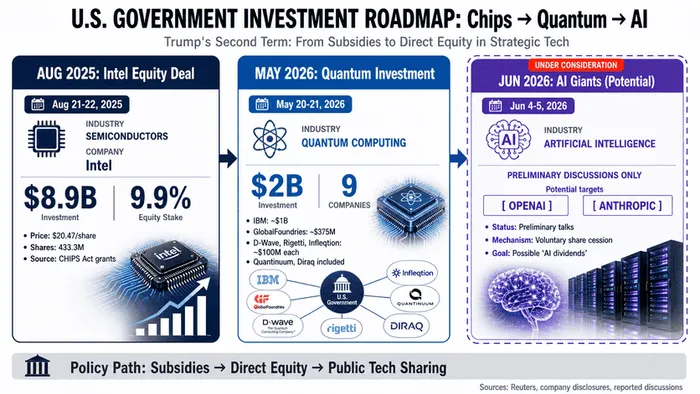
The Policy Roadmap and the Intel Precedent
The administration's investment trajectory into strategic technology has become increasingly formalized over the past year. In August 2025, the U.S. government announced an $8.9 billion investment to acquire an approximate 9.9% equity stake in Intel, utilizing funds from the CHIPS Act and the Secure Enclave project. By May 2026, this "subsidies-for-equity" model expanded into the quantum computing sector, with the administration committing $2 billion across nine firms—including IBM, GlobalFoundries, D-Wave, and Rigetti—to secure minority stakes.
Intel represents the foundational case study of this strategy and has subsequently become one of the most dramatic policy-driven bull stocks in recent market history. When Reuters first reported the potential Intel stake on August 15, 2025, the stock immediately surged nearly 4%. According to Ainvest analysis, as illustrated in the chart below, the stock's trajectory following the government's entry has been historic.
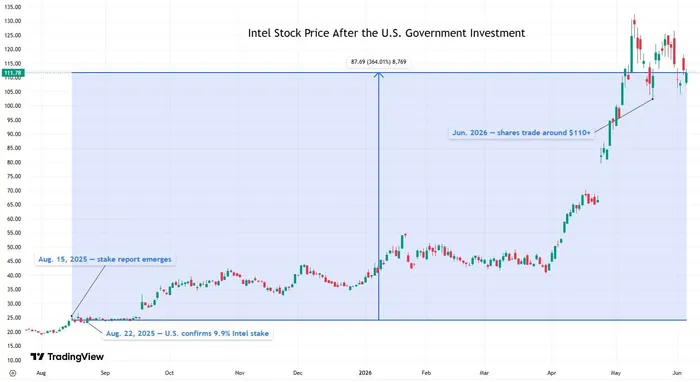
Trading between approximately $108.60 and $111.78 by early June 2026, Intel's shares have posted a cumulative gain of 430% to 446%, rising roughly 88.13 to 91.31 points from the government's $20.47 per share entry cost. Consequently, the book value of the government's holding has swelled from $8.9 billion to an estimated $47 billion to $48 billion, creating a powerful "stock miracle" narrative that the market is now eager to project onto the AI sector.
Indirectly Investing in the AI Proxies
Since pure-play AI giants like OpenAI and Anthropic remain private, public market investors must seek indirect exposure to this emerging national team through established corporate proxies.
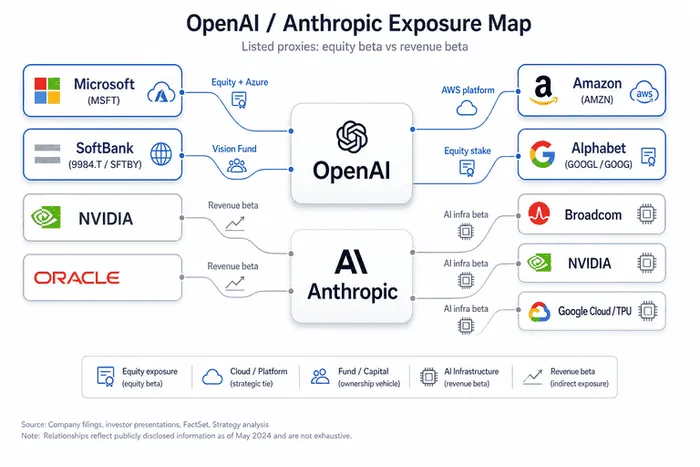
- OpenAI Proxies: Microsoft (MSFT) is the primary equity vehicle, holding an approximate 27% stake in OpenAI valued at roughly $135 billion. This creates a dual binding, as Microsoft also locks in massive long-term cloud computing consumption on its Azure platform. Additionally, SoftBank Group (SFTBY) has injected roughly $346 billion into OpenAI through its Vision Fund as of February 2026, with plans to increase this to $646 billion for an estimated 13% stake.
- Anthropic Proxies: Amazon (AMZN) has committed up to $25 billion to Anthropic, securing AWS as its primary training platform, while Anthropic has pledged over $100 billion in AWS spending over the next decade. Alphabet (GOOGL) has also invested roughly $3 billion for a 10% to 14% stake and recently committed an initial $10 billion toward a new $400 billion valuation round in 2026.
- Infrastructure National Team: Beyond direct equity holders, hardware providers constitute the infrastructural base of this national team. Companies like NVIDIA, Oracle, and Broadcom capture vital "revenue beta" rather than "equity beta," directly benefiting from the massive capital expenditures required to train models for OpenAI and Anthropic.
Conclusion
The era of the AI national team presents profound opportunities, as the U.S. transitions from merely subsidizing technology to actively holding AI assets. While Intel and quantum computing provide clear templates for this policy tool, investors must exercise rigorous risk management. Direct replication of the Intel stock miracle is improbable for unlisted AI unicorns. Ordinary investors should strategically navigate this landscape through the indirect equity and cloud revenue exposures of listed proxies, avoiding speculative traps while positioning for the broader AI infrastructure boom.