

South Korea's finance minister Koo Yun-cheol spoke on Thursday as the won broke past 1,530 per dollar - its weakest level since the 2009 global financial crisis. He said the government would take "immediate measures" when necessary to address excessive foreign-exchange volatility. The won opened above 1,530, then recouped a few ticks after his remarks. Foreign investors dumped roughly 7 trillion won of Korean stocks that same day.
The headline cycle will run on whether intervention arrives and whether it works. The more useful question is what this episode reveals about how vulnerable a small export economy is when global capital moves against it - and how much any government can actually control.
The immediate plumbing
The won didn't fall because of one bad piece of news. It fell because foreign investors have been selling Korean equities for months and showing no sign of stopping. Cumulative foreign capital outflows now stand at roughly 100 trillion won - around $73 billion. In a single week in mid-May, foreigners sold $13.2 billion in Korean stocks, pushing KOSPI volatility to near-record levels. The index briefly tumbled 4 percent that week.
That scale of selling is the primary driver. When foreign investors sell Korean stocks, they convert won proceeds into dollars. That selling pressure on the won is mechanical - not necessarily a view on Korea, but a consequence of portfolio rebalancing away from risk assets in emerging markets.
The rate trap
The Bank of Korea is stuck in what is becoming a familiar position for small-market central banks. In late May, it held its policy rate at 2.5 percent for the eighth consecutive meeting, even though the weakening won was feeding import inflation and the board revealed a hawkish split - at least some members wanted a hike specifically to defend the currency.
The problem is structural. A rate hike would help the won by widening the interest-rate differential with the United States. But it would also damage an economy already under pressure from US tariffs. Korea agreed to a deal with the Trump administration that kept tariffs on auto exports at 15 percent and committed $20 billion in new US investment for 2026. Raising rates to prop up the won would mean actively tightening domestic demand at the same time that export margins are compressed by tariff costs. You can't easily do both.
So the central bank sits on its hands, the currency drifts lower, and the finance minister makes public promises. It is the standard playbook for a country that has exhausted the clean options.
Intervention - what it can and can't do
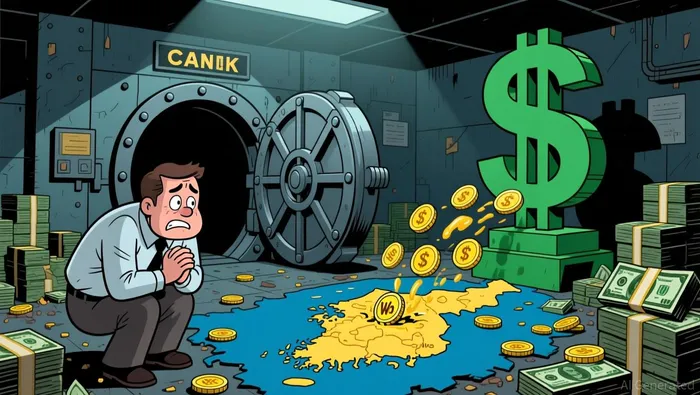
Korea has $427 billion in foreign-exchange reserves, which gives it real firepower. In theory, the Bank of Korea can sell dollars and buy won to push the exchange rate back. It has done so in past episodes.
But reserves are not infinite, and every day of intervention is a choice: spend reserves to slow the decline, or save them for when the pressure becomes truly systemic. In April, BoK officials actually played down concerns about the won, signaling limited direct intervention and letting the currency reflect what they called more organic market dynamics. The pivot to "immediate measures" on Thursday reads as a response to the political optics of a 17-year low, not a sudden change in the underlying calculus.
Here's what intervention can do: create short-term noise, buy time, signal resolve. What it can't do: change the reason foreign investors are selling Korean stocks. If the selling is driven by a broader dollar rally, geopolitical risk, or a reassessment of emerging-market returns, won buying is a speed bump, not a redirect.
I think this is where the story is most interesting. Currency markets are where the political economy of dollar dominance shows up most plainly. A country like Korea - a strong economy, a close US ally, a major semiconductor and auto exporter - can still be pushed into a 17-year currency low by forces it cannot control. Its reserves, its rate policy, its ministerial warnings: all secondary to the direction of global capital.
The wider frame
This is not happening only in Seoul. The same pattern is playing out across small and medium export economies simultaneously dealing with US tariff pressure, dollar strength driven by geopolitical risk, and their own domestic growth worries. The won is a readable case study because the data is transparent and the government has been vocal. But the constraint is shared.
What would change the trajectory? Either foreign selling slows - which requires a change in global risk appetite or a convincing Korean growth story - or the BoK accepts the inflation cost of hiking. Neither is politically painless. Intervention can delay the moment but not resolve the choice.
I'm more interested in watching what happens at the next rate meeting than the next intervention announcement. The won's path tells you about capital flows. The rate decision tells you about how much political power the central bank actually has when its two main mandates - price stability and growth - point in opposite directions. In a fragmented, tariff-charged world, small-economy central banks are learning that lesson repeatedly.
The finance minister's words matter for Thursday's open. The structural question matters for the rest of the year.