

The market had already braced for bad news. What it got was confirmation that the pain persists-and that the recovery timeline is slipping further out of reach.
Gucci's Q1 revenue of €1.35 billion came in slightly below the €1.37 billion whisper number-the modest miss that triggers the "Sell the News" dynamic. When a stock has been trending lower for months, even a result that barely clears consensus gets punished if it doesn't provide a clear catalyst for change. The 8% year-over-year decline marks the 11th consecutive quarterly contraction, a streak that's become increasingly difficult to discount as temporary 11th straight quarterly decline.
Kering shares dropped 6% on the news, putting the stock down roughly 8% year-to-date Kering's shares are down about 8% this year. The move reflects a market recalibrating expectations downward-not because the numbers were worse than feared, but because they confirmed a trajectory that offers no near-term relief.
The macro backdrop has only deepened the challenge. Tourist spending in Europe fell 20% in Q1, representing a 12-point deceleration versus Q4 Planet VAT refunds fell 25% in February and 20% across the first quarter. Bank of America has cut its organic revenue growth assumption for Gucci to negative territory through Q2, with the Middle East conflict adding another layer of uncertainty BofA now expects Gucci to post negative revenue growth.
This is the core expectation gap: investors had priced in a turnaround beginning this spring. Instead, Gucci delivered another quarter of double-digit weakness, pushing the recovery timeline into late 2026 at earliest. The question now isn't whether the brand can recover-but whether the market has already priced in a revival that may not materialize for months.
Iran War Complicates the Turnaround Calculus
The geopolitical shockwave from the Middle East conflict is reshaping the macro backdrop just as Gucci was supposed to be finding its footing. What was already a difficult environment for luxury goods has been compounded by a supply-side shock that threatens to derail any near-term recovery.
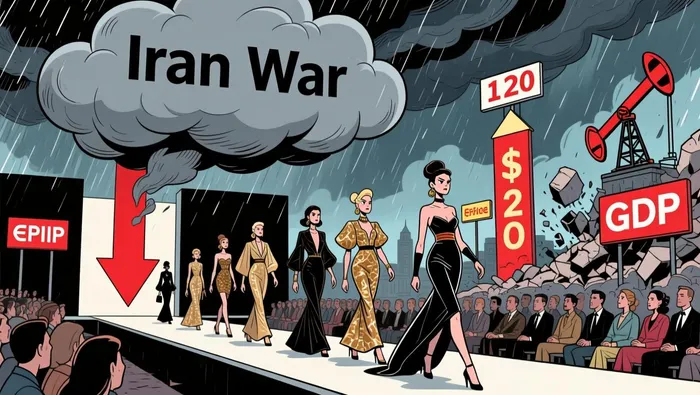
The direct impact is already visible in Kering's regional breakdown: the Middle East conflict triggered an 11% decline in retail revenue in the affected region. This isn't a temporary blip-it's a structural disruption to a key growth market. The Strait of Hormuz closure on 4 March 2026 cut off oil and LNG exports from Gulf states, stranding billions in energy revenue and triggering what the International Energy Agency called the largest supply disruption in the history of the global oil market. Brent Crude surged past $120 per barrel, with production from Kuwait, Iraq, Saudi Arabia, and the UAE dropping by at least 10 million barrels per day.
But the luxury demand destruction goes beyond just higher oil prices. The conflict has shattered the eurozone's fragile recovery. Eurozone inflation hit 2.5% in March, prompting the ECB to signal rate hikes for the first time in years. This is a dangerous combination for luxury goods: rising rates typically cool discretionary spending, and inflation eroding real incomes hits premium brands hardest. The ECB's own bulletin projects the war will cost the eurozone roughly 0.3 percentage points of GDP by end-2026, with real growth slashed to just 0.9%.
For Gucci, this creates a brutal expectation gap. Investors had been pricing in a recovery narrative-maybe delayed, maybe muted, but coming. Now, the macro backdrop has shifted beneath that thesis. The 11% Middle East decline is particularly damaging because it hits a region that was supposed to be a growth engine. Add in the fact that tourist spending in Europe fell 20% in Q1, and the picture becomes clearer: the geopolitical headwinds are not a one-quarter blip, they're a structural shift that extends the recovery timeline.
The question for investors isn't just whether Gucci can survive this-it's whether the market has already priced in a revival that the new macro reality makes unlikely. When the ECB is raising rates and oil prices are volatile, luxury demand doesn't just pause-it contracts. The turnaround calculus now has to account for a world where the macro tailwinds expected for 2026 may never arrive.
Kering's Resilience Play: Can the Jewelry Pivot Offset Fashion Weakness?
Kering's group revenue of €3.6 billion came in line with expectations on a comparable basis-flat year-over-year-despite a 6% reported decline once currency swings hit the numbers revenue stabilized on a comparable basis. That distinction matters. The whisper number was a 5.8% decline. Kering didn't just clear it; it cleared it by walking a tightrope in a world where every other luxury peer is posting double-digit drops.
But the real story isn't the top line-it's the composition.
Jewelry posted 22% comparable growth, a number that stands out like a lighthouse in a storm Jewelry segment sales up 22% on comparable basis. Eyewear delivered €489 million, up 7% on a comparable basis Eyewear revenue up 7% on comparable basis. North America, the one region that wasn't getting crushed by the Middle East conflict or tourist collapse, posted 9% growth North America up 9% on a comparable basis.
This is the diversification arbitrage in action: while Gucci's fashion business contracts for the 11th straight quarter, the non-fashion segments are delivering growth rates that would make most luxury peers jealous. The question is whether this can offset the core weakness-or whether the market has already priced in the pivot.
The stock's reaction tells the story. Kering shares rose 2.62% on the news, closing at 273.8 euros stock rose 2.62% following the announcement. That's not a celebration-it's a shrug. The market had already priced in the jewelry and eyewear strength. What it didn't price in was the durability of that strength relative to the fashion headwinds.
Here's the tension: InvestingPro flags the stock as trading above Fair Value stock trades above Fair Value. Yet the stock is down roughly 8% year-to-date, mirroring Gucci's own decline. The market is rewarding the diversification play-but only up to a point. Once you've already priced in the jewelry tailwind, what's left?
The answer lies in the guidance. Kering's EPS forecast of $8.13 for FY 2026 and $11.95 for FY 2027 implies a recovery trajectory that assumes the jewelry momentum holds EPS forecasts of $8.13 for FY 2026 and $11.95 for FY 2027. But the fashion business-still the overwhelming majority of revenue-continues to contract. The 22% jewelry growth is impressive, but it's a smaller slice of the pie. Even if it keeps accelerating, it can only offset so much fashion weakness.
The expectation gap here is subtle. Investors had priced in a Gucci turnaround beginning in late 2026. Now, with jewelry outperforming and North America holding firm, the thesis has shifted: maybe the group-level numbers stabilize sooner than expected, even if Gucci itself takes longer to turn. That's the diversification play-but it's a play that requires the jewelry segment to keep delivering at a rate that may not be sustainable.
The stock's 64% return over the past year 64% return over the past year suggests the market has already awarded significant credit for this strategy. The question for investors now isn't whether the jewelry pivot works-it's whether the upside remains once the "beat and raise" cycle runs its course. When every quarter becomes a test of whether non-fashion can outpace fashion decline, the margin for error shrinks to zero.
Catalysts & Scenarios: What's the Market Getting Wrong?
The immediate catalyst looms: Kering CEO Luca de Meo is due to unveil his strategic plan within days. The timing is consequential-investors are watching for whether this plan addresses the core problem (an 11th consecutive quarterly decline at Gucci) or offers a credible timeline to growth 11th straight quarterly decline. Most analysts expect Gucci to return to growth only this fall-a delayed but still plausible scenario if conditions stabilize.
But the macro backdrop keeps shifting beneath that timeline.
Tourist spending in Europe fell 20% in Q1, representing a 12-point deceleration versus Q4. That's not a blip-it's a structural hit to a key demand channel for luxury goods. Add in the Iran war, which has shown no signs of resolution, and the picture becomes clearer: the market's recovery thesis assumes a world where the Middle East conflict eases by summer. That assumption is increasingly fragile.
The upside scenario is straightforward: a quick resolution to the Strait of Hormuz disruption restores energy stability, eurozone inflation retreats, and the ECB pauses its rate hike cycle. Luxury demand rebounds as consumer confidence recovers. In this world, Gucci's turnaround arrives in Q3 or Q4 2026 as expected, and the stock re-rates higher. The 8% YTD decline gets erased.
The downside scenario is where the market may be underpricing risk. If the conflict persists-or escalates-the Strait remains closed or heavily restricted, pushing Brent Crude well above $120 and keeping inflation elevated. The ECB is already signaling rate hikes for the first time in years, and eurozone real growth is projected to slow to just 0.9% by end-2026 ECB projects 0.9% growth. In this environment, luxury demand doesn't just pause-it contracts further. The recovery timeline pushes to late 2026 at earliest, possibly into 2027.
Here's what the market is getting wrong: it's pricing in a recovery that assumes the geopolitical environment cooperates. But the Iran war is not a background variable-it's a structural shock that affects energy costs, consumer confidence, and tourist flows simultaneously. The 11% Middle East decline at Kering 11% decline in retail revenue is a leading indicator, not a one-quarter anomaly.
The key watchpoints are clear: de Meo's strategic plan (imminent), Q2 tourist spending data (June), and any movement on the Iran conflict (ongoing). If the plan lacks concrete milestones, or if Q2 tourist numbers remain depressed, the expectation gap widens further. The stock has already priced in a recovery. What it hasn't priced in is the probability that the recovery gets delayed again-or derailed entirely.