

The United States Department of Justice reached a deferred prosecution agreement with Turkey's Halkbank in early March 2026, effectively ending a nearly decade-long criminal case that alleged the state-owned bank processed roughly $20 billion in Iranian oil and gas proceeds to evade U.S. sanctions. The terms are striking for what they don't include: no criminal fine. No admission of guilt. Halkbank agrees to hire an independent compliance monitor and stays barred from transactions benefiting Iran.
If you're reading the headlines, this is a geopolitical thaw story. If you're reading the factor stack, it's a risk-off event layered on top of a margin expansion cycle that was already improving for Turkish banks.
The question isn't whether the settlement is a headline. It's whether it changes the actual return profile for anyone who can invest in Turkish banking, and whether the catalyst matters more than the underlying numbers.
The settlement doesn't move individual Turkish bank stocks. It moves the overhang.
Halkbank itself isn't publicly traded. The major Turkish banks that U.S. investors can access - Garanti BBVA, Akbank, Is Bankasi, Turkbank - trade on the Istanbul Stock Exchange (BIST) and are not directly listed in the United States. The accessible vehicle is the iShares MSCI Turkey ETF (TUR), which holds 73 Turkish companies and is dominated by defense and retail names - ASELSAN at 12.7% and BIM Birlesik Magazalar at 9.3% are the top two positions. Banking exposure exists, but it's fragmented, not concentrated.
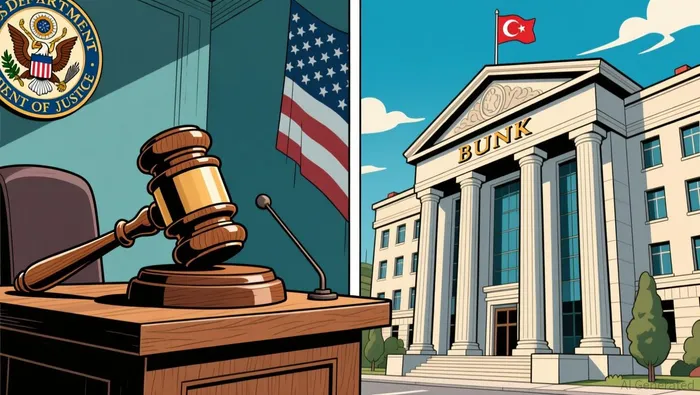
What the settlement does is remove one layer of sanctions risk that has historically made institutional investors nervous about the Turkish banking ecosystem. That matters less if you already own TUR and more if you were sitting on the sidelines waiting for a catalyst. In our framework, catalysts don't create value - they unlock it for people who couldn't act before. Whether that's worth paying for depends on what the underlying factor stack looks like once the noise clears.
The real story is interest rates, not geopolitics.
Here's what's actually driving Turkish banking profitability: the Central Bank of the Republic of Turkey kept its policy rate at 37% through early 2026. Inflation is projected to end 2026 around 23%, per the IMF, meaning the real policy rate - the difference between the nominal rate and inflation - sits at roughly 14 percentage points. Fitch Ratings projects a real policy rate of 4.5% at year-end as rates ease, which is still a highly positive real rate.
Higher net interest margins will likely drive a modest improvement in Turkish banks' profitability this year. Net interest margin is the spread between what banks earn on loans and what they pay on deposits. In a high-rate, high-inflation environment like Turkey's, that spread widens as asset repricing catches up faster than funding costs. It's a mechanical advantage, not a strategic one - but it produces earnings growth regardless of management quality.
The Halkbank settlement is background noise compared to this margin cycle. It removes a tail risk. The margin cycle is the engine.
What TUR actually delivers.
The iShares MSCI Turkey ETF returned 23.5% on a NAV basis in 2026 year-to-date, after a flat-to-negative 2025 (-2.9%). Its 12-month trailing dividend yield sits at 2.14%. Those numbers don't tell you whether the move is valuation recovery or earnings catch-up - and that's the difference between a stock you hold and one you sell.
The fund's top holdings are defense (ASELSAN) and retail (BIM), not banks. Banking exposure is real but diluted. If you want concentrated Turkish banking exposure, TUR is the wrong vehicle. If you want broad Turkey recovery with a banking component, it works. That distinction matters more than the Halkbank headline.
What would change the view.
Three things would shift the calculus here. First: if the CBRT cuts policy rates faster than inflation falls, compressing the real rate and squeezing those net interest margins. Second: if the Halkbank compliance monitor uncovers fresh sanctions violations that reignite the overhang - the agreement includes no fine, but it doesn't include immunity from future enforcement either. Third: if Turkish inflation runs hotter than the IMF's 23% projection, forcing the central bank to hold rates even higher and potentially choking loan demand.
The settlement itself isn't a buy signal or a sell signal. It's a risk reduction event on a name you can't buy, attached to a sector you can access through a fund that doesn't concentrate in it. The actual investing decision sits with the interest rate trajectory and the margin cycle - both of which were improving before the DOJ filed its paperwork in Manhattan.
When the market rallies on geopolitical headlines, check whether the factor stack moved or whether only the narrative did. In this case, the narrative got louder. The factors were already doing the work.