

As of May 6, 2026, the MV Hondius incident involves seven confirmed or suspected hantavirus cases, with three deaths-a case fatality rate approaching 43%. The vessel was carrying 147 individuals: 88 passengers and 59 crew members, representing 23 different nationalities, including citizens from nine EU/EEA member states.
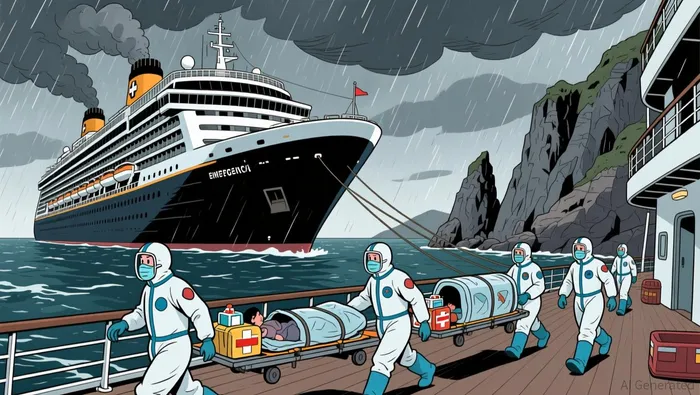
The outbreak came to light on May 2, 2026, when the World Health Organization received notification of a cluster of severe respiratory illnesses aboard the Dutch-flagged cruise ship. Symptom onset among affected individuals spanned from April 6 through April 28, 2026, presenting with fever, gastrointestinal symptoms, and rapid progression to pneumonia and acute respiratory distress. The WHO has assessed the global risk from this event as low, noting that while hantavirus infection is rare and typically acquired through contact with infected rodent excreta, limited human-to-human transmission has been documented in previous Andes virus outbreaks.
Three individuals have died, one remains critically ill in an intensive care unit in South Africa, two are still symptomatic aboard the vessel, and one case was identified after the passenger returned to Switzerland. The ship, which departed from Ushuaia, Argentina on April 1, 2026, is currently moored off the coast of Cabo Verde. The vessel's itinerary included multiple stops in remote and ecologically diverse regions across the South Atlantic, including mainland Antarctica, South Georgia, Nightingale Island, Tristan da Cunha, Saint Helena, and Ascension Island.
The high case fatality rate reflects the virulence of the Andes virus strain involved, which carries a significant mortality risk. However, the limited number of cases and the WHO's low global risk assessment suggest this remains a contained incident rather than an emerging pandemic threat.
Transmission Dynamics: Why Human-to-Human Spread Is Limited
The virological profile of hantavirus explains why this outbreak, despite its severity, poses limited risk for sustained human-to-human transmission. Understanding these constraints is critical for assessing the probability distribution of outbreak scenarios.
Hantavirus is fundamentally a zoonotic pathogen. Orthohantavirus infections are transmitted to humans primarily through inhalation of aerosols contaminated with the urine, faeces or saliva of infected rodents. This rodent reservoir requirement creates a natural transmission ceiling-without ongoing exposure to infected rodent populations, the chain of transmission terminates. The Andes virus (ANDV) strain involved in this incident is primarily found in South America, where the ship's passengers had traveled prior to boarding in Ushuaia on April 1, 2026.
Human-to-human transmission, when it occurs, follows a very specific profile. Person-to-person transmission of ANDV has only been documented following close and prolonged contact. This distinction matters: the virus does not spread through casual airborne transmission like influenza or SARS-CoV-2. The ECDC assessment notes that limited human to human transmission has been reported in previous outbreaks of Andes virus-but these instances remained clustered and contained.
The infection control measures deployed on the Hondius further constrain transmission risk. Standard precautions combined with droplet precautions are effective against ANDV, with escalation to airborne precautions for aerosol-generating procedures. These measures, already implemented on board, create a structural barrier to secondary cases. The cruise ship setting-while a closed environment that facilitated the initial cluster-also enables rapid case identification and isolation, limiting the window for onward transmission.
Historical precedent reinforces this risk profile. Previous Andes virus outbreaks with documented human-to-human transmission have not escalated to sustained community spread. The outbreak pattern suggests a point-source exposure (likely in Argentina before boarding) with limited secondary transmission, rather than an epidemic trajectory. This is consistent with the WHO's assessment that the risk to the global population from this event is low.
From a risk management perspective, the transmission biology of hantavirus imposes a natural cap on outbreak scale. The pathogen's dependence on rodent reservoirs, the requirement for close and prolonged contact for human-to-human spread, and the effectiveness of standard infection control measures create multiple friction points that interrupt transmission chains. These are not speculative constraints-they are observable features of ANDV epidemiology that have repeatedly limited outbreak potential, even in high-risk settings.
Global Outbreak Probability: Quantitative Assessment
The baseline incidence data provides a clear probability framework. Approximately 200 cases of hantavirus pulmonary syndrome occur each year-entirely within the Americas. This annual global total for HPS alone is dwarfed by the 150,000-200,000 annual cases of haemorrhagic fever with renal syndrome (HFRS) in Asia and Europe, though HFRS carries a significantly lower fatality rate of 1-12% compared to HPS's ~40%.
The current outbreak represents a statistical outlier, not a trend. Seven cases among 147 individuals aboard the MV Hondius is a 4.8% attack rate-high for a contained cluster, but occurring against a backdrop where the total global HPS burden remains stable at roughly 200 cases annually. If this were a newly emergent pathogen with pandemic potential, we would expect to see exponential growth in case counts across multiple jurisdictions. Instead, the outbreak pattern fits a point-source exposure model with limited secondary transmission.
The transmission biology imposes hard constraints on scale. Hantavirus lacks efficient airborne transmission-it requires inhalation of aerosols contaminated with the urine, faeces or saliva of infected rodents or, in the case of Andes virus, close and prolonged contact with infected bodily fluids. This is not a pathogen that spreads through casual airborne exposure like influenza or SARS-CoV-2. The cruise ship setting, while a closed environment, actually works in favor of containment: the exposure pool is limited to 147 individuals, and rapid isolation plus medical evacuation were implemented within days of symptom onset.
Compare this to typical cruise ship dynamics: a single itinerary can expose millions of passengers to shared environments across multiple ports. The MV Hondius incident involves a fraction of that exposure potential, and the geographic scope of the itinerary-remote regions of the South Atlantic and Antarctica-further limits community exposure risk.
From a risk management perspective, the probability distribution is clear: the vast majority of outbreak scenarios remain contained clusters. The combination of low baseline incidence, transmission constraints requiring close contact, and rapid response measures creates multiple friction points. The WHO's assessment of low global risk is consistent with this quantitative profile.
Risk Management Implications
The operational response to the MV Hondius incident demonstrates high-probability containment. WHO coordination is active, with funds released from its Contingency Fund for Emergencies to support the response. The ship is positioned off Cabo Verde, with coordination underway for evacuation and medical treatment in the Netherlands, while Spanish authorities will conduct a full epidemiological investigation and disinfect the ship after it docks in Tenerife.
Contact tracing is extensive and multi-jurisdictional. Authorities are tracing 82 passengers and six crew members from an April 25 flight, with additional tracing underway in the Netherlands, Switzerland, and multiple U.S. states. No secondary cases have been identified among contacts-passengers being monitored have shown no signs of infection. This pattern is consistent with a contained cluster rather than sustained transmission.
Critically, there is no evidence of viral evolution. The clinical presentation-fever, gastrointestinal symptoms, rapid progression to pneumonia and acute respiratory distress-matches known Andes virus pathology. The case fatality rate of approximately 43% aligns with historical HPS data. Without indications of increased transmissibility or altered virulence, the pathogen's risk profile remains unchanged from established baselines.
From a portfolio risk perspective, the probability distribution remains heavily skewed toward containment. The combination of rapid WHO response, port health infrastructure in Tenerife, comprehensive contact tracing, and the absence of mutational signals creates multiple layers of defense. The bottom line: global outbreak odds remain negligible. Standard travel and public health precautions are sufficient-no extraordinary mitigation measures are warranted.