

The current outbreak involves eight reported cases-five confirmed by testing and three suspected-with three fatalities. All cases are linked to the MV Hondius cruise ship itinerary in South America, with no additional cases identified in countries where passengers have returned including the United States.
The biological constraints on transmission are significant. This is the Andes virus strain, the only hantavirus type known to transmit human-to-human according to Dr. Emily Abdoler. Even with this capability, transmission requires prolonged close contact-there is no evidence of sustained community spread or airborne transmission characteristic of respiratory viruses like influenza or SARS-CoV-2.
The World Health Organization has been explicit about the transmission dynamics. "This is not COVID, this is not influenza. It spreads very, very differently," said Maria Van Kerkhove, director of epidemic and pandemic management at WHO at a press conference on Thursday. The basic reproduction number (R0) for hantavirus is substantially lower than pandemic respiratory viruses, meaning each infected individual infects far fewer secondary cases.
To put the scale in perspective: the CDC has documented 864 hantavirus cases in the United States between 1993 and 2022, with 38 cases reported in 2025 alone according to CDC surveillance data. The current outbreak represents a concentrated cluster tied to a specific exposure event-likely initial infection at a landfill near Ushuaia, Argentina, where the infected couple was bird watching before boarding the cruise.
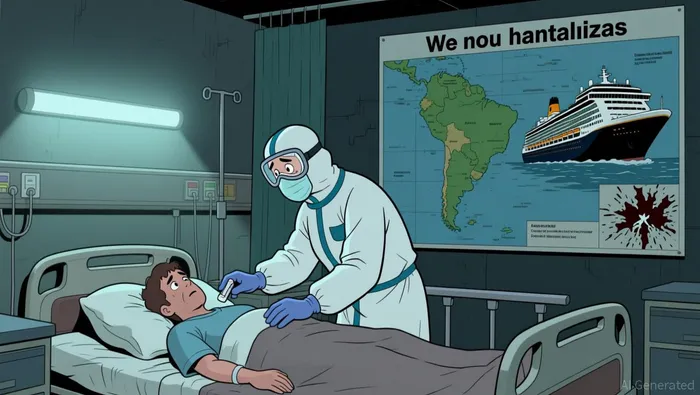
From a risk modeling perspective, the combination of low R0, transmission requiring prolonged close contact, and the absence of community spread outside the cruise ship cohort keeps the statistical probability of a pandemic event negligibly small.
Historical Baseline: Why This Doesn't Signal a Pandemic
The numbers speak clearly: hantavirus is exceptionally rare, even in endemic regions. Since the CDC began monitoring the disease in 1993, a total of 857 cases have been recorded in the United States according to CDC surveillance data. That averages to fewer than 30 cases per year across a population of 330 million people.
The geographic distribution reveals even more about the virus's constraints. Ninety-four percent of all US hantavirus cases occur west of the Mississippi River according to CDC data. The burden falls heavily on a few states: New Mexico leads with 126 cases, Colorado follows with 120, and Arizona accounts for 91 from 1993 to 2023. These three states alone represent the vast majority of the nation's hantavirus burden, and even in these high-incidence regions, annual case counts remain in the double digits at most.
The outbreak origin confirms this is a rodent-exposure event, not the beginning of sustained community transmission. The Dutch couple became infected during wildlife expeditions off the cruise ship itinerary - a classic hantavirus exposure scenario involving contact with rodent droppings or urine as documented in the outbreak investigation. This is the same transmission pathway that accounts for virtually all US hantavirus cases.
From a portfolio risk perspective, the historical baseline matters. A virus that averages fewer than 30 cases annually in a large, mobile population - with 94% concentrated in specific western regions - demonstrates fundamental biological and ecological constraints on spread. The current outbreak, while tragic, falls within the expected range of hantavirus epidemiology. It does not represent a structural break from historical patterns that would warrant pandemic-level preparedness resources.
Risk Assessment: Why the General Public Face Minimal Exposure
The clinical course of hantavirus imposes a natural containment mechanism that fundamentally limits transmission opportunities. Infected individuals deteriorate rapidly-typically within days of symptom onset-requiring hospitalization or, tragically, resulting in death according to Dr. Jeanne Marrazzo. This rapid progression means exposure windows are inherently brief, unlike respiratory viruses where individuals remain ambulatory and socially active during peak infectiousness.
The absence of a licensed antiviral treatment is a clinical limitation, but it does not translate to elevated transmission risk. Supportive hospital care is the only intervention needed, and the disease simply does not spread efficiently in community settings as emphasized by WHO's Maria Van Kerkhove. The Andes virus strain can transmit human-to-human, but only through prolonged close contact-there is no evidence of sustained community spread or airborne transmission characteristic of pandemic respiratory viruses.
From a surveillance standpoint, the monitoring infrastructure is actively engaged. The CDC has raised its travel response to level 3 and is coordinating with state health departments to track disembarked passengers according to the 2026 timeline. At least five U.S. states have reported passengers who returned from the ship, yet no secondary cases have been identified within the country despite this monitoring effort. This absence of secondary transmission, even with active case-finding, is a meaningful signal.
The WHO has been consistently explicit about risk classification. "I want to be unequivocal here. This is not the start of a COVID pandemic," Van Kerkhove stated at a Thursday press conference emphasizing the distinction from pandemic respiratory viruses. The organization has repeatedly classified risk to the general public as low, with no evidence of community transmission in any country outside the concentrated cruise ship cohort.
From a portfolio risk perspective, the combination of rapid clinical deterioration, lack of efficient community spread, and active surveillance with zero secondary cases creates a low-probability, low-impact scenario. The statistical probability of sustained transmission chains remains negligibly small, and the public health impact is contained to a concentrated exposure event rather than broad community dissemination.
Catalysts and Watchpoints
The current risk profile rests on three fragile assumptions-and each one can be tested.
The first watchpoint is geographic dispersion. All eight cases remain tied to the MV Hondius cohort-passengers, crew, or individuals with direct contact to the ship's itinerary including the suspected case on Tristan da Cunha. The moment we observe confirmed cases in multiple countries among travelers who never boarded the ship, or cases emerging in communities with no cruise ship exposure, the model breaks. That would signal community transmission taking hold-a structural shift from a concentrated exposure event to sustained circulation.
The second watchpoint is biological. The Andes virus already carries the rare capacity for human-to-human transmission, but it requires prolonged close contact. The critical question: does the virus acquire mutations that enhance respiratory efficiency? Such a change would be detectable in surveillance data as secondary cases appearing beyond close contacts-family members, healthcare workers, or others with brief exposure. No such pattern exists today according to WHO updates, but it is the primary mutation scenario risk modelers track.
The third watchpoint is transmission chain length. Current data show the outbreak began with a Dutch couple infected during wildlife expeditions off the cruise itinerary before boarding the ship. All subsequent cases trace to that initial exposure event. If any country reports secondary transmission chains extending beyond close contacts of confirmed cases-particularly in regions with no cruise ship linkage-the R0 calculation shifts, and the pandemic risk profile changes materially.
From a portfolio perspective, these three watchpoints represent binary risk events. The probability of any single one occurring remains low given current data. The probability of all three converging is vanishingly small. But the impact of a positive signal on any watchpoint would be immediate and substantial-triggering revised travel advisories, expanded surveillance, and likely a step-change in preparedness resources.
For now, the absence of signals on all three fronts is the meaningful data point. The suspected Tristan da Cunha case reported by UK authorities remains classified as suspected, not confirmed-and it remains linked to the ship's itinerary. The CDC's level 3 travel response reflects precaution, not elevated risk. And the historical baseline holds: 38 cases in the United States in 2025, consistent with the annual average according to CDC surveillance data.
The risk profile remains contained. But these are the variables that would change the equation.