

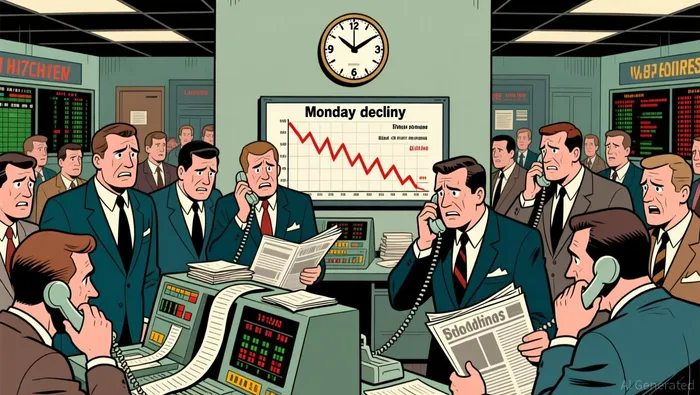
The Monday blues aren't just a workplace sentiment-they were once a documented market anomaly that challenged finance's core theories. The Monday effect, also known as the weekend effect, describes a pattern where stock prices tend to be lower on Mondays compared to Fridays. This wasn't a fleeting quirk; research suggests it existed as far back as 1885, spanning over a century of market data.
The pattern caught formal academic attention in 1981 when Gibbons and Hess published their analysis, giving the phenomenon its scholarly name. But the real significance of the Monday effect lies in what it represented: a direct contradiction to the efficient market hypothesis. According to that theory, stock prices should follow a random walk, making predictable patterns impossible to exploit. Yet here was something that looked remarkably like a predictable pattern-prices consistently higher on Fridays, lower on Mondays.
This created a tension that bothered economists. If markets were truly efficient, anomalies like the weekend effect shouldn't exist. The very presence of a recurring pattern implied that investors could, in theory, time their trades to capture abnormal returns. That implication alone was enough to make the Monday effect a prominent topic in behavioral finance research.
But here's what made it particularly interesting from a behavioral perspective: the effect likely wasn't driven by fundamental value changes. Instead, it pointed to the kind of systematic biases that occur when human psychology meets market structure. The settlement system, news timing, and investor sentiment all interacted in ways that created this weekly rhythm. The effect was real-but it was also a product of specific institutional arrangements and behavioral tendencies, not a reliable strategy for beating the market.
The Behavioral Drivers: Why Mondays Were Different
The Monday effect wasn't just a statistical curiosity-it was a behavioral fingerprint left by specific cognitive and institutional mechanisms. To understand why Mondays consistently underperformed, we need to examine three interconnected drivers: the settlement effect, bad news timing, and the emotional aftermath of the weekend break.
The settlement effect created a structural incentive that exploited investor behavior. When investors bought stocks on Friday, they enjoyed a longer settlement period-three business days meant their shares wouldn't arrive until Wednesday, whereas Monday purchases settled by Thursday. This timing advantage encouraged Friday buying, pushing prices up at week's end. Conversely, Monday selling meant shorter settlement windows, creating a natural imbalance that depressed opening prices. It wasn't about fundamentals; it was about the mechanical advantages built into the trading calendar.
Then there's the matter of when information arrives. Companies learned that releasing unfavorable news after the Friday close meant the market would process that information over the weekend, when investors weren't actively trading. By Monday open, the negative sentiment had already settled, producing the characteristic Monday dip. This wasn't random-it was strategic information timing that capitalized on the market's weekly rhythm.
But the most psychologically interesting driver is sentiment itself. The weekend break isn't just empty time-it's when investors process the week's events, consume news, and form expectations. Pessimistic sentiment on Mondays isn't merely about returning to work; it's about the accumulation of negative information over two non-trading days without the corrective mechanism of active trading. When markets reopen Monday, that pent-up sentiment releases all at once.
What's particularly telling is how these mechanisms interact. The settlement effect created the initial price distortion. Bad news timing amplified it. And investor sentiment-our emotional response to uncertainty-sustained it. Together, they produced a pattern that looked like rational pricing but was actually the product of systematic biases: recency bias (the weekend's news feels fresh), availability heuristic (negative stories are more memorable), and loss aversion (the fear of holding through uncertain weekends).
The behavioral insight here is crucial: the Monday effect persisted not because investors were irrational in the moment, but because the market structure created predictable psychological triggers. When you combine institutional mechanics with human emotional responses, you get anomalies that efficient market theory simply cannot explain.
The Great Disappearance: When and Why the Effect Vanished
Here's the twist that makes the Monday effect such a compelling case study in behavioral finance: it's gone. The pattern that puzzled economists for decades, the anomaly that seemed to contradict efficient market theory, vanished without a trace-and researchers only realized it because they looked at enough data to see the whole picture.
Geoffrey Smith and Russell Robins examined 4,200 Mondays of stock returns from 1926 through 2014, using a statistical method that lets the data reveal when patterns change. They found a clear break point in 1975. That year marks the dividing line between an effect that was real and measurable and one that became indistinguishable from random noise.
The numbers tell the story. From 1926 through 1974, Monday returns averaged down by 18.1 points. That's a substantial weekly discount-a clear pattern that investors could have potentially exploited. But from 1975 through 2014, Monday returns averaged down by only 5 points, a tiny amount that isn't statistically significant. In Smith's words: "It's effectively zero."
This finding carries important implications for how we think about market anomalies. The Monday effect persisted for roughly five decades, then disappeared abruptly. The timing matters: the major studies that tried to explain the effect-Gibbons and Hess in 1981, and others in the early 1980s-were actually analyzing a phenomenon that had already vanished. All these studies that try to explain this weird "weekend effect" are explaining something that disappeared in 1975.
What changed in the mid-1970s? The evidence doesn't give us a single smoking gun, but several structural shifts in market mechanics occurred around that time. The settlement system evolved, trading hours became more standardized, and institutional participation increased. Any of these changes could have disrupted the behavioral triggers that sustained the Monday effect.
From a behavioral finance perspective, this disappearance is actually reassuring. It suggests that the Monday effect wasn't rooted in some deep, immutable feature of human psychology. If it had been-if it were truly about fundamental cognitive biases like loss aversion or recency bias-it should have persisted regardless of market structure. Instead, the effect was likely the product of specific institutional arrangements interacting with human tendencies. Change the institutions, and the anomaly disappears.
The irony is rich: researchers spent years explaining an effect that was already dead. The market had self-corrected, likely because once enough participants became aware of the pattern, arbitrageurs exploited it until it vanished. This is exactly what efficient market theory predicts-anomalies shouldn't persist indefinitely if they're exploitable.
For investors and analysts, the lesson is clear: what looks like a persistent pattern may be a temporary artifact of specific conditions. The Monday effect was real, but it was also contingent. And that contingency is the key to understanding why it disappeared-and why other anomalies might vanish too.
What This Means for Today's Traders
The Monday effect is gone-and that's the most important thing for investors to understand before considering any trading strategy based on day-of-the-week patterns. The anomaly that puzzled economists for decades, the one that seemed to offer a predictable weekly rhythm, vanished back in 1975. Smith and Robins found the effect disappeared-Monday returns since then are effectively indistinguishable from random noise.
Don't try to trade it. Any strategy built on buying on Mondays and selling on Fridays is chasing a ghost.
But here's the behavioral insight that matters: while this specific anomaly disappeared, the underlying psychological mechanisms didn't. The same cognitive biases that created the Monday effect-loss aversion, recency bias, sentiment-driven decision-making-still operate in markets today. They've just found new expressions.
Consider what's happened to similar patterns. The January effect-the tendency for small-cap stocks to outperform in January-showed average outperformance of 0.82% from 1972 to 2002, but has largely disappeared in recent years. Why? Because once an anomaly becomes known, arbitrageurs exploit it until it vanishes. The market self-corrects.
This is the crucial lesson: market inefficiencies are often temporary artifacts of specific conditions, not permanent features. The Monday effect persisted for roughly five decades because the institutional arrangements that created it-the settlement system, news timing, limited trading hours-remained stable. Change those conditions, and the anomaly disappears.
Yet the story isn't entirely one of market efficiency winning. Recent research shows the Monday effect persists in emerging markets, where retail participation is higher and sentiment effects are stronger. This suggests the anomaly wasn't about human psychology per se, but about how specific market structures amplify or dampen behavioral tendencies.
For investors and analysts, the takeaway is nuanced. Don't look for easy patterns in price data and assume they'll persist. But also don't assume markets are fully efficient. Behavioral biases create predictable distortions-they just migrate. Momentum effects, sentiment-driven volatility, the reaction to news cycles: these are the modern manifestations of the same psychological forces that drove the Monday effect.
The real value of studying anomalies like the Monday effect isn't in finding exploitable patterns. It's in understanding the conditions that allow inefficiencies to exist-and recognizing that those conditions are always changing. The market is a living system, constantly adapting to the very behaviors that create opportunities. What works today may be gone tomorrow. The only constant is the human psychology that drives it all.