

The wire headlines say oil is rising after Iran fires missiles at Israel. Stock futures are drifting lower. The instinct is to assume another supply shock is underway. I disagree. The story this time is different, and the difference matters for anyone who actually invests in oil and gas equities rather than headlines.
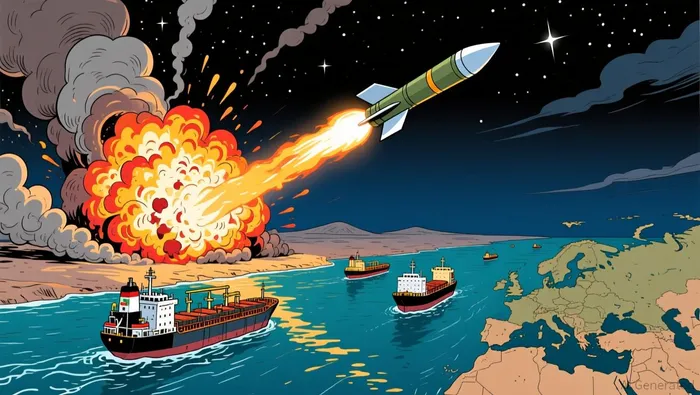
Iran fired roughly ten ballistic missiles at northern Israel on June 7th - its first direct strike since the fragile April truce. The trigger was Israel striking civilian areas in Beirut, Lebanon. Iran also closed its western airspace and threatened US targets. The geopolitics are real, and they are dangerous. But the supply story the market is repricing is not new. It is months old.
The Strait of Hormuz - the narrow waterway that normally handles roughly 15 million barrels per-day of crude and oil product exports - was effectively closed to commercial shipping starting March 1st, 2026. Iran announced a full reopening on April 17th, but President Trump maintained a US blockade on Iranian-linked shipping. As of early June, independent monitors still describe the strait as effectively closed to most shipping traffic. That disruption has been the primary driver of oil prices for over 90 days. The market already absorbed it.
So what is the June 7th move? Brent crude rose to $95.65 per barrel that day - up roughly 2.75%. WTI sat near $93. These are not panic numbers. Brent peaked above $120 back in April during the initial war escalation, when the strait first closed and the scale of the disruption became undeniable. Since then, prices have rolled back nearly 25%. The current level reflects a market that has worked through the worst-case supply math and is now pricing in the possibility - however fragile - of eventual de-escalation.
Here is what the headlines are not telling you. The IEA reported in May that global oil supply will fall by approximately 3.9 million barrels per day across 2026 due to the war. The EIA, in its May Short-Term Energy Outlook, sees inventories declining by 2.6 million barrels per day on average this year. Both agencies are cutting demand forecasts too - the IEA expects oil demand to contract by 80,000 barrels per day in 2026. The supply deficit is enormous, but the demand destruction is the pressure-release valve the market keeps forgetting.
Now let's talk about what actually matters for investors: cash flow.
The 38 E&P companies tracked by RBN Energy saw profits surge in the first quarter of 2026 as oil prices soared above $100 per barrel during the March escalation. These were not thin-margin results. These were windfall quarters for companies that have spent years cutting costs and running lean. And despite the cash flow bonanza, Lower 48 producers maintained disciplined capital spending, according to Q1 2026 earnings analysis from Nova Labs. They are not throwing money at unnecessary rigs. They are generating cash, paying down balance sheets, and returning capital to shareholders.
That combination - record cash flow generation with restrained capex - is the real investment thesis, not the missile headline. For an E&P investor, the question is not whether Iran will fire another round of missiles. The question is whether the companies you own can convert high commodity prices into free cash flow and balance-sheet strength while peers blow through cash trying to grow production. The Q1 data says the best operators are already doing it.
From a valuation perspective, the picture is even more interesting. If Brent holds in the $95 range - and the structural supply deficit from the Hormuz disruption suggests it should - E&P companies that were fairly valued at $70-per-barrel oil are now generating cash flows 35% above the levels the market used to price them. That gap between the cash-flow reality and the stock price is where the value lives.
While it's true that the geopolitical situation is unstable and the truce remains fragile, I would argue that this instability is precisely what creates the opportunity. Retail investors and headline traders react to the missiles. They sell on the scare. The companies with real assets, real cash flow, and real balance-sheet discipline don't care about the headline cycle. They care about the price of oil, and that price is being held up by a supply deficit that is months old and still widening.
Even if the ceasefire collapses completely and the Strait of Hormuz goes fully dark again, the E&P names with strong balance sheets and fee-adjacent midstream partners are still the ones positioned to survive and profit. The market's fear response to each escalation creates the exact buying opportunity that deep-value investing is built to exploit.
For midstream investors, the case is different but equally strong. Midstream companies with fee-based contracted revenue - the kind of cash flows that don't depend on whether Brent is $95 or $120 - are getting sold off alongside commodity-exposed names every time a headline fires. That is a mispricing. A pipeline company with 85%+ fee-based EBITDA and a covered distribution does not need oil to stay high. It needs volume to move, and volumes have been structurally resilient even through the Hormuz disruption because global refineries keep running on available feedstock.
All things considered, the June 7th escalation is noise layered on top of a supply story the market already knows. The missile headlines will fade. The cash flows won't. For E&P investors, the Q1 2026 results prove the cash-flow engine is running hot. For midstream investors, the panic selloffs on geopolitical headlines create exactly the kind of dislocation that fee-based cash flows were built to survive. I would not be chasing the fear trade. I would be looking at the cash-flow data and buying the names the market is abandoning on reflex.
The opportunity is not in the headline. It is in the gap between the headline and the numbers. That gap is wide right now. It will not stay that way forever.