

Holcim's fourth-quarter results delivered a clear signal: underlying business momentum is strong, but it was partially obscured by a powerful currency headwind. The company reported sales of 3.82 billion Swiss francs, a 4.8% year-over-year decline. Recurring operating profit fell slightly to 601 million francs, down 0.8%. On the surface, these figures look like a slowdown. The culprit was the appreciation of the Swiss franc, which reduced reported sales by 206 million francs and operating profit by 41 million francs during the quarter.
Look past the headline numbers, and the story changes. On a local-currency basis, which strips out the impact of exchange rate swings, the company's performance was robust. Sales grew 3.4%, and recurring operating profit surged 12.2%. This divergence is the key takeaway. It indicates that demand for Holcim's products-cement, aggregates, and its higher-margin Building Solutions-is solid in the markets where it operates, even as the stronger Swiss franc dampened the reported financials.
This underlying strength is the foundation for the company's forward guidance. Management expects to grow sales by 3-5% in 2026, a target that aligns with the local-currency growth seen in Q4. More importantly, it anticipates an 8% to 10% improvement in operating profit for the year. The 12.2% local-currency profit jump in the final quarter suggests the company is on track to meet or exceed that ambitious target, provided currency volatility doesn't intensify.
This trajectory is set against the backdrop of the NextGen Growth 2030 strategy. The plan aims to leverage sustainability leadership and expand high-value Building Solutions to drive profitable growth. The Q4 results, once adjusted for currency, show that this strategy is beginning to take hold, with local-currency profit growth significantly outpacing sales growth. For investors, the message is clear: the currency drag is a temporary reporting effect. The real story is one of improving profitability in core markets, a trend that supports the company's ambitious 2026 targets.
Demand for Sustainable Materials: Volume, Revenue, and Market Share
The structural demand tailwind for sustainable construction materials is not a future possibility; it is a present, powerful force. The cement industry itself is the engine of this shift, responsible for approximately eight percent of global CO₂ emissions. This massive decarbonization pressure is creating a fundamental market need that Holcim is strategically positioned to fill.
This pressure is translating directly into market demand for the company's sustainable offerings. Holcim's NextGen Growth 2030 strategy explicitly aims to be the leading partner for sustainable construction, and its innovation pipeline demonstrates how it is capturing this demand. The company is scaling solutions like low-carbon cement, which uses alternative fuels and clinker substitutes, and pioneering new materials such as biochar. As highlighted in its 2026 outlook, biochar is moving from a niche experimental additive to a high-performance material, with successful pilot projects proving its ability to reduce emissions without compromising structural integrity. This kind of tangible progress reassures developers and accelerates mainstream adoption.
The company's positioning is further strengthened by its focus on high-value Building Solutions and its strategic expansion in key growth regions. The NextGen strategy targets accelerating growth in Latin America to benefit from strong fundamentals and industrialization trends. This dual focus-on advanced, sustainable products and on expanding into dynamic markets-creates a powerful revenue and volume growth engine. By offering tailored solutions for the world's rapid urbanization, Holcim is not just responding to demand; it is defining the future of construction materials. The bottom line is that the decarbonization imperative is a massive, non-negotiable market driver, and Holcim's integrated approach to sustainability and regional growth is designed to capture a significant share of this expanding pie.
Production and Supply Trends for Low-Carbon Materials
The strategic pivot toward sustainability is fundamentally reshaping Holcim's production footprint. Scaling high-value Building Solutions and low-carbon cement isn't just about selling new products; it requires a complete overhaul of the supply chain, from raw material sourcing to on-site processing. This shift is creating new, specialized production demands that the company must successfully navigate to capture its growth targets.
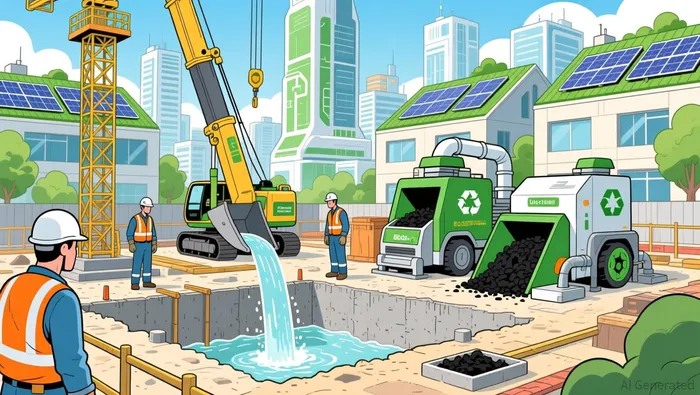
The core of this transformation is the move away from traditional, high-clinker cement. As the industry faces massive decarbonization pressure, the solution lies in materials like low-carbon cement and supplementary cementitious materials (SCMs). These products contain less clinker and more aggregates such as blast furnace slag, fly ash, or processed construction waste. This substitution significantly cuts emissions per ton, but it introduces new requirements for material quality and consistency. The increased use of recycled construction demolition materials, a key part of Holcim's circular economy goal, demands advanced recycling technology and crushing plants capable of separating materials by type, removing contaminants, and achieving precise grain sizes. This technical shift is changing the requirements for construction machinery, recycling technology, and material processing on the construction site.
Evidence of this scaling is emerging in specific innovations. Holcim is moving beyond pilot projects to mainstream applications for materials like biochar, a carbon-negative additive produced from organic waste. The company has proven its viability through high-profile projects, including a net-zero concrete prototype at the Venice Biennale and a trial with Canary Wharf Group. Similarly, calcined clay is being positioned as a key ingredient to halve cement's CO2 footprint. These are not theoretical concepts; they represent tangible steps to expand the supply of specialized, lower-carbon materials.
The investment case hinges on Holcim's ability to manage this complex transition. The company must successfully scale these new production processes while absorbing the associated costs of decarbonization and circular economy infrastructure. At the same time, it aims to capture premium pricing for its sustainable offerings and drive volume growth through its expanded Building Solutions portfolio. The bottom line is that supply capacity is not keeping pace with demand simply by building more of the old product. It requires a strategic, capital-intensive build-out of new capabilities, from R&D to recycling plants. For Holcim, the path to profitable growth is inextricably linked to its success in scaling this new, sustainable supply chain.
Catalysts and Risks: The Supply-Demand Balance in Q1 2026
The immediate test for Holcim's strategy arrives today. The company is scheduled to release its Q1 2026 trading update on April 24, 2026. This report will provide the first concrete data point on whether the strong local-currency growth trends seen in the final quarter of 2025 are holding. Investors will scrutinize it for confirmation of sales momentum and any fresh currency impact, which could validate or challenge the path toward the ambitious 8% to 10% operating profit improvement target for the full year.
The key investment risk, however, lies beneath the surface of these headline numbers. The company's push for sustainability requires massive capital expenditure to scale new production processes for low-carbon cement and Building Solutions. Progress on these decarbonization investments will directly pressure margins and cash flow in the near term. The market will be watching to see if the projected profit leap can be achieved despite these outlays, or if the capital intensity of the transition creates a temporary drag.
Regulatory developments also act as a powerful catalyst. The massive decarbonization pressure on the cement industry is increasingly being formalized into policy. Watch for new carbon pricing mechanisms or mandatory sustainable construction standards in key markets. Such regulations could accelerate the shift in demand toward Holcim's sustainable offerings, effectively tipping the supply-demand balance in its favor. Conversely, delays or weaker enforcement could slow the adoption of new materials, prolonging the industry's reliance on high-emission products.
For now, the supply-demand balance in sustainable materials hinges on three near-term metrics. First, the Q1 trading update must confirm the local-currency growth trajectory. Second, the company must demonstrate that its capital allocation for decarbonization is on track without derailing the 2026 profit target. Third, regulatory momentum will determine the pace at which demand for its sustainable solutions can expand. These are the factors that will decide if Holcim's strategic pivot translates into sustained financial outperformance.