

Summary
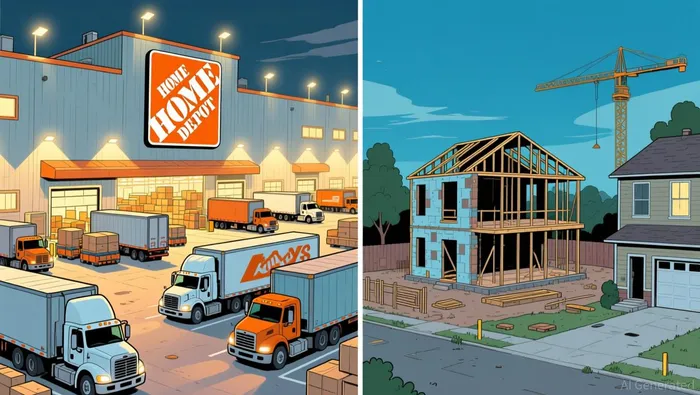
- The company headlines are calling a "Home Depot rival" - North American Builders Supply - is a single-location Illinois building materials distributor. The bankruptcy comparison is not only unjustifiable; in my opinion, it is irresponsible clickbait.
- The real home improvement sector story isn't bankruptcy contagion. It's a dramatic slowdown in same-store sales growth at Home Depot and Lowe's, combined with diverging free cash flow trajectories.
- Home Depot's FCF fell 9% to $16.3 billion in fiscal 2025, while comps decelerated to +0.6% in Q1 FY2026 - a far cry from the double-digit growth that drove the sector's last bull run.
- Lowe's generated only $7.8 billion in FCF but grew it 25% year-over-year, and offers a slightly higher dividend yield of approximately 2.01%.
- I rate Home Depot as a Buy at current levels for its dividend commitment and cash-generation scale, and Lowe's as a Hold. The sector is under pressure, but the structural moat remains intact.
I always keep an eye out for irrational false narratives that frequently take the retail press by storm - and the latest one is the claim that a "Home Depot rival" has filed Chapter 11 bankruptcy.
The company in question is North American Builders Supply, a Yorkville, Illinois-based building materials supplier that filed Chapter 11 on December 3, 2025, seeking to restructure its debt. This is a regional distributor with essentially a single retail location and a wholesale operation serving local contractors. It has nothing resembling the scale, market share, or competitive footprint of Home Depot or Lowe's.
Comparisons with either megacap are not only unjustifiable and irrational; in my opinion, they are irresponsible. North American Builders Supply is a plumbing-and-millwork distributor that sells lumber, windows, and trim to regional builders. It does not compete in the $150+ billion national home improvement retail market. One-outlet regional distributors have always been fragile - they lack the supply chain leverage, buying power, and scale economics that protect the duopoly at the other end of the industry.
The bankruptcy headlines exist because publishers need to connect a small filing to a big name. The real story investors should focus on is entirely different: Home Depot and Lowe's are facing a genuine structural slowdown in their core business, and the data is becoming impossible to ignore.
The comp-store slowdown is the real signal
Home Depot reported Q1 fiscal 2026 results in May 2026 that beat on both adjusted EPS ($3.43 versus $3.41 expected) and revenue ($41.77 billion versus $41.52 billion expected). Total sales rose 4.8% year-over-year. That sounds solid until you look at comparable store sales - the metric that strips out store count growth and shows what's actually happening at existing locations.
Comps grew just 0.6%. That is a dramatic deceleration from the era when Home Depot was posting double-digit comp growth during the pandemic and post-pandemic housing boom. It means the topline growth of 4.8% is being carried by new stores and acquisitions, not by organic customer demand at existing locations.
The same pattern runs at Lowe's, which has been posting similarly compressed comps throughout 2025 and into 2026. As the housing market cools under elevated mortgage rates and softer residential construction, the discretionary home improvement spend that fueled both companies' last expansion cycle is fading.
The fact that Home Depot's comps have finally caught Lowe's after nearly a year of trailing, as analysts have noted, is a consolation prize in a deteriorating trend - not a competitive victory.
Free cash flow tells the deeper story
Here's where the data gets interesting, and where the two names diverge in ways that matter for your portfolio.
Home Depot generated $16.3 billion in free cash flow for fiscal 2025 - still an enormous number, but down 9% from $17.9 billion in fiscal 2024. Free cash flow is the cash a company generates after funding its operations and capital expenditures; it's the pool that dividends, buybacks, and debt paydown all draw from. A 9% decline in FCF at a company that just posted top-line revenue growth is a signal that margins are compressing and working capital demands are increasing.
The FCF yield - free cash flow per share divided by share price - sits at approximately 4.53%, slightly below its 10-year median of 4.61%. That tells me the stock is not cheap by its own historical standards, though it's not stretched either.
Lowe's, by contrast, generated $7.8 billion in FCF for 2025 - less than half of Home Depot's absolute number, reflecting its smaller scale. But Lowe's FCF grew 25% year-over-year, up from $6.2 billion in 2024. The divergence is real: Lowe's is generating more cash in a weaker environment, while Home Depot's cash engine is losing a step.
That said, absolute scale matters enormously. Home Depot's $16.3 billion in FCF dwarfs Lowe's $7.8 billion. The question is trajectory, not just magnitude.
Dividend commitment tips the scale
This is where my preference crystallizes. I trust dividend growth as a commitment to shareholders more than I trust buyback volume or earnings multiples.
Home Depot increased its quarterly dividend by 1.3% in February 2026 when it reported Q4 FY2025 results. That's not a large increase, but it's another step in a decades-long pattern of consistent dividend growth at a company that has never cut its dividend. The adjusted ROIC (return on invested capital - a measure of how efficiently management deploys shareholder money) was 25.7% in FY2025, down from 31.9% the prior year. The decline reflects the comp slowdown, but 25.7% is still an exceptional return on capital for a retailer.
Lowe's carries a dividend yield of approximately 2.01% in 2026 and has also maintained a consistent track record of increases. Its quarterly dividend stands at $1.20 per share. Both companies are dividend growers in the structural sense - they increase annually, they don't cut, and their FCF easily covers payouts. But Home Depot's combination of larger FCF base, longer dividend growth history, and superior ROIC gives it the edge.
The false narrative versus the real risk
The real risk in this sector isn't bankruptcy contagion from small distributors. It's the possibility that the comp slowdown accelerates into a comp decline. If same-store sales go negative at both HD and LOW, the market will reassess the durability of the business model - and multiples will contract.
That being the case, the current entry point matters. Home Depot at approximately 4.5% FCF yield, with a fortress balance sheet and a dividend that has grown through every recession since 1981, represents a company whose fundamentals are weakening at the margin but whose structural advantages remain intact. The scale of its 2,300+ stores, its supply chain infrastructure, and its Pro-customer franchise are not replicable.
Lowe's is running a leaner operation with improving cash generation, but its smaller scale and narrower margins make it more vulnerable if conditions deteriorate further. The 25% FCF growth is impressive, but it's growing from a smaller base.
Rating
I rate Home Depot (HD) as a Buy. The dividend commitment, FCF scale, and balance sheet strength justify holding through the current comp slowdown, and the stock's FCF yield near its 10-year median suggests the worst of the multiple contraction may already be priced in. In my opinion, investors who can tolerate the near-term housing drag will find this a compelling entry point.
I rate Lowe's (LOW) as a Hold. The improving FCF trajectory is encouraging, but I need to see at least one more quarter of sustained comp growth before upgrading my conviction. At approximately 2% dividend yield and from a position of smaller scale, Lowe's is a fine company executing well - just not the best allocation in the duopoly right now.
The bankruptcy of a one-store Illinois distributor has nothing to do with the investment case here. But the comp slowdown at HD and LOW is real, and it's the metric that should govern your conviction - not the headlines.